
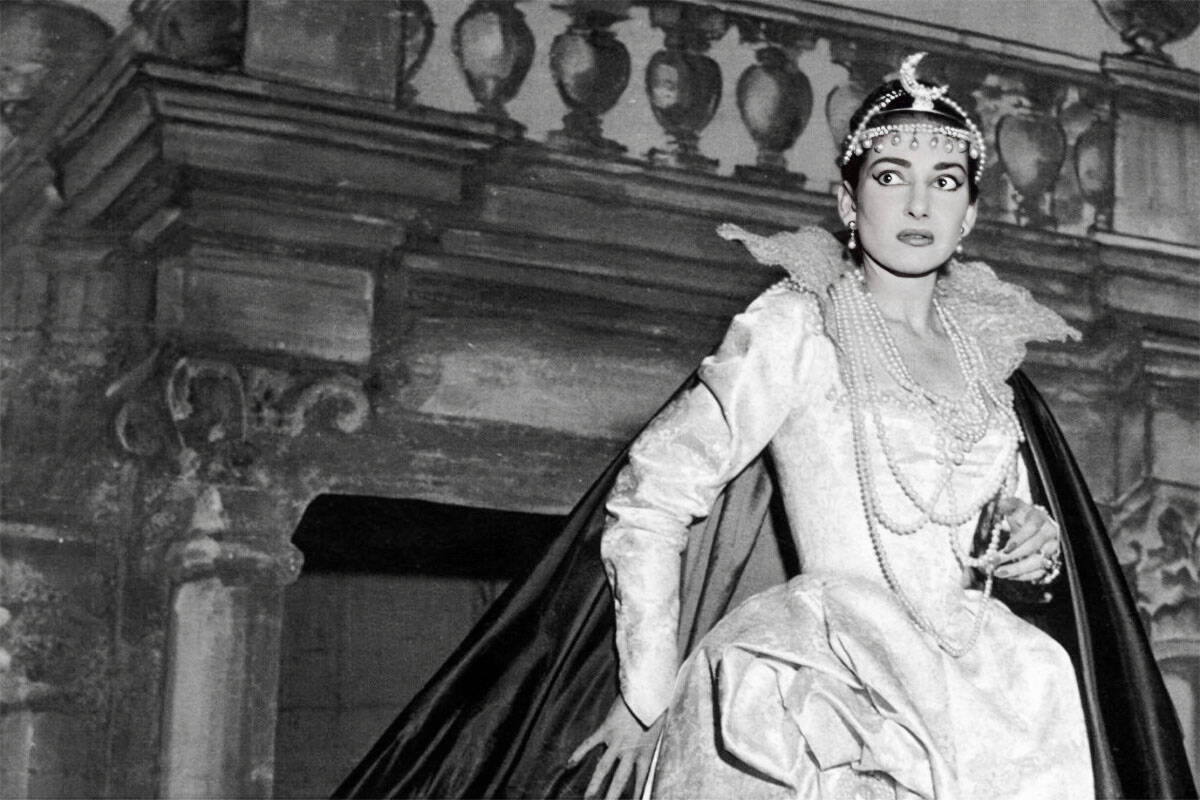
Six original opera gowns worn by Maria Callas during her legendary performances at Teatro alla Scala are now on view in the United States for the first time, offering a rare, tangible look at the artistry behind one of the most influential figures in 20th-century opera.
For Greek-American audiences, the exhibition carries particular weight. Callas, a Greek-American soprano, remains a cultural bridge between Greece, Italy, and the United States, admired not only for her voice but for how she reshaped opera as a fully theatrical art.
Titled Callas at La Scala: Costumes for Ifigenia, Amina, Anna, Fiorilla, the exhibition is on view from January 21 through March 21, 2026, at the Luther W. Brady Art Gallery in George Washington University’s Corcoran Flagg Building. Admission is free and open to the public.
Four Roles That Defined a Career
The exhibition presents six gowns worn by Callas in four iconic roles: Ifigenia in Ifigenia in Tauride, Amina in La Sonnambula, Anna in Anna Bolena, and Fiorilla in Il Turco in Italia. Together, they illustrate the remarkable range of a performer who moved effortlessly between tragedy and comedy, queens and commoners.
While Il Turco in Italia was directed by Franco Zeffirelli, the other productions were staged by Luchino Visconti. These collaborations helped define Callas’s reputation as a singer who treated gesture, movement, and dramatic presence as integral to vocal performance.
Displayed alongside the gowns are original costume sketches by designers Nicola Benois and Piero Tosi, as well as archival photographs of Callas in performance. Each costume is set against a backdrop inspired by its original staging, giving visitors a sense of how fabric, color, and silhouette shaped the emotional impact of the roles.
A Cultural Collaboration Across Borders
The exhibition is the result of a partnership between the Italian Cultural Institute of Washington, the Luther W. Brady Art Gallery, and the Embassy of Greece, with contributions from Fondazione Teatro alla Scala and Fondazione Zeffirelli Onlus.
At the opening reception on January 22, ambassadors from Greece and Italy spoke to Callas’s lasting legacy. Antonis Alexandridis reflected on Callas’s lifelong pride in her Greek heritage, noting that she requested her ashes be scattered in the Aegean Sea. Marco Peronaci emphasized her central place in Italian opera and noted UNESCO’s recognition of opera singing as intangible cultural heritage of humanity.
Students Bringing History to Life
A distinctive element of the exhibition is the role played by students from the Corcoran Theater and Dance department at the Corcoran School of Arts & Design. Under the guidance of Professor Tanya Williams Wetenhall, students researched Callas, her collaborators, and the operas she performed, contributing texts that appear directly on the gallery walls.
Graduate and undergraduate students also assisted with preparing the exhibition, including dressing the mannequins that display the gowns. Their involvement underscores how Callas’s legacy continues to inform new generations of artists and scholars, connecting historical performance to contemporary study.
Visiting Information
- Exhibition: Callas at La Scala: Costumes for Ifigenia, Amina, Anna, Fiorilla
- Dates: January 21 – March 21, 2026
- Hours: Wednesday–Saturday, 1:00–5:00 pm
- Admission: Free
- Location: Luther W. Brady Art Gallery, Corcoran Flagg Building
500 17th Street NW, Washington, DC 20006 - Note: Closed on U.S. holidays and during GW school breaks
Seen up close, these gowns do more than illustrate operatic history. They remind visitors that Callas’s impact was never only about sound, but about presence, discipline, and the visual language of performance, a legacy that continues to resonate across borders and generations.