

The Greek-French historian who helped restore Byzantium to Europe’s intellectual map has died at 99.
Hélène Glykatzi-Ahrweiler (Ελένη Γλύκατζη-Αρβελέρ) was not simply a specialist of a distant empire. She was a figure who insisted that Byzantium belonged at the center of Europe’s story, and that modern Greece could not understand itself without confronting both its strengths and its illusions. In France, she is remembered as one of the central figures in the post-1968 reorganization of Paris universities and as the first woman to direct the Sorbonne in its 700-year history.
Her life traced an arc from refugee Athens to the summit of French academia, without ever severing the thread that tied her to Greece.
From Refugee Athens to Paris
Born in Athens in 1926 in the refugee neighborhood of Vyronas, to a family of Asia Minor origin, Glykatzi-Ahrweiler grew up in a Greece still marked by the trauma of 1922. She came of age during the Nazi occupation, joined EPON as a teenager under the nom de guerre “Niki,” and participated in the Resistance.
After the war, she belonged to the broader wave of young Greek intellectuals who left the country during a period of political rupture, part of the same postwar migration often symbolized by the Mataroa voyage, which carried dozens of Greek thinkers to France in the aftermath of war and civil conflict.
She studied history and archaeology at the University of Athens and worked at the Center for Asia Minor Studies. In 1953, she moved to Paris for advanced studies, a decision that would define her intellectual trajectory.

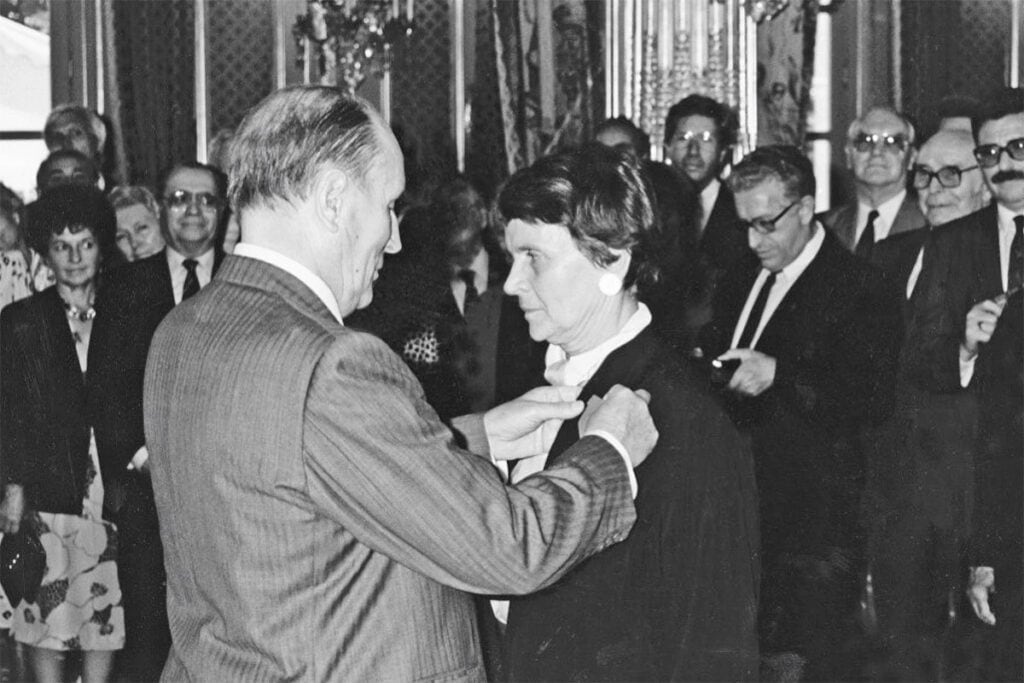
In France, she rose through the ranks of the CNRS and the Sorbonne. In 1967, she became the first woman to head the Sorbonne’s History Department. Over the following decades, she assumed some of the highest responsibilities in the French academic system, serving as rectrice de l’Académie de Paris and chancelière des universités de Paris, appointed under President François Mitterrand. She later presided over the Centre Georges Pompidou and held leadership roles in major European university associations and UNESCO-related bodies.
French tributes described her as a grande historienne franco-grecque, emphasizing both her dual belonging and her institutional stature. The commemorative materials of Université Paris 1 Panthéon-Sorbonne reconstruct her career as part of the university’s official history, noting that the naming of the La Chapelle library after her in 2024 was an obvious recognition of one of its foundational leaders.
In the French corpus, she appears firmly integrated into the institutional canon. The emphasis is on governance and legacy. The absence of controversy reflects the frame of French academic memory, not the totality of her public life.
Reframing Byzantium for Europe
Glykatzi-Ahrweiler’s scholarship focused on the political, administrative, and maritime structures of the Byzantine Empire. For generations, “Byzantine” in Western discourse often functioned as shorthand for decadence or obscure intrigue. Byzantium was treated as a shadow between classical antiquity and the Renaissance.
Her work challenged that framing.
Through major studies such as Byzance et la mer and L’Idéologie politique de l’empire byzantin, she helped secure broader recognition of Byzantium as a central pillar of European civilization. French and international coverage consistently credit her with contributing decisively to this shift.
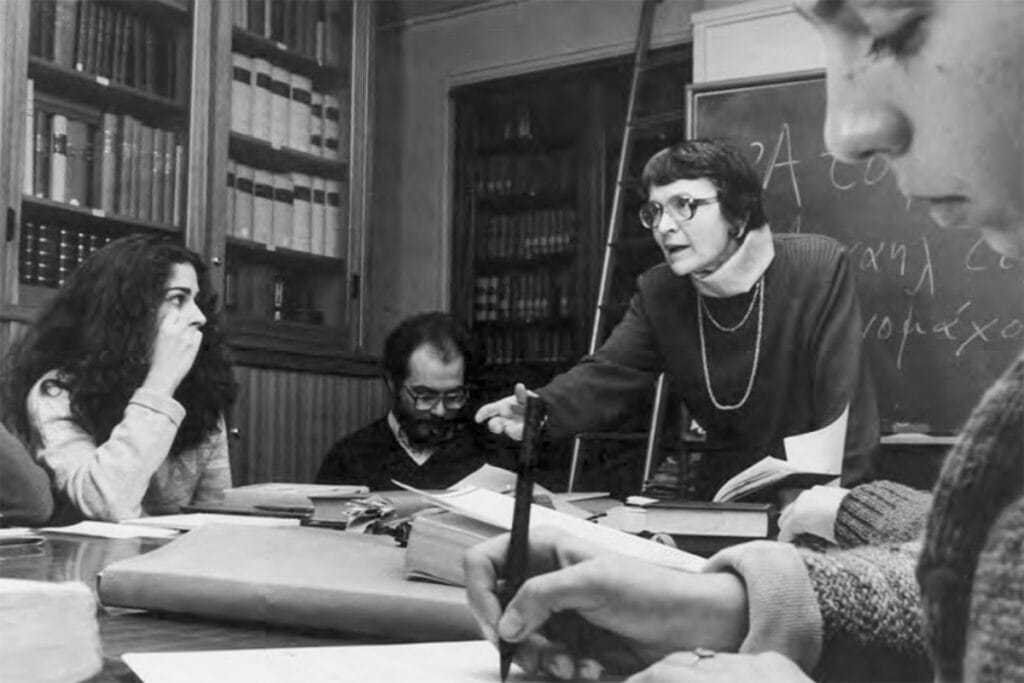
She often explained her approach in simple terms. “History, for me, is not just a profession; it’s an experience,” she said in one long interview. For her, history was lived continuity, not archival distance.
At the same time, she warned against instrumentalizing the past. “History that teaches only one solution is a dangerous thing,” she remarked in a late interview. That sentence captures both her intellectual seriousness and her resistance to mythologizing.
She helped make Byzantium legible again to a broader European audience, not as ornament, but as inheritance.
A Public Intellectual in Greece
Although she built her career in France, Glykatzi-Ahrweiler remained deeply engaged with Greece. She returned frequently to give lectures and public interventions, became an honorary member of the Academy of Athens, served as president of the European Cultural Centre of Delphi, acted as a UNICEF Goodwill Ambassador for Greece, and participated in the “Greece 2021” bicentenary committee.
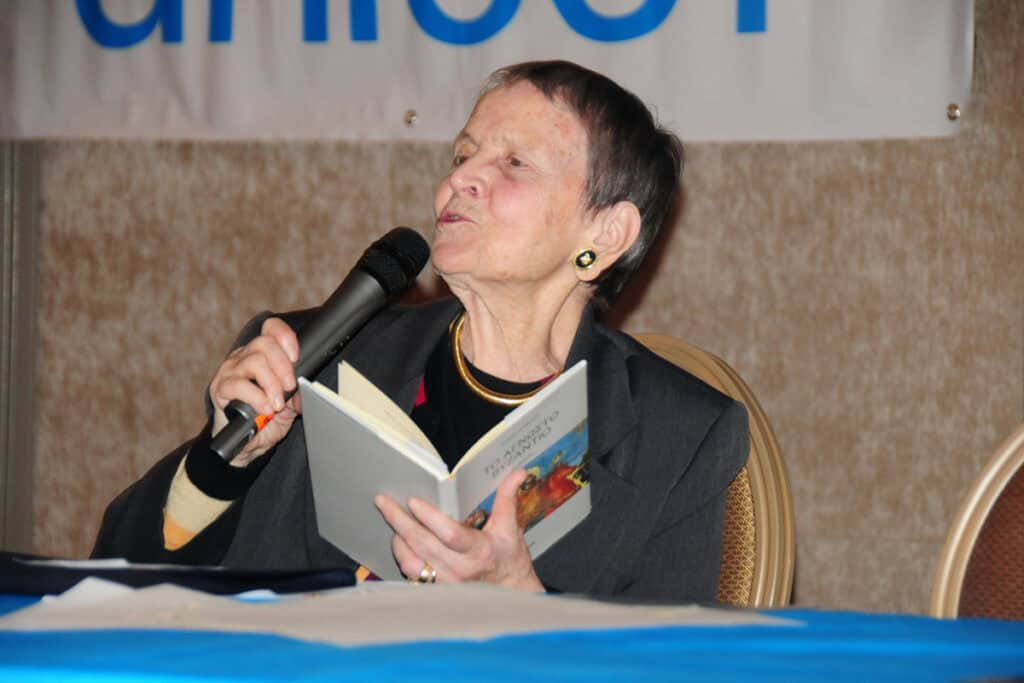
From the 1990s onward, she was a regular presence in Greek media. She insisted that genuine patriotism requires self-knowledge rather than flattery. Greeks, she suggested more than once, prefer praise to self-examination. Real love of country begins with knowing who you are.
She also warned that the past, however luminous, offers no guarantee for the future. Greece’s classical inheritance could not substitute for economic strength, institutional solidity, or civic responsibility.
She resisted political labels, once remarking, “I am left, because everything must pass through there, but also right, because from there everything will be fixed.”
In one interview, she spoke of what she called the “seven mortal sins” of the Greeks, from hubris to institutional indifference, as obstacles to any serious European future.
She illustrated Greek overconfidence with a dry anecdote from the Sorbonne. Greek students arriving in Paris, she said, often came convinced they would “teach the others,” a remark that was both affectionate and cutting.
She even advanced a controversial thesis that the main royal tomb at Vergina contained the remains of Alexander the Great rather than Philip II, a view rejected by most archaeologists but defended by her with characteristic confidence.
In later interviews, she described the post-1974 transition to democracy, known in Greece as the Metapolitefsi (Μεταπολίτευση), not merely as a constitutional shift but as the moment Greece anchored itself in Europe and ceased to define itself primarily as Balkan.
Europe, she argued as early as the 1990s, was not a sentimental idea but a framework of shared economic interest and cultural participation.
During the financial crisis, she defended Greece’s European orientation and publicly supported the “Yes” vote in the 2015 referendum. She later endorsed Kyriakos Mitsotakis in New Democracy’s leadership race and called for the abolition of university asylum. A public clash with then-minister Pavlos Polakis underscored how sharply her comments could resonate in a polarized environment.
She once suggested that her bluntness would likely have prevented her from building an academic career in Greece, remarking that she doubted she would have been hired even as an assistant professor.
France and Greece: Two Frames of Memory
The contrast between French and Greek coverage is striking, though it is primarily a difference in framing rather than in her actual activity.
French outlets integrate Greece into her story through quotations from Greek leaders and references to the debt crisis or tensions with Turkey, but they treat these moments in civilizational terms. When she defined patrie as emotion and shared interests, a collective “nous,” French coverage emphasized the philosophical dimension rather than partisan alignment.
The Paris 1 materials are more institutional. They present her governance as strengthening the university’s international visibility and academic excellence.
Greek coverage, by contrast, often foregrounded her participation in domestic debates. The same intellectual who is remembered in Paris as a builder of institutions was, in Athens, a challenging and sometimes uncomfortable voice in national argument.
Both perspectives reflect real dimensions of her life. They differ in emphasis, not in substance.
A Transnational Legacy
Hélène Glykatzi-Ahrweiler leaves behind institutions, books, and arguments. But she also leaves a model.
From the refugee streets of Vyronas to the leadership of the Sorbonne, she demonstrated that Greek identity, taken seriously and critically, can stand at the center of Europe without apology.
In French institutional memory, she stands as a central figure of academic leadership.
In Greek public debate, she remains associated with candor and provocation.
Across both contexts, she helped reinsert Byzantium into Europe’s narrative while warning against the easy uses of history. But she never allowed history to become a refuge. The past, she argued, provides foundations, not guarantees.
History, she reminded audiences, is dangerous when it pretends to offer only one solution.
For a woman who crossed war, exile, and the highest levels of European academia, that warning may be the clearest measure of her legacy.
Watch: An interview with Glykatzi-Ahrweiler on Naftemporiki TV (Dec. 3, 2023).