
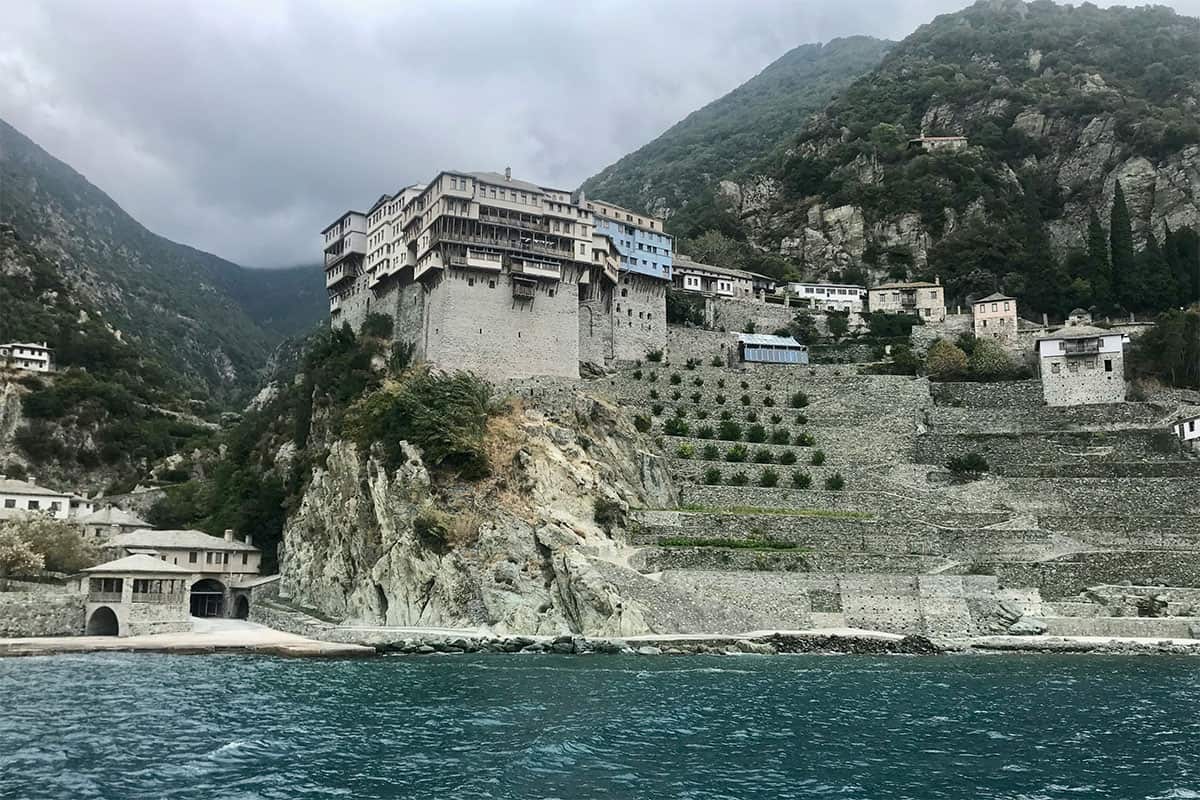
From the water, Mount Athos does not announce itself with noise. The monasteries rise slowly out of the rock above the Aegean, distant and self-contained, their walls turned inward as much as outward. Boats pass along the coast. Pilgrims wait for permission to enter. Others remain on deck and look from afar. Women are among them. They can approach the peninsula by sea, but they cannot set foot on it.
That boundary has been in place for centuries. On Athos, the ban is known as the avaton, the long-standing rule that prohibits women from entering the monastic territory. The restriction is enforced under Greek law, and even male visitors cannot simply arrive unannounced. Entry is controlled through a permit system, and access is limited.
To understand why the rule still exists, it helps to understand what Mount Athos is, and what it is not.
Athos is not a conventional destination, even if modern travel coverage often treats it that way. It is a self-governing monastic community within the Greek state, home to twenty monasteries and a continuous spiritual presence that stretches back more than a millennium. While it is part of Greece, it operates with a degree of autonomy rooted in Byzantine tradition and preserved through modern legal frameworks.
Within that setting, the exclusion of women is tied to the identity of the place itself. Mount Athos is traditionally understood in Orthodox Christianity as the “Garden of the Virgin Mary.” In that religious understanding, the peninsula is dedicated to the Theotokos alone, regarded as its sole female presence and spiritual protector. The life that developed there is built on celibacy, ascetic discipline, and separation from the outside world. The avaton is therefore not presented by the monastic community as a modern social rule, but as part of a protected spiritual order.
Still, the rule has not gone unquestioned.
From one perspective, the issue is direct: a place within modern Greece, and within the wider European legal order, excludes women by rule. From another, Mount Athos is a rare religious community whose internal life has been preserved precisely by resisting the logic of open access, tourism, and contemporary public norms. That tension is not incidental. It is the center of the question.
European institutions have wrestled with it before. When Greece joined the European Communities (the precursor to today’s European Union) in 1981, Mount Athos was granted explicit recognition of its special status, as protected under the Greek Constitution. In practical terms, this meant that European law would take that status into account rather than override it. The exception was not overlooked. It was formally acknowledged.
That did not end the debate. In the decades since, criticism has resurfaced through parliamentary discussions and rights-based arguments, particularly around non-discrimination and access. Yet none of those pressures has altered the arrangement. The Greek state continues to defend Athos as a constitutionally protected religious community, and the broader European framework has, however uneasily, allowed that protection to remain in place.
For many outside observers, the ban is the whole story. For others, it is only one part of a larger and older reality. Mount Athos is not simply a peninsula with unusual rules. It is one of the most important centers of Orthodox monastic life, with its own rhythm, hierarchy, and understanding of sacred space. That does not make the exclusion easier for everyone to accept. But it helps explain why the debate has never been resolved by argument alone.
There is no simple answer, and perhaps that is why the question persists. Mount Athos sits at the intersection of two different ways of understanding the world, one rooted in continuity and spiritual discipline, the other in access and shared rights.
For now, the balance holds. Mount Athos remains what it has been for centuries: a place defined not only by its history and its landscape, but also by its boundaries. For those who visit, the experience is shaped as much by what is permitted as by what is not.
And for those who remain just beyond the shore, looking toward the monasteries from the deck of a passing boat, the distance itself becomes part of the meaning.