
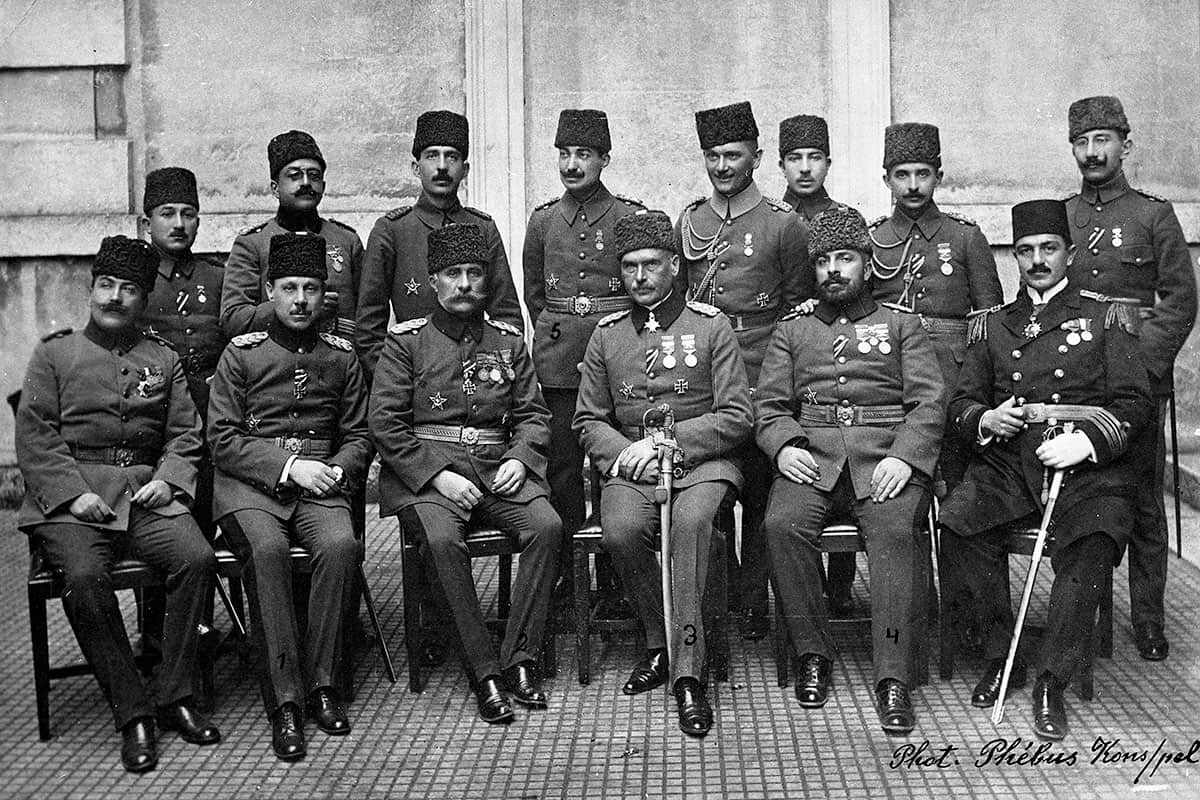
In 1917, German general Otto Liman von Sanders ordered Greeks from Ayvalık on the Aegean coast to be deported into the interior of the Ottoman Empire. The stated reason was suspected espionage and collaboration with the Entente.
The removal affected a large part of the Greek population of Ayvalık and its surroundings. German diplomatic estimates cited by genocide researcher Tessa Hofmann put the number at 12,000 to 20,000 people. Hofmann places Liman’s order in April 1917. Historian Charalampos Minasidis, drawing on more recent research, records another order by Liman in July to deport the entire remaining Greek Orthodox population. The differing dates appear to reflect stages in a deportation campaign that unfolded over several months.
About 200 deportees died before Liman canceled the July operation and ordered the others repatriated, according to Minasidis’s peer-reviewed study in New Perspectives on Turkey. Some did not return to Ayvalık for eight months. Even then, they were prevented from returning to houses that had been occupied in their absence.
Liman had also used his authority in the opposite way. He intervened against the deportation of Armenians from Smyrna and, according to German diplomatic records examined by historians, resisted efforts to deport Greeks from parts of Ionia and Smyrna.
Both records belong to the same officer.
Born in Stolp, Prussia, in 1855, Liman arrived in Constantinople in December 1913 as head of a German military mission sent to reorganize the Ottoman army after its defeats in the Balkan Wars. In March 1915, he was given command of the Ottoman Fifth Army, responsible for defending the Dardanelles at Gallipoli. More recent military scholarship has given greater weight to the role of Ottoman commanders, particularly Mustafa Kemal, rather than treating the campaign as Liman’s victory alone.
After Gallipoli, Liman’s military responsibilities extended across western Anatolia, bringing areas with large Greek Orthodox populations within his sphere of command.
A coast under suspicion
Pressure on Ottoman Greeks had begun well before Liman became directly involved at Ayvalık.
During World War I, the Committee of Union and Progress government and Ottoman military authorities increasingly treated Greek Orthodox communities in strategically sensitive regions as possible security threats because of their real or alleged connections with Greece, Russia, and the Entente.
Coastal communities were particularly exposed. Civilians were sent into the interior, men were conscripted into the army and labor battalions, families were separated, and homes and other property were lost or occupied.
Minasidis places these policies within efforts to secure Ottoman rear areas while also altering the empire’s demographic composition. His study estimates that around 300,000 Greek Orthodox people were deported inland between 1914 and 1918, while contemporary Greek estimates of the wider number displaced were considerably higher.
The deportations have been interpreted differently within the scholarship. Genocide researchers place them within the broader persecution and genocide of Ottoman Greeks, while other studies examine the same policies through wartime internal exile, population engineering and military security. These approaches differ in emphasis, but not over the extensive forced displacement of Greek Orthodox civilians.
Ayvalık, known to the Greeks as Kydonies, had already been caught in that process before Liman issued his own instructions. Ottoman military authorities exiled about 300 prominent residents in late 1916, followed by most of the population of the town and surrounding area.
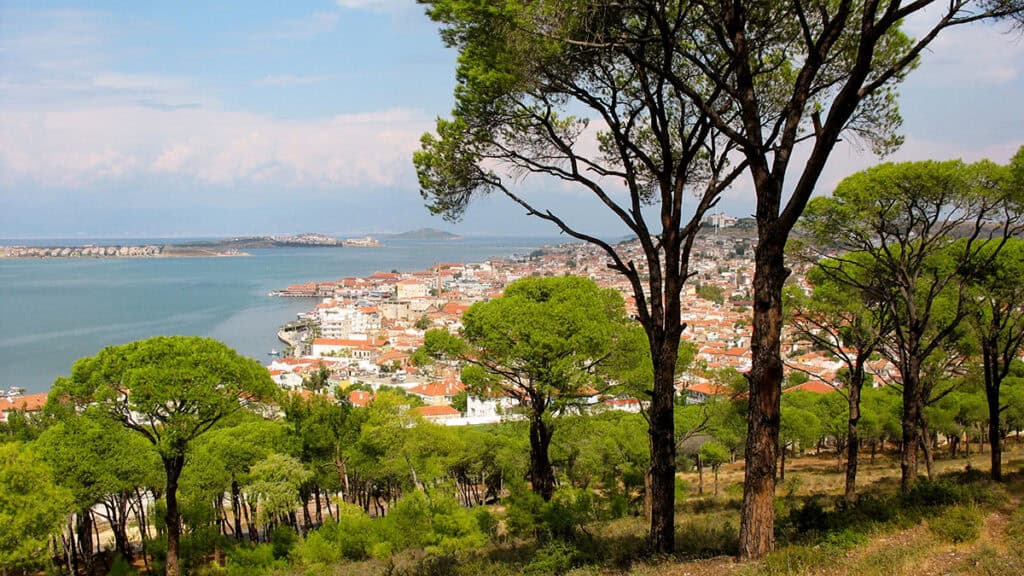
Liman did not begin the persecution of Ayvalık. He did, however, put his own military authority behind further deportation.
Hofmann, whose study draws on German and Austrian diplomatic records, writes that Liman ordered the “evacuation” of Ayvalık and its surroundings in April 1917 over accusations of persistent treason and espionage. She also records the contemporary German estimate of 12,000 to 20,000 people affected.
Minasidis records a July order from Liman directing that the whole Greek Orthodox population of Ayvalık be sent inland because of alleged pro-Entente espionage. After learning that the operation had caused about 200 deaths, Liman canceled it and ordered the remaining deportees returned, acknowledging that deportation on such a scale was unnecessary and should be avoided.
The reversal did not erase what had happened. Repatriation was slow, and some people who finally reached Ayvalık months later could not return to their homes.
In Smyrna, a different record
Liman’s actions in Smyrna show another use of the authority he exercised along the coast.
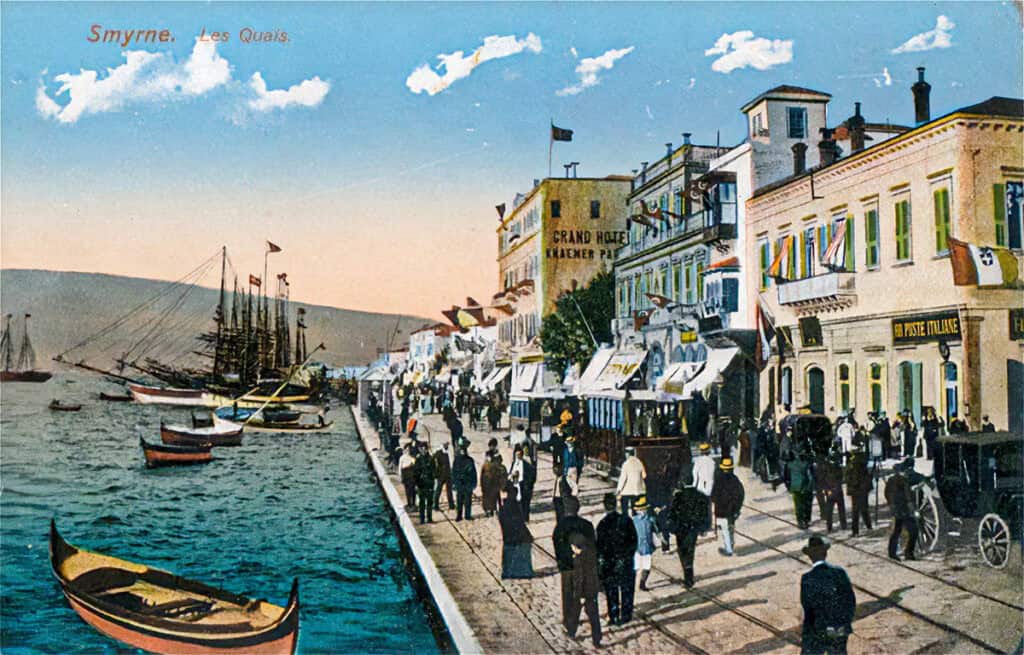
In November 1916, Ottoman authorities were arresting and deporting Armenians from the city. Liman was in Smyrna on an inspection visit.
In a report dated November 12, he told the German Embassy that mass arrests and deportations interfered with matters under military authority, including conscription, railway use, public health, and order in a city close to the enemy. He informed the provincial governor that further mass arrests and deportations could not take place without his approval and threatened to stop another attempt with armed force.
The governor backed down. The document is preserved in a University of Mainz collection of German wartime records. The academic 1914-1918 Online encyclopedia independently identifies Liman as one of the few high-ranking German officers who successfully intervened for Smyrna’s Armenian population.
His reasoning in that report was not expressed solely in humanitarian terms. Liman emphasized military jurisdiction, security, and order. Deportation itself was not something he rejected as a matter of principle.
His dealings with the Greeks followed a similar pattern. Hofmann writes that Liman, with support from the German Foreign Office, opposed the wholesale deportation of Greeks from Ionia in 1916 and intervened again when the Greeks of Smyrna faced deportation late in 1917. She places those actions alongside his order at Ayvalık.
Liman could therefore resist a mass deportation as excessive or militarily unnecessary without rejecting forced removal in every circumstance. At Ayvalık, allegations of espionage were sufficient for him to act against a civilian population collectively.
The account Liman left behind
After the war, Liman portrayed his relationship with Smyrna’s Greeks in considerably warmer terms.
His memoir, Fünf Jahre Türkei, was published in Berlin in 1920. In it, he wrote that he had repeatedly protected Greeks in Smyrna and elsewhere along the Asia Minor coast from Ottoman abuses. A digitized copy of the original German edition is held by the University and State Library of Saxony-Anhalt.
Liman claimed that his portrait had been displayed in a large Greek school, that the president of Smyrna’s Greek community had offered a banquet in his honor, and that Greek men and women regularly came to his headquarters with petitions.
Those details come from Liman himself. His memoir appeared after the Ottoman defeat and after accusations had been made about German responsibility for the treatment of the empire’s Christian populations.
The context around his account is revealing. Soon after describing the gratitude he said he received from Smyrna’s Greeks, Liman complained about accusations against him and discussed Greek espionage along the coast. Hofmann also points to what the memoir leaves out: Liman did not include the Ayvalık deportation of 1917 in his published account.
His memoir, therefore, offers evidence of how he wanted his wartime role remembered, but it cannot settle the question of what that role was.
Malta and the postwar accusations
Liman’s responsibility became a matter for the victorious Allies after the war.
British authorities arrested him in February 1919 as he attempted to return to Germany. He was taken to Malta and held for more than six months amid accusations that he had been involved in war crimes against Armenians and Greeks.
Some later accounts describe his eventual release as an acquittal. That wording goes beyond the documented outcome.
According to 1914-1918 Online, the International Encyclopedia of the First World War, the allegations concerning crimes against Armenians and Greeks could not be proved. Liman was released and returned to Germany. There was no completed war-crimes trial ending in a formal acquittal.
His reputation remained unsettled.
Muriel Mirak-Weissbach revisited the case in her 2025 book, A German General and the Armenian Genocide: Otto Liman von Sanders Between Honor and State. The study draws on previously unpublished archival material and takes a more favorable view of his resistance to deportation policies. Berghahn Books describes his legacy as “highly contested.” Historian Margaret Lavinia Anderson, commenting on the book, notes both its effort to salvage Liman’s reputation and the documentation behind his repeated refusals of some deportation orders.
The documents supporting those interventions are substantial. So are the records from Ayvalık.
Liman used his position to stop or oppose deportations when Christians in Smyrna and elsewhere faced removal. For some families, the intervention of a senior German commander could make the difference between remaining in their city and being sent into the interior.
At Ayvalık, his authority worked in the other direction. Thousands of Greeks were displaced, people died during the deportations, and some of those who returned found that the homes they had left were no longer theirs.
Otto Liman von Sanders died in Munich on August 22, 1929, at the age of 74. His years in Asia Minor do not leave behind the record of a consistent protector or a single-minded persecutor. They leave a German commander whose decisions could shield civilians in one city and force them from their homes in another.