
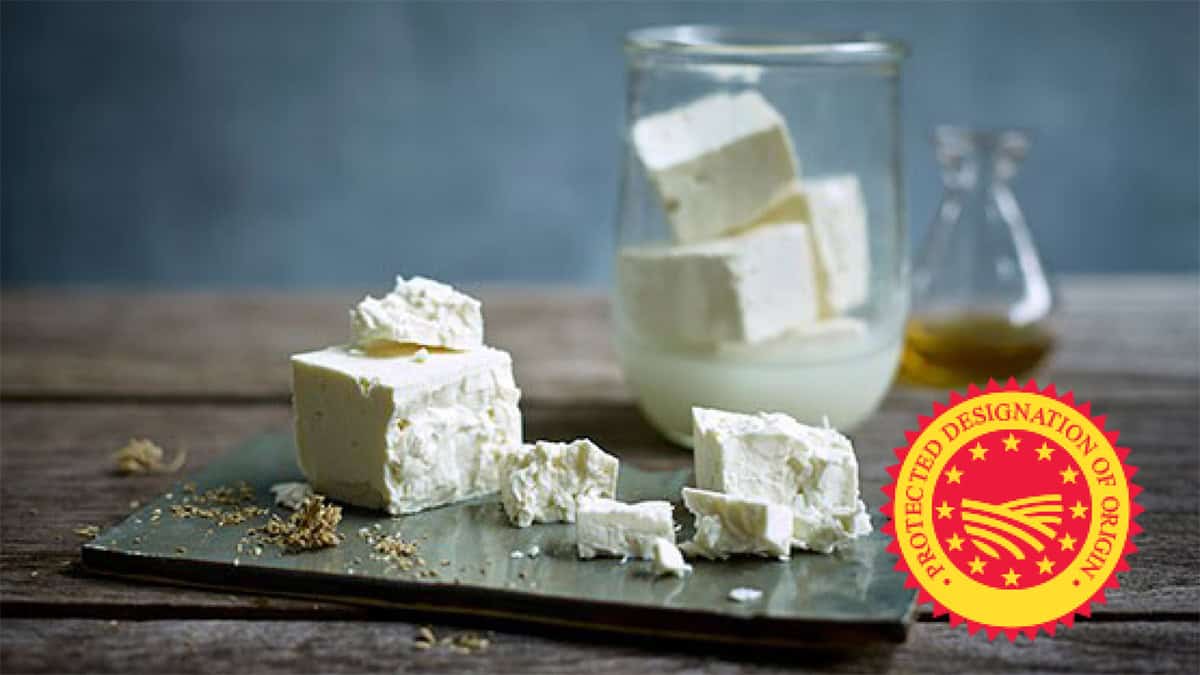
Feta has become a point of friction in U.S.-Mexico trade talks as Washington challenges new protections that Mexico has agreed to grant to European food names.
The dispute stems from the modernized EU-Mexico trade agreement signed on May 22. It would protect 336 European agricultural and food geographical indications in Mexico, including feta from Greece, alongside products such as Parmigiano Reggiano from Italy. Together with 232 European spirit names already protected in Mexico, the agreement covers 568 EU geographical indications. Greece’s list includes feta and Elia Kalamatas.
Mexico has not yet ratified the agreement, leaving the provisions open to pressure from Washington. Reuters reported Friday that cheese naming rights have become a sticking point in broader U.S.-Mexico trade negotiations. The United States objects to restrictions on names such as “feta” and “parmesan,” which American dairy producers regard as generic terms rather than names reserved for European products.
For feta, the agreement does not mean an immediate end to every non-Greek cheese sold under that name in Mexico.
Certain producers already using “feta” would be allowed to continue for up to eight years after the agreement takes effect, provided the product’s geographical origin is visibly identified. Once that transition expires, the EU protection would apply fully.
Nothing in the agreement changes what American cheesemakers may call products sold inside the United States. The immediate issue is whether they will retain the same freedom when exporting to Mexico.
That is commercially important. U.S. cheese exports to Mexico are worth about $1 billion annually, according to Reuters, while EU dairy exports to Mexico total roughly $200 million. Nearly 30 percent of the cheese consumed in Mexico is now imported, with the United States supplying most of those imports.
The disagreement over names predates the new European agreement.
When the United States and Mexico negotiated the USMCA, they signed a side letter protecting market access for American cheeses sold in Mexico under a specified list of names. Those include mozzarella, gouda, provolone, ricotta, brie and cheddar. Feta and parmesan are not on the list. U.S. agricultural advisers warned at the time that leaving parmesan and other terms out could expose American producers to future restrictions.
The Office of the U.S. Trade Representative has continued to challenge the European approach. USTR argues that geographical indication protections negotiated by the EU can prevent American producers from using terms that have long served as common product names in the United States and other markets. Its 2026 Special 301 review added the European Union to its Watch List amid broader intellectual-property concerns.
For Greece, the argument over whether “feta” is a generic name was fought out in Europe decades ago.
Feta was first registered as a Protected Designation of Origin in the European Union in 1996. Denmark, Germany and France challenged the protection, and the European Court of Justice annulled the registration in 1999 after finding that the European Commission had not adequately considered production and use of the name outside Greece. The ruling did not declare feta generic.
The Commission reconsidered the issue and registered feta again in 2002. Germany and Denmark challenged that decision, arguing in part that the name had become generic because feta-style cheese was being made and consumed elsewhere in Europe.
The court rejected that argument in 2005. It found that production remained concentrated in Greece and that consumers continued to associate feta with Greece even when cheeses bearing the name were made elsewhere. The PDO registration remained in place.
Under that protection, feta is not simply the European name for white brined cheese. It must be produced in designated parts of Greece from sheep’s milk or a mixture of sheep’s and goat’s milk and meet the specifications attached to the PDO.
The current dispute is broader than feta. The EU-Mexico agreement covers hundreds of European geographical indications, including several cheese names, and not all receive identical treatment. Mexican manchego, for example, has specific provisions allowing continued use of the name with labeling that distinguishes it from the Spanish protected product. Parmigiano Reggiano also has rules addressing some prior use of the term “parmesano.”
But feta offers a particularly clear example of what Washington and Brussels disagree about.
Greece and the EU spent years establishing that feta identifies a product tied to a particular place and method of production. The United States takes the opposite position in markets where “feta” has long been used as the name of a type of cheese.
Mexico is now where those two approaches meet.
If the EU-Mexico agreement takes effect as signed, qualifying producers will have several years to adjust. After that transition, Mexico would treat “feta” much more like the European Union does, reserving the name for the protected Greek product rather than leaving it available as a general cheese term.