
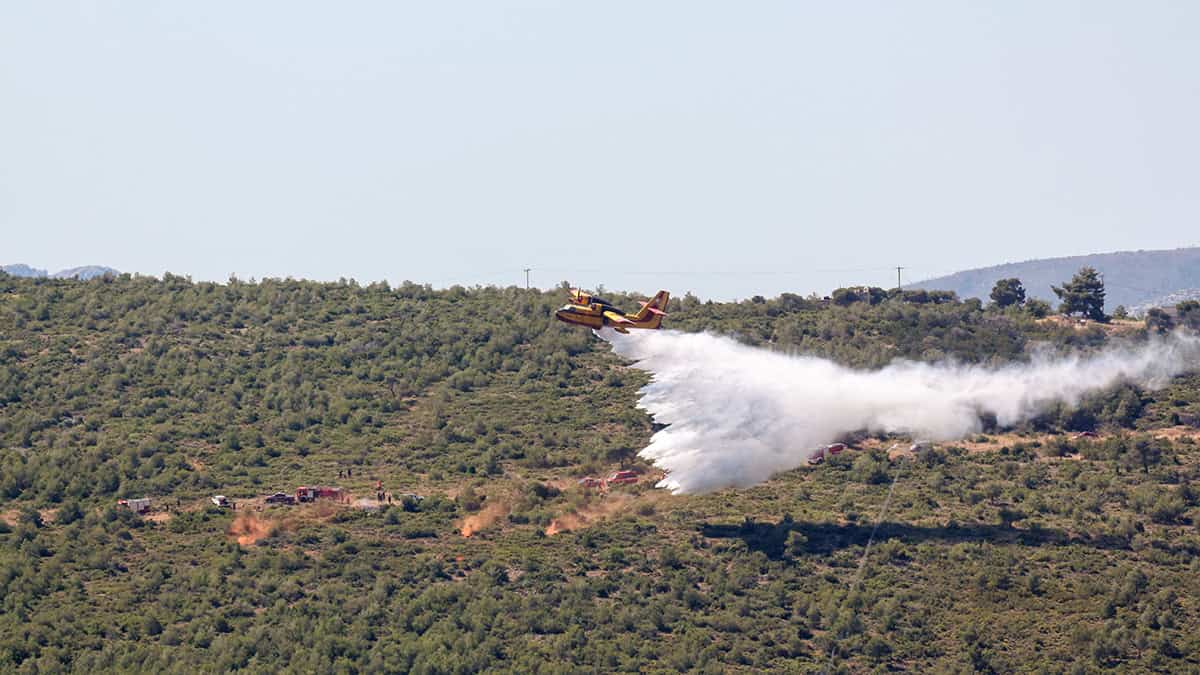
Greece is committing billions of euros over several years to civil protection, with wildfire among the largest demands on the system.
The money is visible in the sky, on forest roads and increasingly in space. Greece is renting 51 aircraft and helicopters for the 2026 fire season while buying new helicopters and Canadairs of its own. More than 1,000 new emergency vehicles have been delivered. Forest crews are clearing vegetation and maintaining firebreaks. Drones patrol fire-prone areas day and night, while four Greek wildfire-monitoring satellites launched in May are moving toward full operational service.
A substantial share of that investment addresses needs accumulated over many years.
Greece’s CL-215 firefighting fleet dates to aircraft first acquired in 1974, with some planes approaching half a century of service. Forestry staffing and funding declined over decades, particularly during the debt crisis. The Peloponnese fires of 2007, Mati in 2018 and Evros in 2023 each exposed different weaknesses in the way the country prepared for, fought and recovered from major fires.
The Ministry of Climate Crisis and Civil Protection has a €1.438 billion budget for 2026. A separate multi-year modernization program, AIGIS, has a budget of about €2.08 billion.
Those figures do not amount to a €3.5 billion wildfire bill. They overlap, cover different periods and include floods, earthquakes, rescues and other emergencies. The 2026 state budget provides €856 million in regular Civil Protection spending and €582 million in public investment.
The accounts nevertheless show how much Greece is now committing to a system that struggled for years with old equipment, limited prevention resources and divided responsibilities.
The latest official cumulative count, issued on August 26, recorded 3,083 wildland fires since May 1, including 830 during August. About 300,000 stremmas, or 30,000 hectares, had burned. Approximately 28,000 stremmas, or 2,800 hectares, were classified as forest, while four large fires accounted for roughly two-thirds of the total burned area.
Civil Protection Minister Evangelos Tournas said the number of fires was about 20% lower than in comparable previous periods. That does not establish that higher spending caused the reduction. Weather, ignition patterns and the behavior of a handful of large fires can change the figures sharply from year to year.
Five firefighters and firefighting aviation personnel died during the summer. Three firefighters were killed on July 29 in fires in Crete and the Peloponnese. Two more crew members died on August 2 when firefighting helicopters collided near Psatha, west of Athens.
What does it cost to run the system?
The €856 million regular budget is the closest public figure to the annual cost of operating Greece’s Civil Protection system, though it covers much more than wildfire.
One line shows the scale of aerial operations. The state budget provides €156 million for leased aerial assets during the fire season and for the National Aerial Search and Rescue Mechanism.
A separate procurement request places €148 million specifically at the disposal of leased aerial firefighting services for 2026. That figure sits within the broader aerial-services budget and should not be added to the €156 million.
Greece has 51 leased aerial assets available this season alongside about 30 nationally operated Canadairs, PZLs, Chinooks and other aircraft.
Leasing buys more than the aircraft. Contracts can include pilots, engineers, maintenance and technical support. It also allows Greece to expand its fleet for the months when fire danger is highest without maintaining every aircraft throughout the year.
Aircraft have operational limits, however. Strong winds during some of this summer’s fires prevented or restricted water drops. A large aerial fleet gives incident commanders more options, but it cannot guarantee control of a fire burning under extreme wind, heat and fuel conditions.
That is one reason the question of wildfire spending cannot be reduced to how many aircraft Greece can put in the air.
Why is Greece buying so much equipment?
About €1.32 billion of the €2.08 billion AIGIS program is allocated to operational equipment and response, with another €346.3 million for warning and prevention, €216.1 million for infrastructure, and €193.1 million for coordination and support. The AIGIS program breakdown also covers floods, earthquakes, and other emergencies.
Part of the program expands capacity. Part replaces or modernizes equipment that has remained in service for decades.
The Canadair fleet provides the clearest example.
Greece acquired its first nine CL-215 water bombers in 1974. The government is replacing the older generation with DHC-515 aircraft. Five new DHC-515s being purchased by Greece cost €265 million, while additional aircraft will be assigned through the European Union’s rescEU fleet.
Seven newer CL-415s will remain in service but are receiving a €43 million modernization. The government says their decades-old electronic systems have become more difficult to support as parts disappear from the market. The work includes new avionics, navigation and communications equipment.
Another €311.2 million contract covers eight Airbus H215 firefighting helicopters, with an option for two more. The agreement includes training and technical support rather than simply the purchase of eight airframes.
Renewal is also underway on the ground. By August, more than 1,000 vehicles and their equipment had been delivered through a procurement covering 1,711 vehicles. Funding comes from Greek and European sources, including the Recovery and Resilience Facility, the European Regional Development Fund, and the European Investment Bank.
AIGIS also finances equipment that attracts less attention than aircraft: thermal cameras, breathing apparatus, protective clothing, communications systems, rescue tools, generators and other systems used across Civil Protection.
Greece is therefore not simply building a larger firefighting operation. It is renewing equipment that aged through years when major public investment was severely constrained.
A long decline in forestry capacity
The imbalance between firefighting and prevention predates the Greek debt crisis.
Responsibility for suppressing forest fires moved from the Forest Service to the Fire Service in 1998. Over the following decade, public resources increasingly favored suppression. An OECD review of Greece’s wildfire system found that suppression funding more than doubled between 1998 and 2008.
The financial crisis then reduced resources available to an already weakened forestry system.
Forest Service funding fell from about €116 million in 2010 to €83 million in 2017, a decline of nearly 30%. By 2017, its funding was roughly one-fifth of the amount available to the Fire Service.
Staffing followed a similar path.
A Reuters examination of Greece’s forestry system published in June found that more than 6,000 forestry employees dealt with fire prevention and mitigation in 2000. Fewer than 3,000 remained by 2026. Austerity following the sovereign debt crisis contributed to the decline, and permanent recruitment effectively stopped for more than two decades. About 300 employees have been added since 2024.
The debt crisis did not create Greece’s wildfire problem. The institutional shift toward suppression had begun earlier, while changing land use, development in fire-prone areas and accumulated vegetation added other risks.
Austerity made those problems harder to correct and delayed renewal of public equipment and forestry capacity.
From the Peloponnese to Mati and Evros
The 2007 Peloponnese fires caused between €1.9 billion and €3 billion in economic damage, according to OECD estimates. Burned areas also faced erosion and increased flood risk long after the flames were extinguished.
On July 23, 2018, fire swept through Mati, east of Athens, killing 104 people.
Mati exposed failures extending beyond firefighting capacity. Investigations and later court proceedings examined shortcomings in emergency management and coordination, while subsequent reforms placed greater emphasis on organized evacuations and the 112 public-warning system.
Five years later, the Alexandroupolis-Evros fire burned more than 96,000 hectares and became the largest single wildfire recorded in the European Union since the European Forest Fire Information System began keeping records in 2000.
The disasters presented different problems. The Peloponnese showed the potential economic and environmental scale. Mati exposed weaknesses in coordination and emergency management. Evros demonstrated the limits of suppression when extreme weather and fuel conditions produce a fire too large to control through conventional means alone.
The spending that followed is partly an attempt to address all three.
Prevention now includes forests, drones and satellites
Greece has increased spending on measures designed to reduce risk before fires become large emergencies.
The Environment Ministry’s AntiNero V-PLUS program includes 19 contracts worth €81.98 million in 2026. The work covers vegetation and fuel management, forest roads, firebreaks, water infrastructure and interventions in vulnerable ecosystems.
The ministry puts the combined AntiNero budget over the past five years at about €667 million, covering work across more than 900,000 stremmas of forest ecosystems.
Municipalities and municipal associations are receiving another €50 million for fire protection this year, compared with €40 million in 2025 and €18.4 million in 2019. The allocation can finance vegetation clearing and preventive work, but also machinery, vehicles, and emergency-response expenses, so it cannot all be classified as prevention.
Forest management is now accompanied by a growing early-detection network.
Civil Protection deployed 108 surveillance drones across Greece in 2026, including 33 in Attica. Equipped with optical and thermal cameras, they provide continuous surveillance and can identify new fire outbreaks before they are visible from conventional lookout points.
A separate €14.44 million fire-detection project is developing autonomous monitoring stations using Lidar, weather instruments, telecommunications equipment and high-resolution imaging, with artificial intelligence incorporated into the system.
Greece has also moved wildfire monitoring into orbit.
Four infrared CubeSats forming the Hellenic Fire System launched on May 3 and returned their first thermal imagery in July. The satellites are designed to detect active fires and thermal anomalies as Greece develops a dedicated national space-based wildfire-monitoring capability. The system is part of the wider 13-satellite Greek National Small Satellite Programme and is financed through the EU Recovery and Resilience Facility in cooperation with the European Space Agency.
Early detection can shorten the time between ignition and the first attack. What Greece does not yet publish is a consistent national measure showing how many fires were first detected through drones, satellites or new sensors, how much earlier they were found or how often that lead time prevented a small fire from becoming a large one.
Without those data, the technology can be measured as added capability, but not yet assigned a clear financial return.
AntiNero has also faced procurement scrutiny
More prevention spending does not show by itself whether every euro has been managed effectively.
The Environment Ministry acknowledged in August that Greece’s Financial Audit Committee imposed a €29.94 million financial correction in September 2025 over a finding of artificial contract splitting involving part of the AntiNero II contracts from 2022 and 2023.
The ministry has challenged the decision before the Court of Audit, and enforcement has been suspended while the case proceeds. It argues that the separate tenders reflected different forest areas and operational requirements and says the finding concerns the procurement structure rather than whether the work was carried out.
The dispute does not establish that AntiNero as a whole failed. It does illustrate why value for money cannot be judged from budget totals alone.
Where do the firefighters fit?
The Fire Service is larger too.
Staffing is expected to approach 19,000 people in 2026, almost 5,000 more than in 2019. Another 1,076 recruits are planned this year, while payroll-related appropriations have increased by €76.3 million.
About 2,500 firefighters remain seasonal, working eight months of the year.
Hundreds demonstrated in Athens on August 31 seeking year-round employment. They are also challenging an age limit of 30 for recruitment into 600 seven-year Fire Service positions. Seasonal firefighters say the rule prevents about 2,000 of the current 2,500 from competing.
The government has not published an estimate of what another four months of employment for all 2,500 would cost.
It did approve another €3.04 million in August for overtime, night work, Sundays, and holidays as demands on the seasonal workforce increased during the summer.
The firefighters argue that experienced personnel could remain in the system during winter for preparedness and prevention-related duties. Not all forest-management work belongs to the Fire Service, and no published analysis demonstrates that extending those contracts would save more than it costs.
Their demand nevertheless raises the same question as the equipment program: how Greece divides resources between emergency response and capacity that exists before the next fire starts.
Is the money well spent?
There is strong evidence that Greece needed substantial reinvestment.
Replacing aircraft approaching half a century in service, modernizing obsolete electronics and renewing an aging vehicle fleet address documented problems. Forestry staffing and funding declined sharply. Mati exposed failures in emergency management. Evros demonstrated the limits of even a large suppression operation under extreme conditions.
It is harder to establish whether the current mix of aircraft, equipment, forest management, surveillance technology and personnel is the best use of the money available.
Greece does not publish one consolidated wildfire account showing the full annual cost of prevention, detection, suppression, personnel and recovery. Capital programs overlap with annual budgets. European funds pay for some investments. Military-operated aircraft generate expenses elsewhere in government. Forestry and municipal spending sit outside the Civil Protection Ministry.
Performance data are similarly fragmented.
Government figures showing fewer fires this year are encouraging, but one season cannot establish whether higher spending caused the improvement. A more useful measure would be how often forest management, early detection and initial response keep fires from developing into large incidents, measured consistently over several years.
Those data are not yet readily available.
The OECD has repeatedly warned that wildfire-prone countries tend to spend much more on suppression than prevention. Its review of Greece found a longstanding preference for emergency response and called for stable prevention funding, greater fuel management and closer coordination among the Fire Service, forestry authorities and local government.
Aircraft and firefighters remain necessary. Prevention cannot eliminate ignitions, and some fires will escape initial control.
The unresolved issue is the balance.
The cost of failure can reach billions
Wildfire costs do not end with firefighting.
Homes, businesses and farms can be destroyed. Roads, electricity networks and water systems require repairs. Tourism can be disrupted. Burned slopes become more vulnerable to erosion and flooding.
Insurance covers only part of those losses. OECD research found that just 9% of wildfire losses in Greece between 1990 and 2019 were insured, leaving households, businesses, and the government to absorb much of the remainder.
There is a broader economic case for climate adaptation. Bank of Greece research estimates that adaptation investment could reduce Greece’s cumulative economic damage from climate change by almost 30% compared with an inaction scenario. The calculation applies across the economy, not specifically to wildfire programs, so it cannot be treated as a return on AIGIS or AntiNero.
It does show why spending before disasters can make economic sense even when the benefit is damage that never occurs.
Greece is preparing for a longer fire season
The pressure on the system is unlikely to ease.
Climate change does not ignite a forest fire. Human activity remains responsible for most wildfire ignitions in Europe.
Higher temperatures, prolonged dry periods and lower moisture in vegetation can make conditions after an ignition more dangerous, allowing fires to spread faster and burn more intensely.
Bank of Greece projections anticipate 10 to 20 additional days with elevated wildfire risk by mid-century, rising to 15 to 50 additional days toward the end of the century, particularly in areas already prone to fire. The same research points toward lower rainfall, greater drought and more extreme heavy-rainfall events.
A peer-reviewed 2026 study in Fire Ecology reaches a similar conclusion for the Mediterranean. At 2 degrees Celsius of global warming, parts of Greece are projected to experience fire seasons that are 20 to 30 days longer than the historical reference period. At 3 degrees, the projected increase in the number of days across Greece is roughly 20 to 40 days.
Longer periods of dangerous fire weather change the economics of Civil Protection. Equipment may be needed over longer seasons. Surveillance will have to operate for more of the year. Forest management becomes a recurring requirement rather than a pre-summer exercise. Personnel models built around a narrowly defined fire season may also come under pressure.
Greece has begun replacing equipment that should have been renewed years ago, rebuilding some of the forestry capacity lost during decades of underinvestment and adding tools that barely existed in the old system, from thermal drones to dedicated satellites.
The need for that investment is easier to establish than its efficiency.
For a threat expected to grow, the next step is not simply another aircraft or another spending program. Greece also needs public accounts that show what it spends before, during, and after wildfires, and whether those investments are reducing the number of fires that become disasters.