
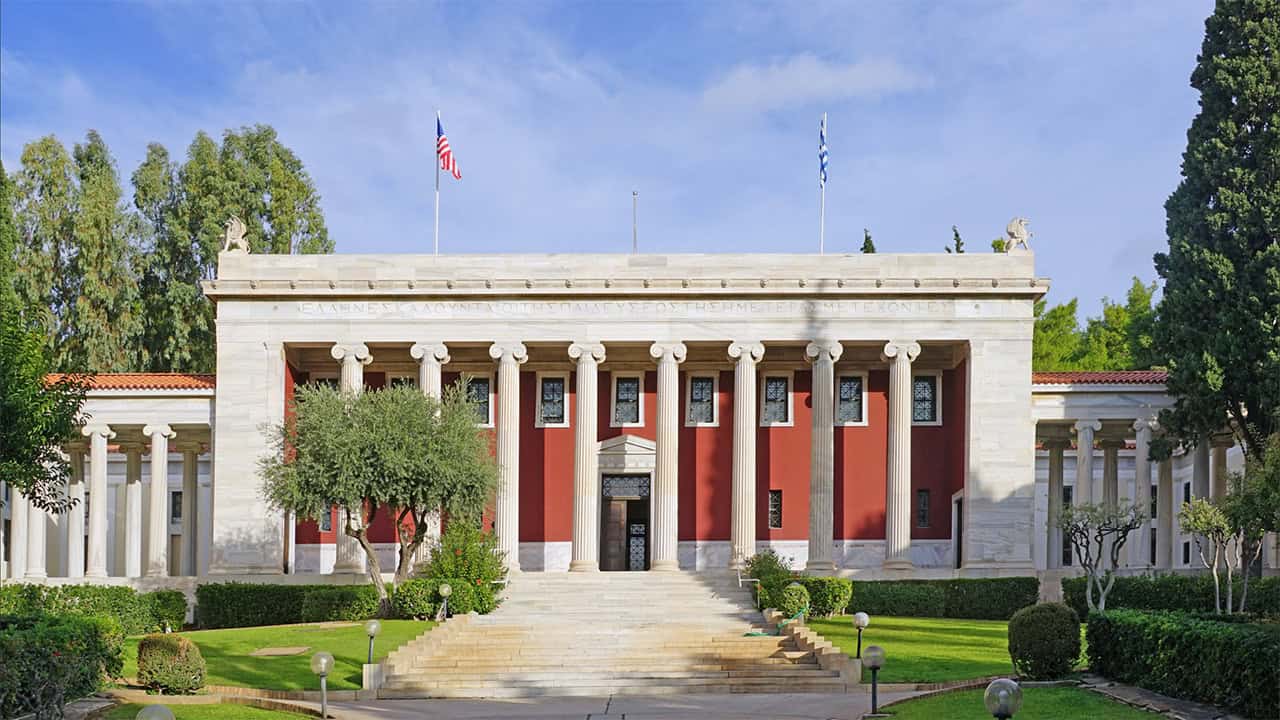
Historian Anthony Molho, who survived Nazi persecution in Thessaloniki as a child and later taught for decades at Brown University, has donated 6,470 books from his personal collection to the Gennadius Library in Athens. At least 600 more volumes are expected to follow.
The American School of Classical Studies at Athens announced the donation on October 1. The books cover subjects ranging from Renaissance Italy and European political history to Jewish communities, Mediterranean commerce, and migration.
A Childhood in Wartime Thessaloniki
Born in Thessaloniki in 1939, Molho was a young child when German forces occupied the city in April 1941. His family belonged to a Jewish community whose presence in Thessaloniki stretched back centuries.
Before World War II, the city had Greece’s largest Jewish population. Between March and August 1943, German authorities deported more than 45,000 Jews from Thessaloniki to Auschwitz-Birkenau, where most were murdered. Fewer than 2,000 Jews lived in the city after the war, according to the United States Holocaust Memorial Museum.
Molho and his parents survived, aided by people who risked their lives to protect them. The rest of his mother’s family perished at Auschwitz.
Decades later, he would write about those years in a memoir examining his family’s experiences and the decisions of the people who helped them survive.
An Academic Career in America and Europe
Molho earned his doctorate from Western Reserve University, now part of Case Western Reserve University, in 1965. After teaching at the University of Vermont and Michigan State University, he joined Brown University’s history faculty in 1966.
He remained at Brown until 2000, becoming the David Herlihy University Professor. During his years there, he chaired the history department from 1979 to 1983 and led the university’s Modern Greek Studies Program from 1998 to 2000.
His early research focused on Renaissance Florence, particularly the relationship between public finances, political authority, and the city’s ruling families.
In Florentine Public Finances in the Early Renaissance, 1400–1433 (1971), Molho examined how taxation, public debt, and the financial demands of war affected Florence’s government. Using archival records, he traced the pressures that reshaped the city’s finances and political institutions during the fifteenth century.
His later book, Marriage Alliance in Late Medieval Florence (1994), explored how marriages and dowries helped wealthy Florentine families preserve their influence. The study examined family relationships not simply as private arrangements but as part of the city’s political and economic life.
Molho’s interests also extended to Mediterranean trade, Jewish merchant networks, migration, and the history of Jewish communities.
Among his publications is The Jewish Community of Salonika: The End of a Long History, published in the journal Diaspora in 1991. The article examined the history of Thessaloniki’s Jewish community, a subject connected to his birthplace and family background.
His engagement with that history therefore preceded the publication of his childhood memoir by more than three decades.
In 2001, Molho moved to the European University Institute in Florence, where he taught until 2010. He headed its Department of History and Civilization and directed the Academy of European History before becoming Professor Emeritus.
His academic distinctions include the Premio Internazionale Galileo Galilei in 2010, election to the Academia Europaea in 2013, and honorary degrees from the University of Athens and the University of Crete.
Writing About His Own Survival
After a career largely devoted to earlier periods of European history, Molho turned to the years he spent as a Jewish child in German-occupied Greece.
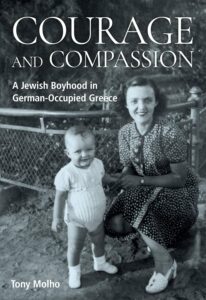
His memoir, Courage and Compassion: A Jewish Boyhood in German-Occupied Greece, was published in English by Berghahn Books in 2024.
The original Greek edition, Η Κοινοτοπία του Καλού: Ένα εβραιόπουλο στην Ελλάδα της Κατοχής, appeared in November 2022 and received the Ouranis Prize from the Academy of Athens.
The book recounts Molho’s experiences between the ages of four and six, when his parents struggled to protect him from Nazi persecution. Much of the narrative concerns the people who sheltered and assisted his family, sometimes at considerable risk to themselves.
Its Greek title draws on Hannah Arendt’s concept of the “banality of evil,” directing attention instead to ordinary people whose decisions helped save lives.
Writing the memoir also required Molho to confront the uncertainties of childhood memory. Which events could he remember directly, and which had he come to know through accounts given by his parents and others?
Those questions arose during a March 2025 discussion at Brown University, where Molho spoke about his book with Holocaust historian Omer Bartov and Elsa Amanatidou, director of Brown’s Modern Greek Studies Program.
Asked why he had waited so long to write the memoir, Molho initially responded with humor before acknowledging the challenge.
“This was not an easy exercise,” he said.
The conversation, reported by Brown Alumni Magazine, addressed the difficulty of separating personal recollections from events reconstructed through the memories of others.
For Molho, writing about his childhood meant examining a history he had lived through but was too young to understand fully at the time.
A New Home for His Books in Athens
Molho’s donation comes as the Gennadius Library marks its centenary. Founded in 1926, the library holds books, manuscripts, maps, and archival materials documenting Greek history and its connections with Europe and the Mediterranean.
Its anniversary exhibition, Gennadius Library 100: A Century of Inspiration, remains on view through December 20, 2026.
The Molho collection adds thousands of volumes on European and Mediterranean history to the library’s holdings, including works in fields that occupied him throughout his academic career.
The books will become available to researchers after cataloging and processing are complete. The library has not announced an opening date.