
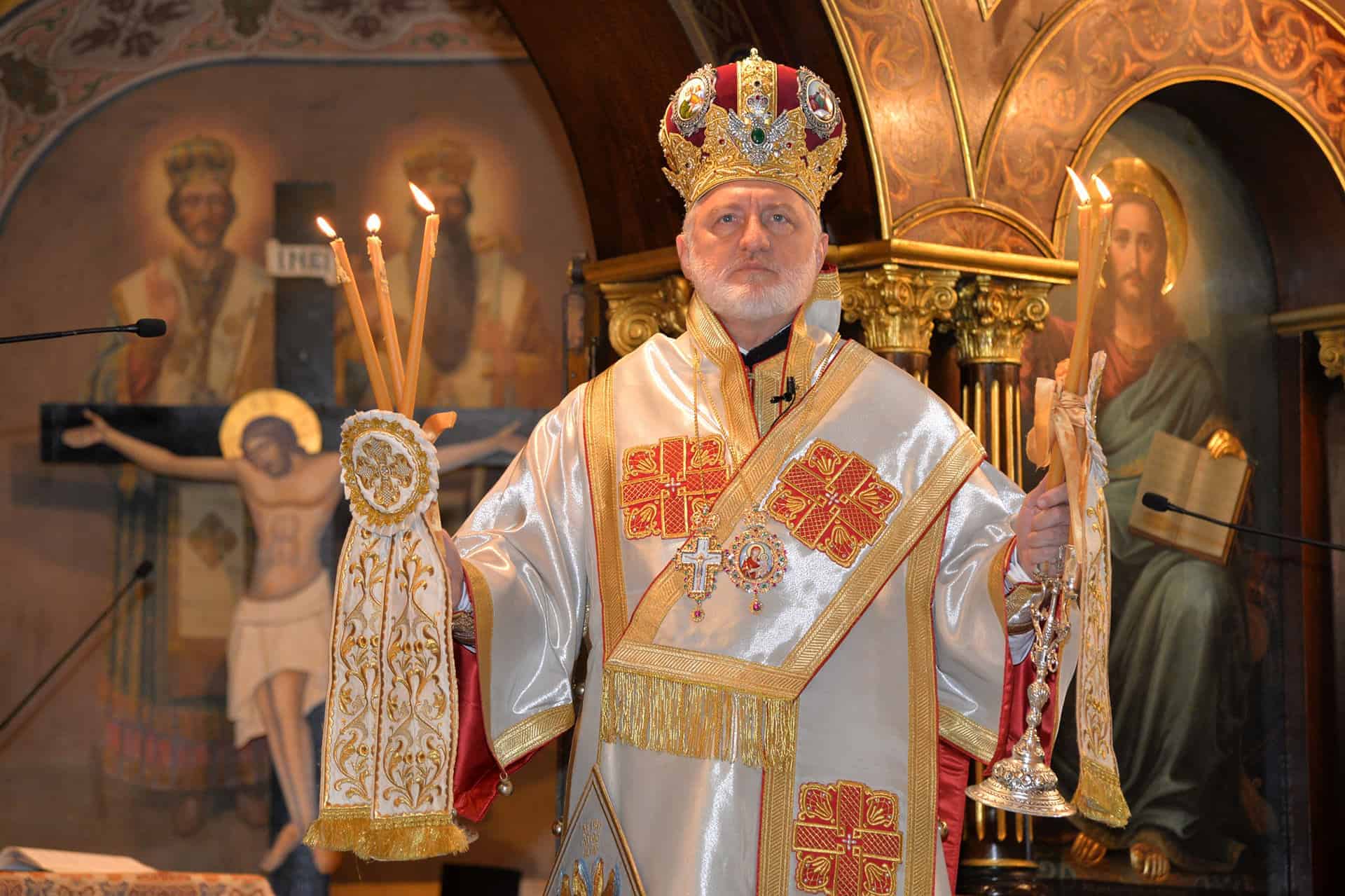
Archbishop Elpidophoros of America challenged the idea that the United States was intended to be a Christian nation during a gathering of church leaders in Philadelphia on Tuesday, October 13, 2026. He argued that religious freedom must protect people of every faith, without allowing any religious community to impose its beliefs on others.
The head of the Greek Orthodox Archdiocese of America spoke at the National Council of Churches’ Christian Unity Gathering, held at the Wyndham Philadelphia Historic District Hotel. He also serves as chair of the council’s Governing Board, a position he assumed in October 2025 as the first Eastern Orthodox hierarch and head of a jurisdiction to hold the chairmanship.
Welcoming participants to the city of the Liberty Bell during America’s 250th-anniversary year, Elpidophoros turned to the First Amendment and the relationship between religious belief and government authority.
He acknowledged that some Americans, including members of the council, believe the country was intended to be Christian. In his published remarks, he rejected that interpretation, saying it was contrary to the nation’s founding documents and principles.
He argued that the First Amendment protects freedom from religion as well as freedom of religion. The choice to believe or practice a faith, he said, belongs to individual conscience and cannot be required by the state.
The Archbishop also criticized claims of religious superiority. He warned against communities that consider themselves exclusively legitimate or expect their beliefs to govern society. Religious freedom, in his view, requires different traditions to respect one another, even when their teachings differ.
The National Council of Churches, founded in 1950, includes 37 member communions from Protestant, Anglican, Orthodox, and other Christian traditions. Although they share a belief in Christ, Elpidophoros observed, they do not necessarily understand or practice their faith in the same way.
“This is the gift of listening,” he said, referring to openness toward perspectives that might otherwise remain unfamiliar.
Drawing on the Christian theological concept of perichoresis, which he explained through the Orthodox understanding of the Holy Trinity, Elpidophoros described relationships founded on love and freedom rather than domination. He translated the term as “inter-dwelling” and connected it to Christ’s commandment to love one another.
“There can be dialogue, even many forms of persuasion, but never compulsion,” he said.
The Christian Unity Gathering, held October 12–16 under the theme “Freedom to Worship, Freedom from Fear,” examined religious liberty through discussions and visits to Philadelphia sites.
One session addressed fears associated with religious hatred, racial violence, political retaliation, surveillance, misinformation, and threats against houses of worship, as detailed in the National Council of Churches’ gathering coverage.
Bishop Heinrich Bedford-Strohm, moderator of the World Council of Churches’ central committee, also addressed the gathering on October 13, warning against the use of Christianity to justify political actions he considered contrary to its teachings.
He criticized Russia’s use of religious rhetoric to defend its war against Ukraine, then raised concerns about developments in the United States. His examples included immigration enforcement, the closing of development agencies, support for Christian nationalism, and a return to fossil fuels.
In his remarks reported by the World Council of Churches, Bedford-Strohm urged churches worldwide to examine where their primary loyalty lies and whether it is truly with Christ.
Elpidophoros closed his own remarks by returning to Christ’s commandment to love one another without conditions. He urged Christians to express their religious freedom through that teaching, with respect for others forming part of how they practice their own faith.