
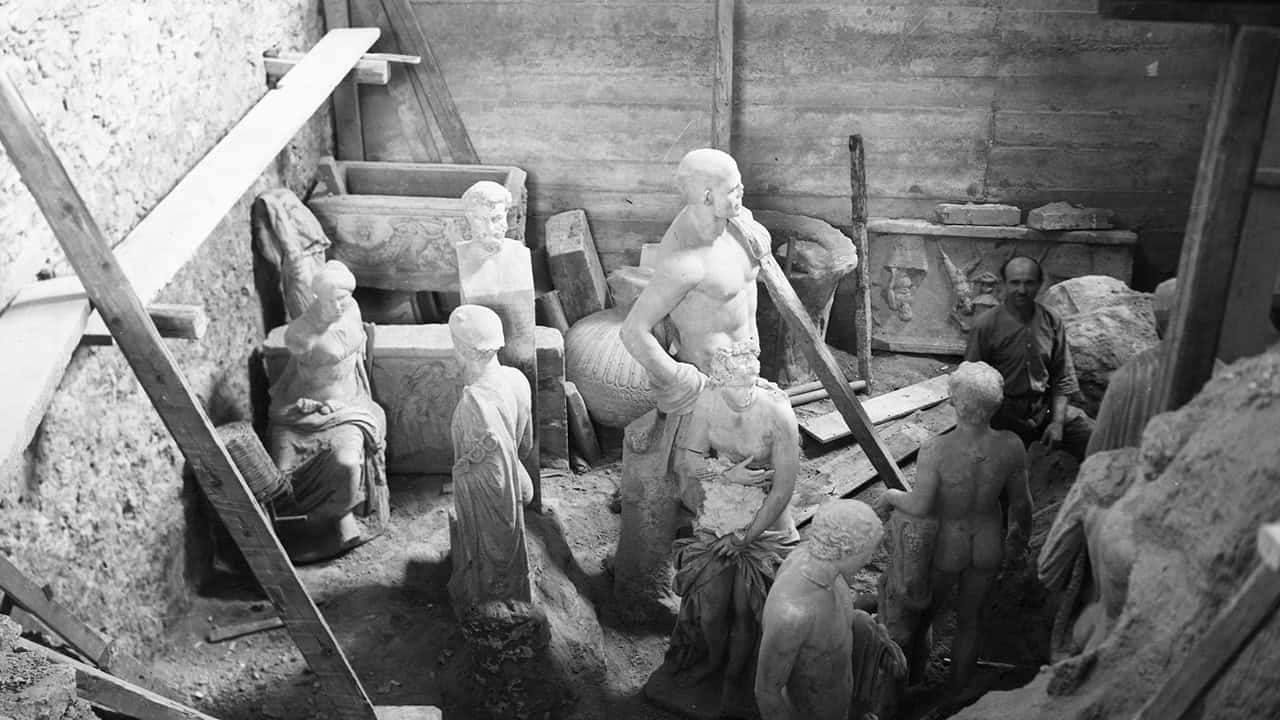
When German troops entered Athens in April 1941, much of the National Archaeological Museum’s collection had disappeared from view. Marble statues lay buried beneath gallery floors. Smaller antiquities had been packed into crates and moved to shelters, while gold objects were hidden in the basements of the Bank of Greece.
For six months, museum employees had worked to protect the collections from bombing, destruction, and looting. Archaeologist Semni Karouzou later recalled that workers arrived before the moon had set and often remained until nightfall. The antiquities stayed hidden throughout the occupation, despite German demands to reopen the museum.
Their story is revisited in a new exhibition, Divided Past: Greek-German Relations in Dark Times, which opened in Athens on October 12, 2026. Organized by the National Archaeological Museum and the German Archaeological Institute, it also presents newly cataloged records concerning German archaeological activities during the Nazi occupation.
The concealment of the Greek collections is already well documented. The exhibition places that history alongside preliminary findings from a joint research project examining material confiscated from the German institute and its wartime director after Athens was liberated.
Six months to hide the antiquities
Greece entered World War II on October 28, 1940, when Italian forces invaded from Albania. Two days later, preparations began to protect the National Archaeological Museum’s collections. On November 11, the Ministry of Education issued technical instructions for safeguarding antiquities against air raids.
Committees were formed to organize the work. Semni Papaspyridi-Karouzou, curator of the museum’s vase and minor-arts collections, was among the archaeologists involved.
Her recollections, presented in March 1967 and published in 1984 in the proceedings of the First Congress of the Greek Archaeologists Association, describe the demanding conditions inside the museum.
The work continued throughout the winter of 1940–41, while Greek troops fought Italian forces on the Albanian front. Moving the largest sculptures required considerable physical labor. Workers opened deep trenches in the museum floors, then used ropes, chains, and lifting equipment to lower the marble statues into hiding. Sculptor Andreas Panagiotakis directed the craftsmen handling the heavy sculptures, calling out instructions as they maneuvered the statues into the pits.
Smaller objects were packed and taken elsewhere for safekeeping. According to the museum’s historical account, 35 crates were stored in the cave of Enneakrounos and another 22 at the site known as the Prison of Socrates.
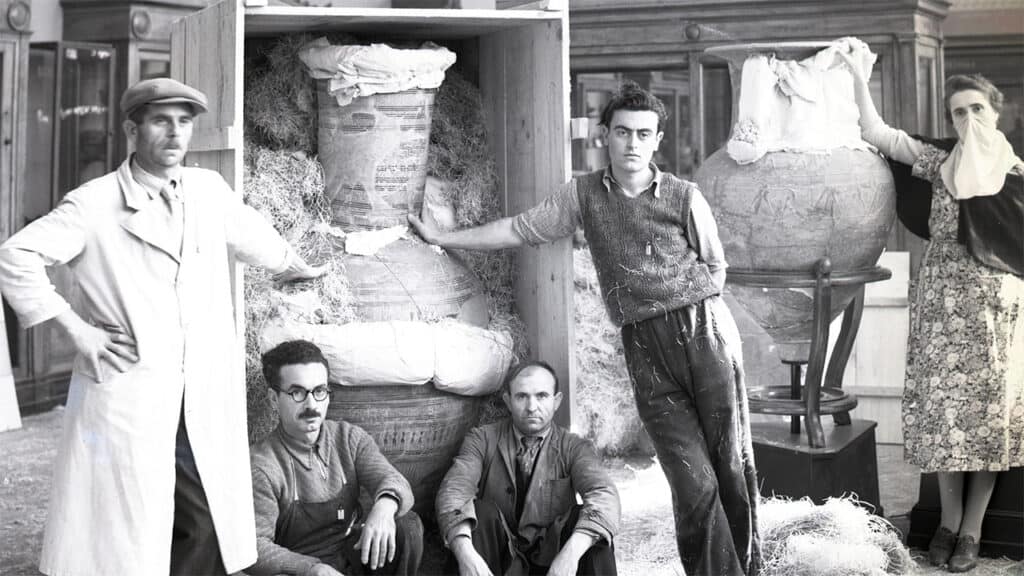
The operation extended beyond Athens. Across Greece, archaeological employees dismantled exhibitions, packed fragile objects, and searched for places where collections might survive the war.
By the time German troops reached the capital, the National Archaeological Museum’s preparations were complete.
The demand to reopen the museum
The day after German troops entered Athens, Semni Karouzou and her husband, archaeologist Christos Karouzos, resigned their memberships in the German Archaeological Institute.
In a June 16, 1945, interview with the literary periodical Elefthera Grammata, Christos Karouzos explained his decision. He believed the institute had long abandoned its scientific independence and feared that offers of cultural cooperation could be used to compromise Greek scholars under occupation.
In June 1941, archaeologist Hans Ulrich von Schönebeck, who headed the occupation authorities’ service for the protection of art monuments, pressed for the National Archaeological Museum to reopen.
The occupation authorities compiled a list of 103 statues they wanted returned to public display. Among them were the Artemision bronze, the Antikythera Youth, and the Marathon Youth.
The order was never carried out. Christos Karouzos later credited the resistance of the Greek Archaeological Service with protecting the country’s principal museums from destruction and looting.
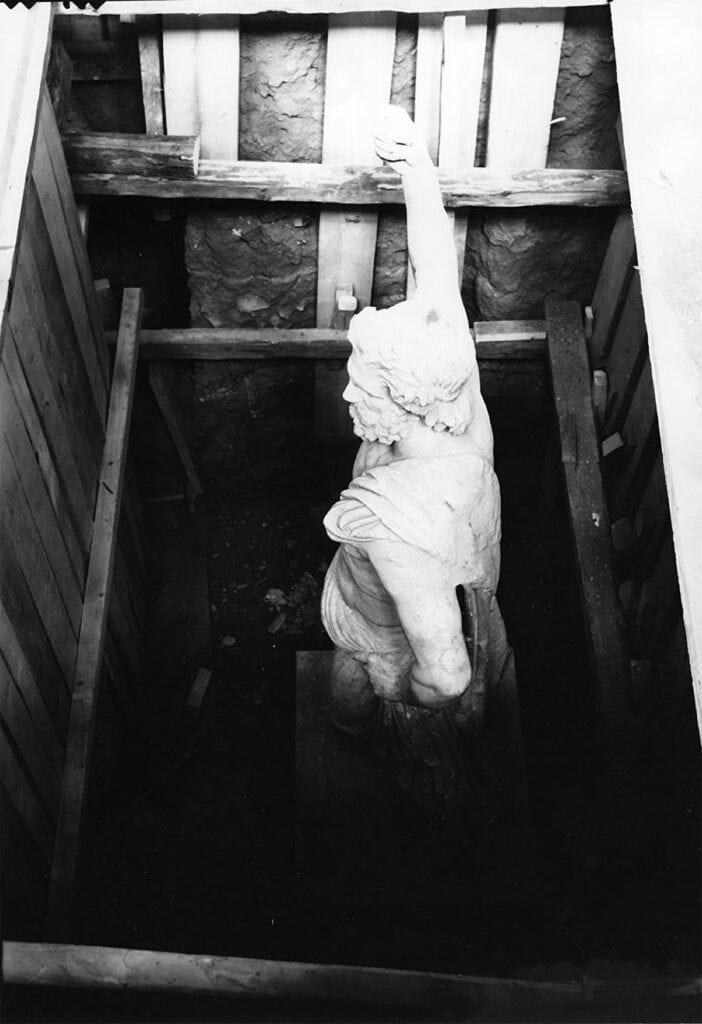
The antiquities remained hidden after German forces withdrew from Athens in October 1944. During the fighting that erupted in the capital that December, bombs struck the museum’s wooden roof. Semni Karouzou recalled that the marble sculptures survived because they had been buried deep underground.
The statues return to daylight
Recovery work began in March 1946 under the direction of Christos Karouzos, by then director of the museum, and Semni Karouzou.
The staff faced another difficult operation. Statues that had remained buried for years had to be excavated, examined, conserved, and returned to their galleries. Semni Karouzou remembered the anxiety over what condition the sculptures might be in beneath the thick covering of sand.
On June 4, 1946, poet George Seferis visited the museum and recorded the scene in his diary.
Workers were digging with picks and shovels in a gallery that resembled an archaeological excavation. Some statues were still embedded in the earth, their upper bodies emerging as the soil was removed.
In the museum’s English translation, Seferis described the sight as “a resurrection dance of rising figures.”
The following year, the museum reopened its first three exhibition halls. Historical photographs of the recovery show ancient sculptures surrounded by ropes, wooden supports, open trenches, and the workers responsible for bringing them back into view.
Examining the German institute’s wartime records
The new exhibition also turns to the German Archaeological Institute, whose relationship with Greek scholars had been strained by the Nazi regime and the occupation.
Walther Wrede directed the institute in Athens from 1937 to 1944 while also heading the Nazi Party’s organization in Greece.
After Athens was liberated on October 12, 1944, Greek authorities took control of the institute’s property. Its building remained under Greek administration until 1951.
Documents, photographs, and archaeological objects confiscated from the institute and Wrede’s private residence during that period eventually entered the National Archaeological Museum’s holdings.
In June 2023, staff from the German Archaeological Institute began examining the material. A joint research project with the Greek museum followed in 2024, supported by the German Federal Foreign Office’s Cultural Preservation Program.
According to the German Archaeological Institute’s research account, researchers cataloged approximately 1,000 ancient objects, mostly pottery fragments, and around 200 coins now held by the Numismatic Museum.
They also documented 342 records totaling approximately 3,200 pages, along with 401 photographs. The documentary and photographic material has been digitized.
Among the records are Wrede’s archaeological notes, drawings, manuscripts, private correspondence, letters involving Nazi officials, and pocket diaries from 1942 and 1943.
Archaeologist Maria Spathi cataloged the objects, while historian Petros Koris organized and indexed the historical records in Greek and German.
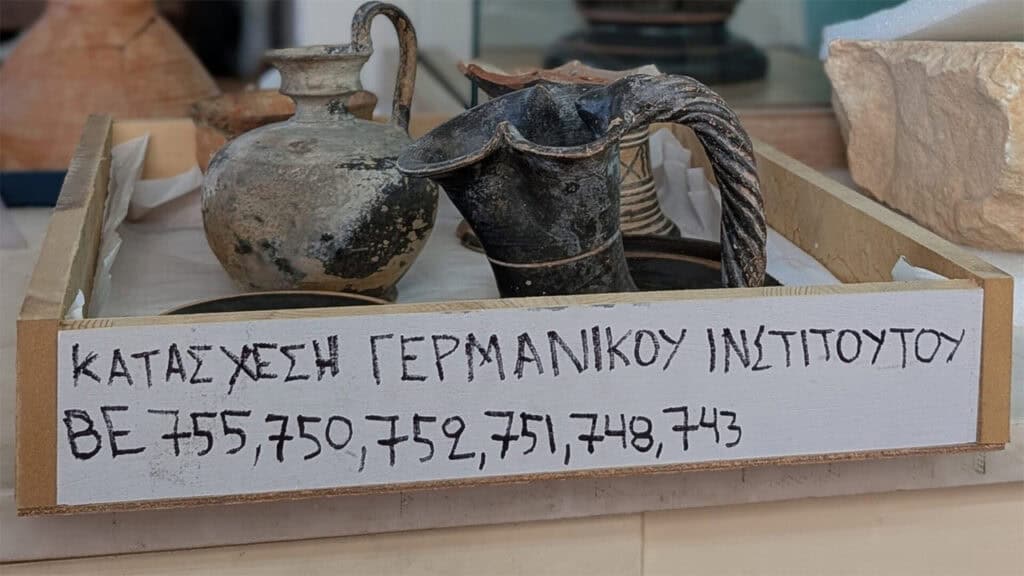
Much of the archaeological material appears to have come from the institute, while the archival documents are largely connected to Wrede’s private circle.
Wrede’s Nazi Party position was already known. The newly examined documents provide additional material for investigating his activities and the institute’s relationship with political authorities during the occupation. The material is still being studied, and the exhibition presents preliminary findings rather than definitive conclusions about the activities of individual German archaeologists.
Revisiting a divided history
The exhibition is presented at two locations in Athens.
At the National Archaeological Museum, selected antiquities, historical photographs, and documents trace the preparations for war, the concealment of the Greek collections, and the confiscation of material associated with the German institute.
The presentation at the German Archaeological Institute concentrates on its wartime activities and the history of its archaeological collection, with selected pottery fragments and case studies concerning Attica and the Argolid.
The exhibition opened on the 82nd anniversary of Athens’ liberation from German occupation. It also coincided with the international conference Archaeology and Occupation: Greece 1941–1944, held in Athens from October 15 to 17.
The conference drew criticism before it opened over a poster featuring a wartime photograph of a Wehrmacht flag above the Acropolis. Culture Minister Lina Mendoni called the choice a mistake, and the organizers replaced the image following the ministry’s intervention. In an October 13 joint statement, they explained that the photograph had been selected as a historical document to illustrate the conference’s subject, without intending to cause offense.
Divided Past: Greek-German Relations in Dark Times runs through January 31, 2027, at the National Archaeological Museum (44 Patision Street) and the German Archaeological Institute (1 Fidiou Street), both in Athens.
Until November 15, the National Archaeological Museum is open Wednesday through Monday from 8 a.m. to 8 p.m. and Tuesday from 1 p.m. to 8 p.m. From November 16, hours change to 8:30 a.m.–3:30 p.m. Wednesday through Monday, while Tuesday hours remain unchanged.
The German Archaeological Institute is open Monday through Friday from 9 a.m. to 4 p.m. Groups of five or more must arrange their visit in advance at ausstellung.athen@dainst.de.
Further details are available through the National Archaeological Museum’s exhibition announcement.