
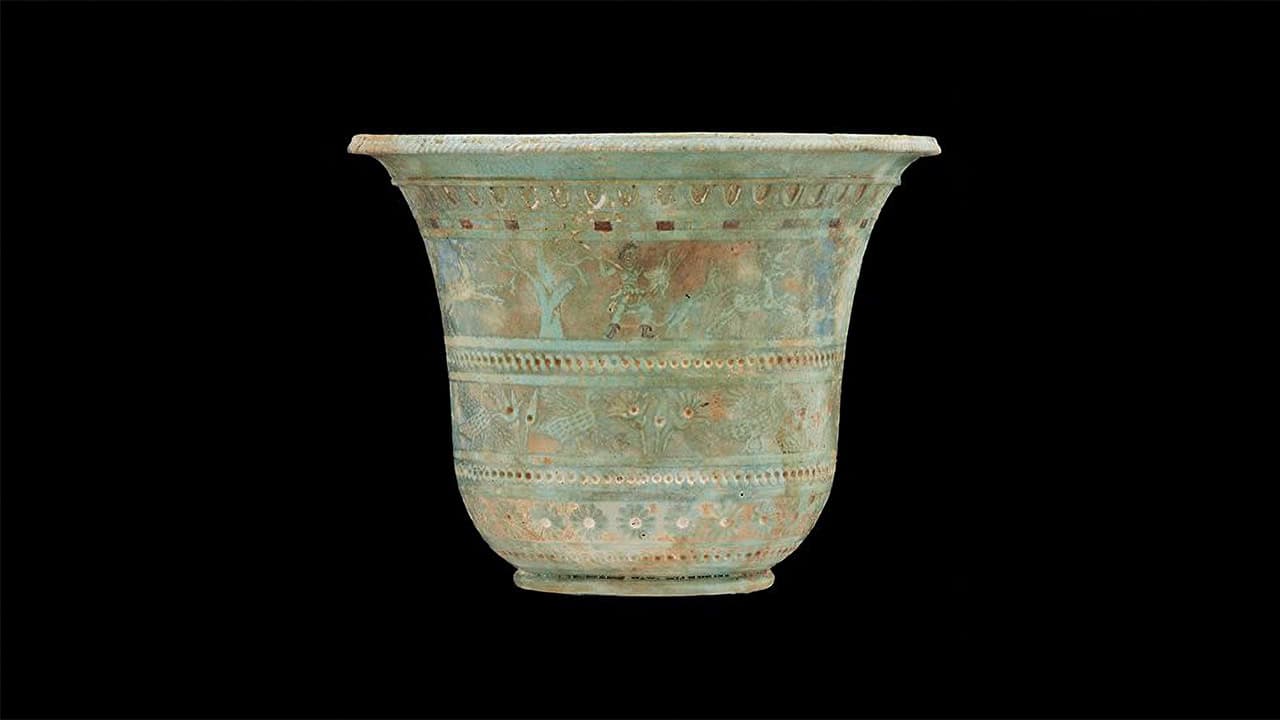
An Egyptian vase decorated with the Greek goddess Artemis may have been made before Thessaloniki itself existed. By the time it was buried with a wealthy woman around 275 BC, it was already decades old.
The Archaeological Museum of Thessaloniki has selected the blue-green vessel as its featured object for October 2026. Discovered in 1958, the vase is part of a burial whose contents have led archaeologists to reconsider who the woman was and what place she may have held in the city’s early society.
The vessel is a kalathos, a basket-shaped container made from Egyptian faience, a quartz-based material covered with a glassy coating. Its decoration combines Egyptian and Greek imagery. Waterbirds stand before lotus flowers, while a scene above them depicts Artemis hunting deer, hares, and a wild boar with the help of dogs. The goddess wears a short tunic and boots and carries a bow, arrows, and a javelin.
Red glass coating appears on her boots and hair and on one of the decorative bands. Small gold plates and buttons may once have adorned the vessel, judging from surviving ornaments on comparable Egyptian objects.
In the museum’s October presentation, archaeologist Anna Arvanitaki dates the vase to approximately 325–300 BC. Traces of use suggest it was not new when placed in the tomb.
The grave was uncovered in March 1958 during road construction in Neapolis, in Thessaloniki’s western cemetery. It contained fourteen terracotta figurines, twelve gold ornaments, perfume vessels, a bronze mirror, a shallow vessel known as a phiale, a glass drinking cup, and the Egyptian basket. No traces of human bones were found.
Archaeologist Alexandra Daffa-Nikonanou published the burial in 1986 in the journal Makedonika. Her original study dated the grave to the second century BC and suggested that the deceased may have been a young, unmarried woman, partly because of the figurines placed beside her. She also noted symbolic imagery associated with Aphrodite and Dionysus among the grave goods.
A later reassessment of the pottery moved the burial to the second quarter of the third century BC, considerably earlier than originally believed.
Archaeologist Despina Ignatiadou proposed a different interpretation. In her study Arsinoë II in Macedonia, she suggested that the woman was probably a priestess of a more mature age who possessed expensive ritual vessels and jewelry, some made long before her death. Ignatiadou also identified possible connections between the burial, Ptolemaic Egypt, and the early worship of Aphrodite-Isis, a divine figure combining Greek and Egyptian religious traditions.
Her interpretation remains a hypothesis. No surviving inscription establishes the woman’s name or confirms that she held a religious office.
Thessaloniki was founded around 315 BC by Cassander, one of Alexander the Great’s successors. The city was therefore only about 40 years old when the woman was buried. Her Egyptian vessel, possibly older than the city, belonged to a period when Macedonia’s connections with Egypt extended across trade, politics, and religion.
How the vase reached Thessaloniki remains unknown. It is now displayed in showcase 10 of the Archaeological Museum of Thessaloniki’s permanent exhibition, Thessaloniki, Metropolis of Macedonia.
The woman buried in Neapolis remains unidentified, but the objects placed beside her have allowed archaeologists to reconsider both her age and her possible religious role in the young Macedonian city.