
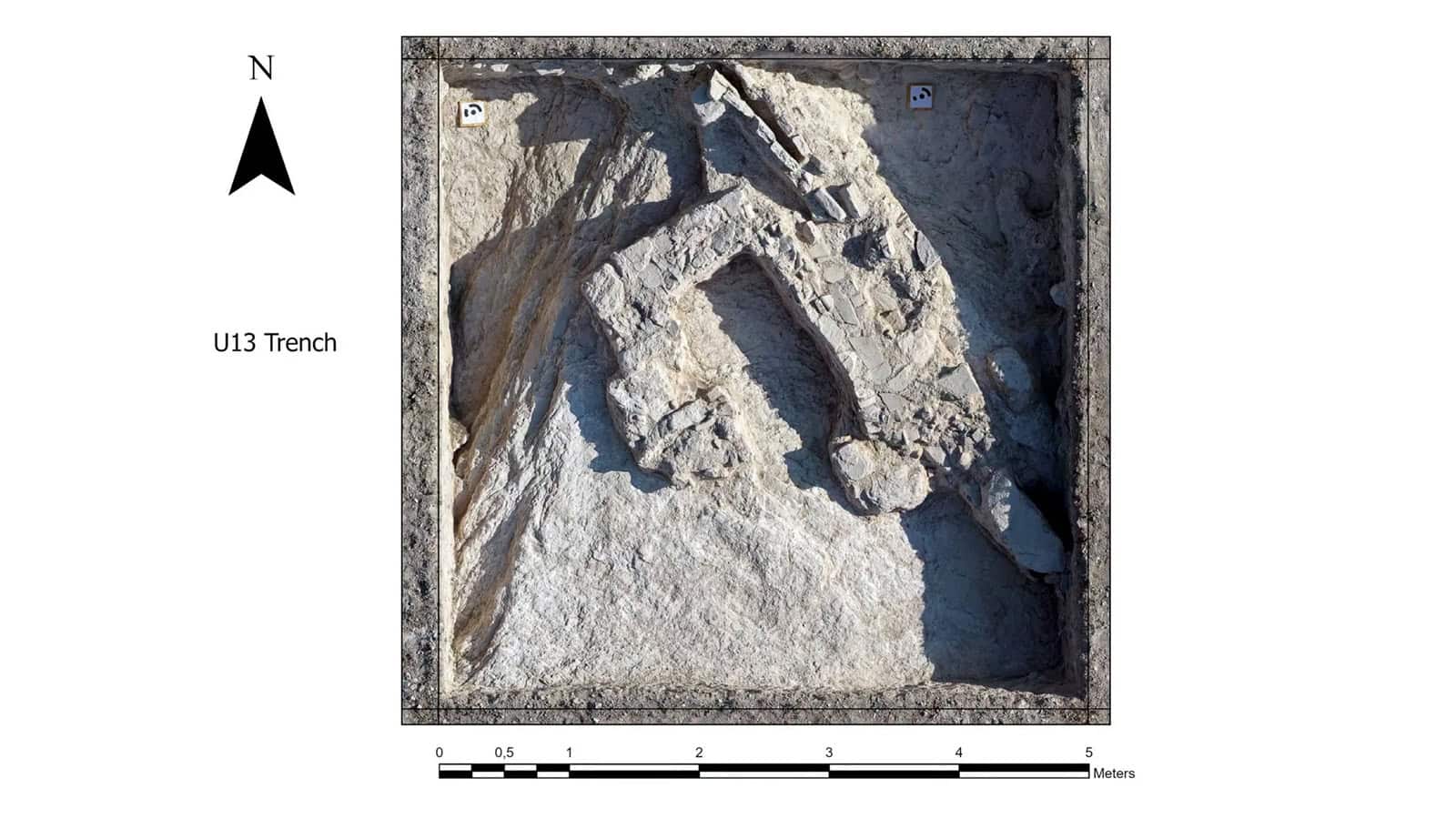
Archaeologists at a Byzantine pottery workshop near Larnaca, Cyprus, have uncovered a stone-built basin showing how clay was prepared for ceramic production. The discovery at Menogeia-Limnes provides rare physical evidence of a stage of pottery-making that is difficult to reconstruct from finished vessels alone.
The basin was built directly on bedrock and contained alternating layers of clean clay and sifted soil. Water entered through a channel formed by two parallel rows of upright stones, revealing how workers supplied the area where clay was prepared.
According to the Cyprus Department of Antiquities, the basin provides the first direct archaeological evidence on the island of this stage of production at a pottery workshop from its historical periods. The findings were reported by the Cyprus Mail on October 26.
The workshop had already been identified during excavations in 2025. In 2026, archaeologists opened five additional trenches, revealing storage and working areas containing prepared clay, fragments of pottery wheels, a large storage jar still in its original position, and ceramic pieces damaged during firing.
While finished pottery can reveal what was manufactured, the newly uncovered basin offers evidence of how the raw material was prepared before vessels were shaped.
Pottery recovered from the excavations indicates three periods of activity at the workshop: the late fourth to fifth centuries, the sixth to mid-seventh centuries, and the late seventh to mid-eighth centuries.
The excavations took place from June 15 to July 24, 2026, as part of the University of Cyprus’s Settled and Sacred Landscapes of Cyprus research project, directed by Associate Professor Athanasios Vionis and Dr. Doria Nicolaou.
Nearby Church Reveals Centuries of Religious Activity
The same research project uncovered further evidence at Kofinou-Agios Herakleios, where archaeologists have been investigating a Byzantine church complex and its surrounding cemetery.
Carved architectural stones confirmed that a church previously uncovered at the site had a dome. Researchers tentatively date the building to the eighth through tenth centuries, when it was constructed over the central aisle of an earlier basilica dating from the late sixth or early seventh century.
The excavations also documented an organized cemetery that, according to the Department of Antiquities, remained in continuous use from the sixth to the sixteenth century. Researchers describe it as the first archaeological documentation in Cyprus of an organized cemetery used without interruption for approximately 1,000 years.
The findings also trace how the church’s purpose changed. Archaeological evidence indicates that it was abandoned and partly collapsed around the middle of the fourteenth century. Hearths, cooking vessels, and animal bones discovered among the ruins show that the building was later used for domestic activities, while burials continued in the surrounding area into the sixteenth century.