
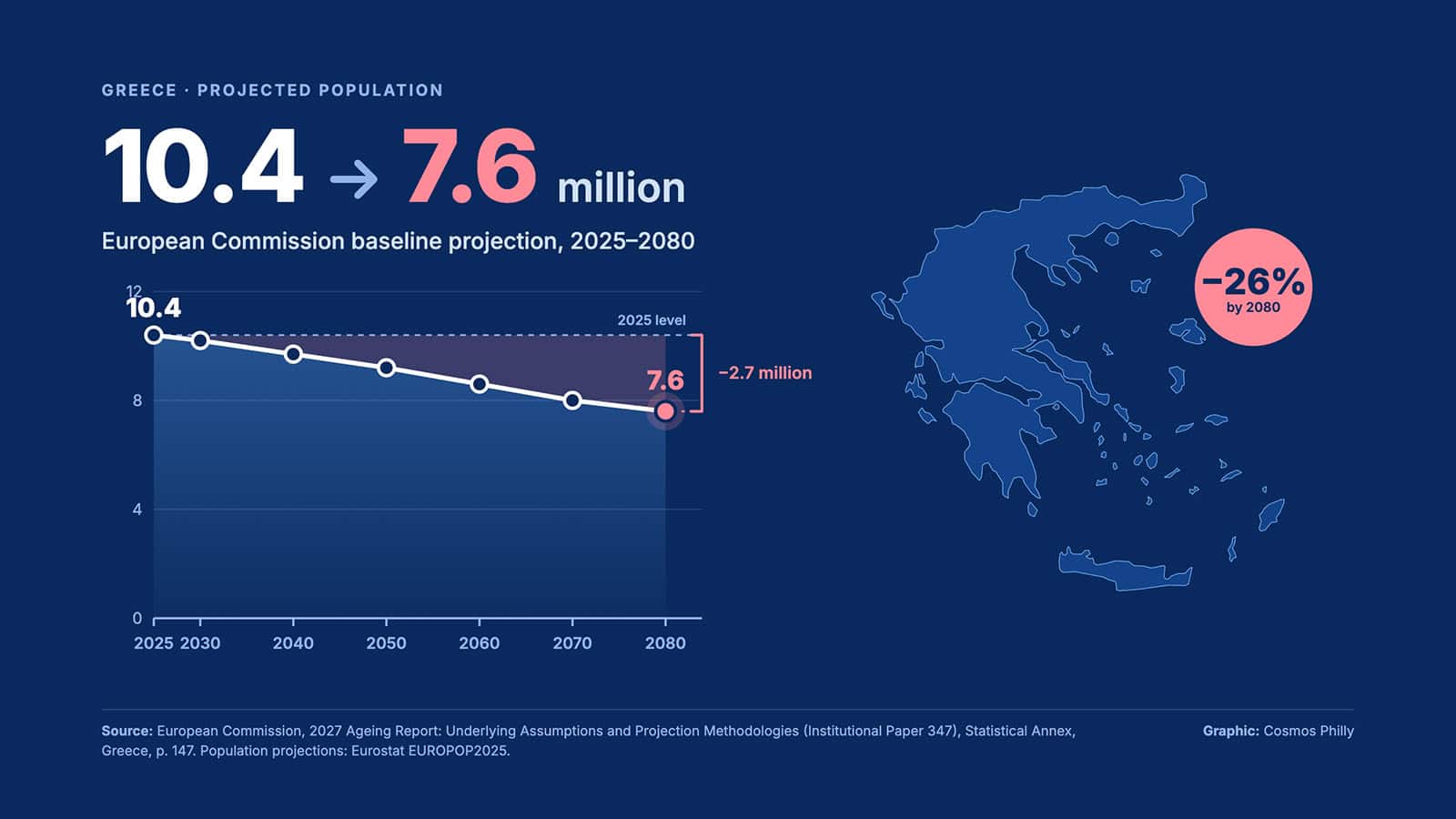
Greece could lose more than a quarter of its population over the next 55 years, falling from 10.4 million residents in 2025 to 7.6 million by 2080, according to new European Commission projections. The country also faces a shrinking workforce and a growing proportion of elderly residents.
The figures appear in the first volume of the 2027 Ageing Report, published on November 4, 2026. The Commission projects a population decline of approximately 26% for Greece, compared with 8% across the European Union.
Under the report’s baseline scenario, Greece’s population would fall to 10.2 million by 2030, 9.2 million by 2050, and 8 million by 2070 before reaching 7.6 million in 2080.
An Older Population and Fewer Workers
Greece is expected to become considerably older as its population declines. Residents aged 65 and above, who accounted for 23.9% of the population in 2025, could represent 34.9% by 2050. Their share would remain close to that level through 2080.
The proportion of people aged 80 and older is expected to more than double, rising from 7.2% in 2025 to 14.9% in 2080. Such a shift would increase demand for healthcare, long-term care, and support services for older residents.
Meanwhile, the number of people aged 20 to 64 is expected to fall from approximately 6 million in 2025 to 4.6 million in 2050 and 3.8 million by 2080.
Among that same age group, the labor force, which includes employed people and those seeking work, is projected to shrink from 4.65 million to 3.07 million. The decline would occur despite an expected improvement in employment rates.
By 2050, Greece could have nearly 70 residents aged 65 and older for every 100 people of working age, compared with approximately 41 in 2025. This demographic ratio does not measure pensioners against employed workers, but it indicates how the balance between generations is expected to change.
Economic Growth Could Slow
A smaller workforce could also limit Greece’s long-term economic growth.
The Commission estimates that Greece’s annual potential GDP growth rate could slow from 1.6% in 2025 to 0.2% in 2050, with growth projected at 0.8% in 2080.
These are projections of the economy’s potential growth, not short-term forecasts of actual GDP. Higher productivity could partially compensate for the loss of workers, but the report suggests that fewer people of working age will remain a constraint on economic activity.
Greece’s fertility rate is projected to increase from 1.20 children per woman in 2025 to 1.45 in 2080. That would still be well below the approximate replacement level of 2.1 children per woman.
The Commission also expects Greece to record positive net migration throughout the period. However, the anticipated inflows would not be sufficient to offset the overall population decline.
Long-Term Projections, Not a Fixed Outcome
The figures are based on Eurostat’s demographic projections and economic assumptions that generally reflect existing policies. They describe a possible future if those assumptions hold, rather than an inevitable outcome.
Changes in birth rates, migration, employment, productivity, or government policy could alter Greece’s demographic and economic trajectory.
The November publication establishes the assumptions and methodologies for the broader 2027 Ageing Report. A second volume, expected in spring 2027, will examine projected public spending on pensions, healthcare, long-term care, and education.
The findings will provide a more detailed picture of how Greece’s changing population could affect public finances in the decades ahead.