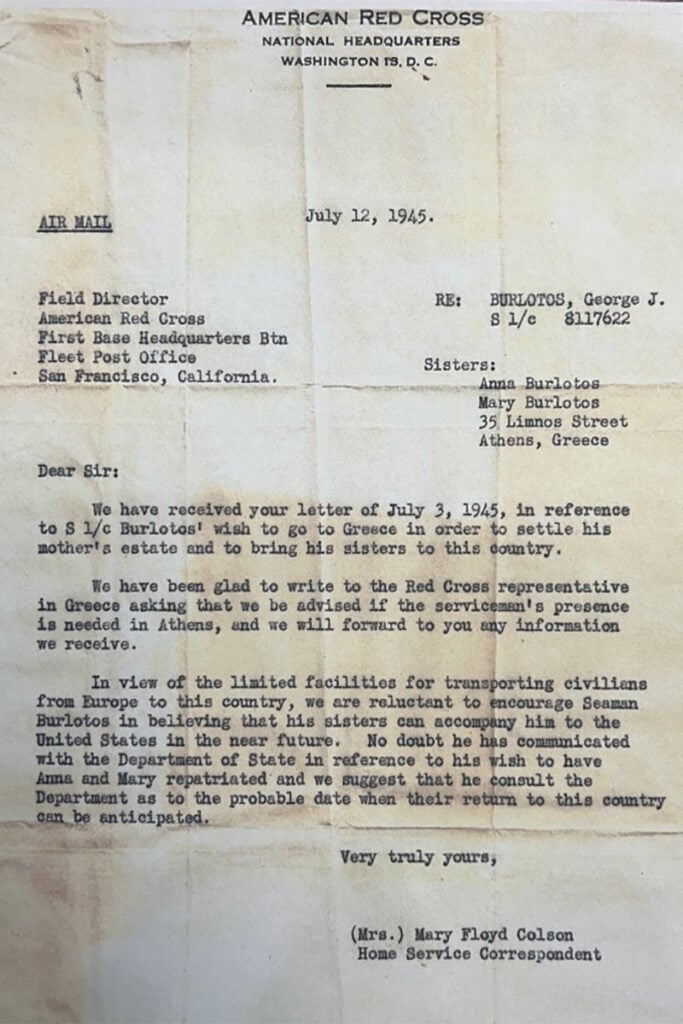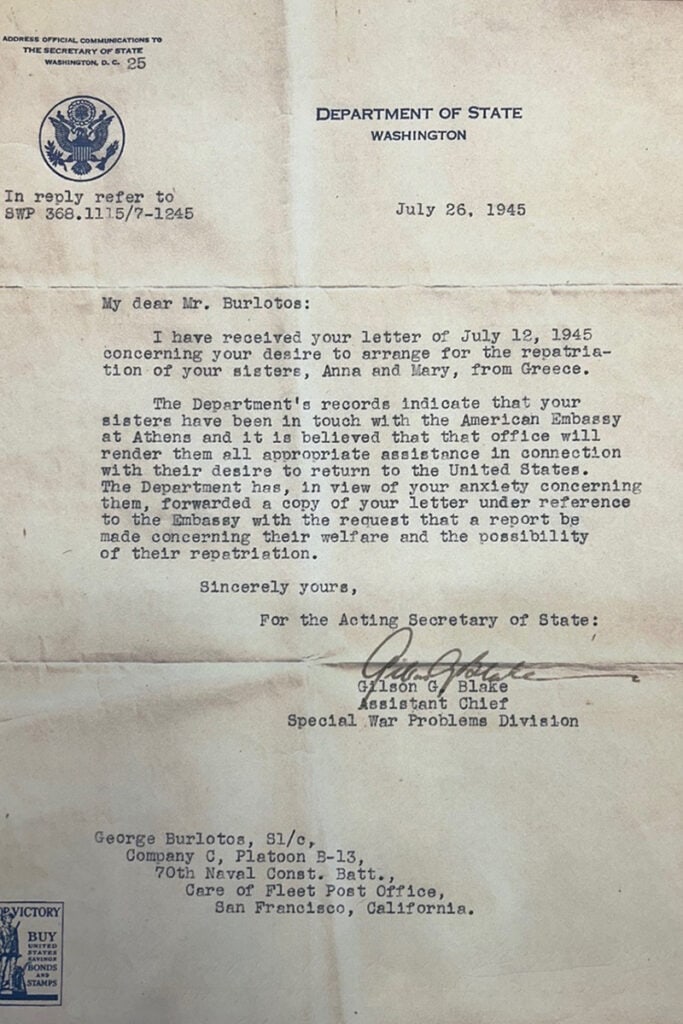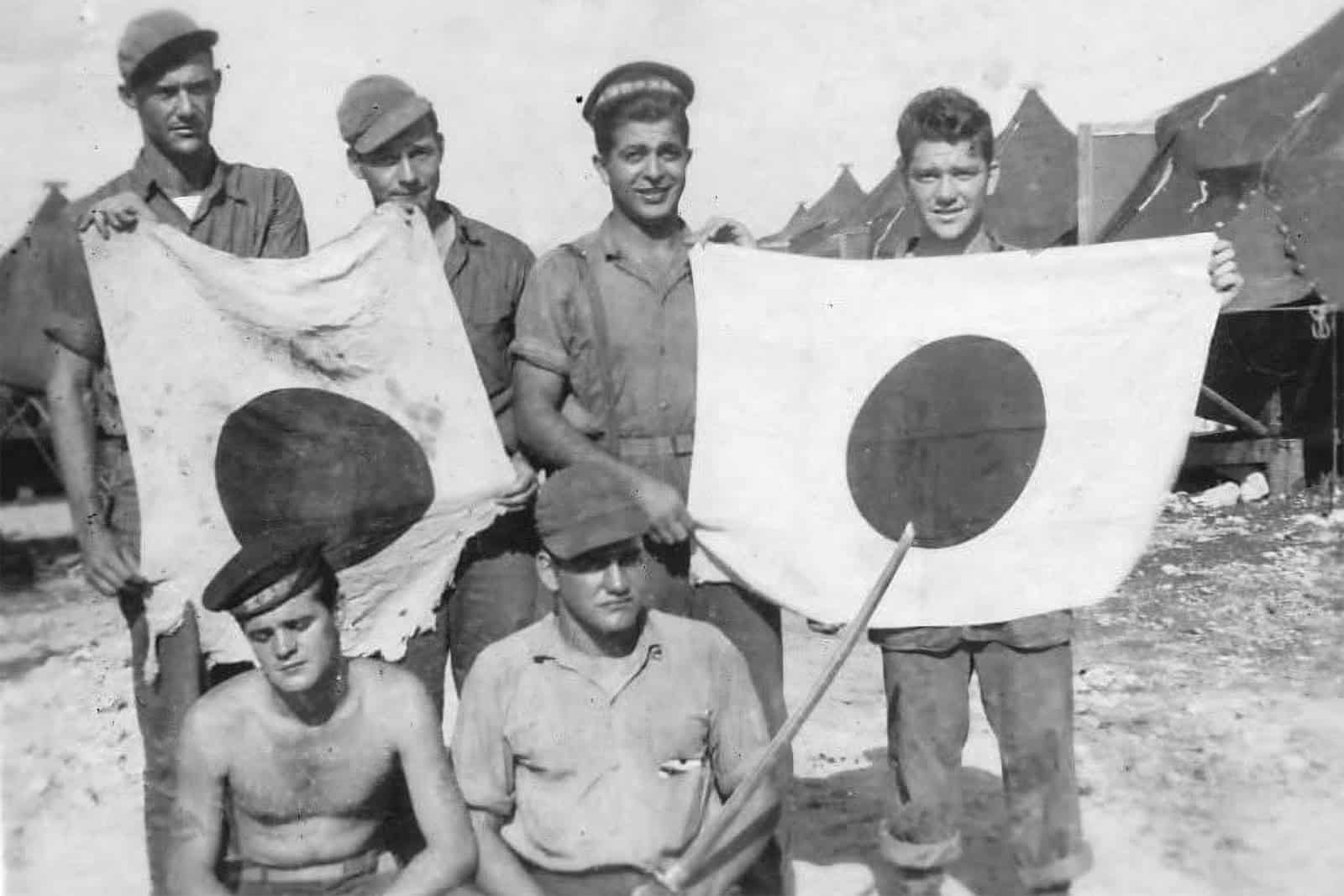
As we celebrate Veterans Day and honor those who valiantly served our country, I wanted to share a letter my father, George Burlotos, wrote from Guam when he was serving his country “on the road to Tokyo” during World War II in the Pacific Theater.
My father was born in Passaic, NJ, in 1923. Due to his mother’s illness, George, along with his mother, Eleni, and two younger sisters, Anne (Marlys) and Mary (Kalellis), returned to Greece in 1929. They were very poor and would often move between different relatives’ homes. After 10 years, in 1939, my 15-year-old father returned to the United States by himself on the Greek ship T.S.S. Nea Hellas. His departure from Greece would be the last time he saw his mother. Once back in America, George attended Woodrow Wilson High School in Camden, NJ, from 1939 to 1943.
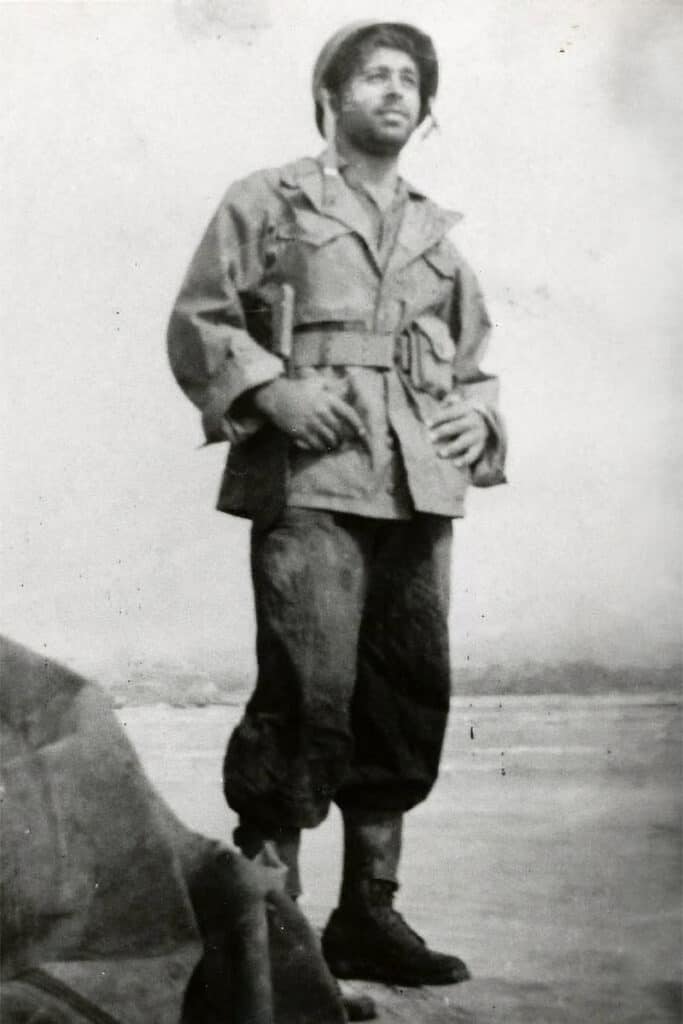
Upon graduation, he immediately enlisted in the U.S. Navy. George proudly served in the 70th Construction Battalion Amphibious Seabee Forces. George served throughout the Pacific, including Iwo Jima, Guam, Guadalcanal, and the invasion of Okinawa, where he survived constant strafing and horrific kamikaze attacks.
During George’s service in the Pacific, he was extremely worried about his mother and sisters’ survival in German-occupied Greece. It was a difficult time for everyone. The Nazis somehow discovered that my father’s sisters had a brother who was fighting for the Americans. After much interrogation, the local villagers convinced the German soldiers to release them.
Nazi Germany’s occupation of Greece ended in October 1944, and Greece quickly fell into a civil war. In May 1945, George’s mother and sisters were in Athens preparing to finally return to the United States. As his mother (my grandmother) was leaving the American Consulate with the necessary paperwork, she was tragically struck and killed by a communist during a car chase.
During this time, my father had just spent 45 harrowing days in the Battle of Okinawa, with some of the fiercest fighting in the Pacific. The Japanese were desperate, and Okinawa was the peak of deadly kamikaze attacks. My father survived many such attacks, including one on May 12, 1945, when several Japanese kamikazes flew directly overhead and struck the battleship USS New Mexico, which was anchored right next to my father’s ship. Fifty-four U.S. sailors on the USS New Mexico died in the attack, and my father often spoke of this unforgettable event in his life.
After Okinawa, my father, like many of the American troops in the Pacific, was restaging in Guam, preparing for the invasion of Japan. The “Road to Tokyo” was the massive Allied strategy to defeat Imperial Japan and force its surrender. This was the battle cry of the American Pacific forces.
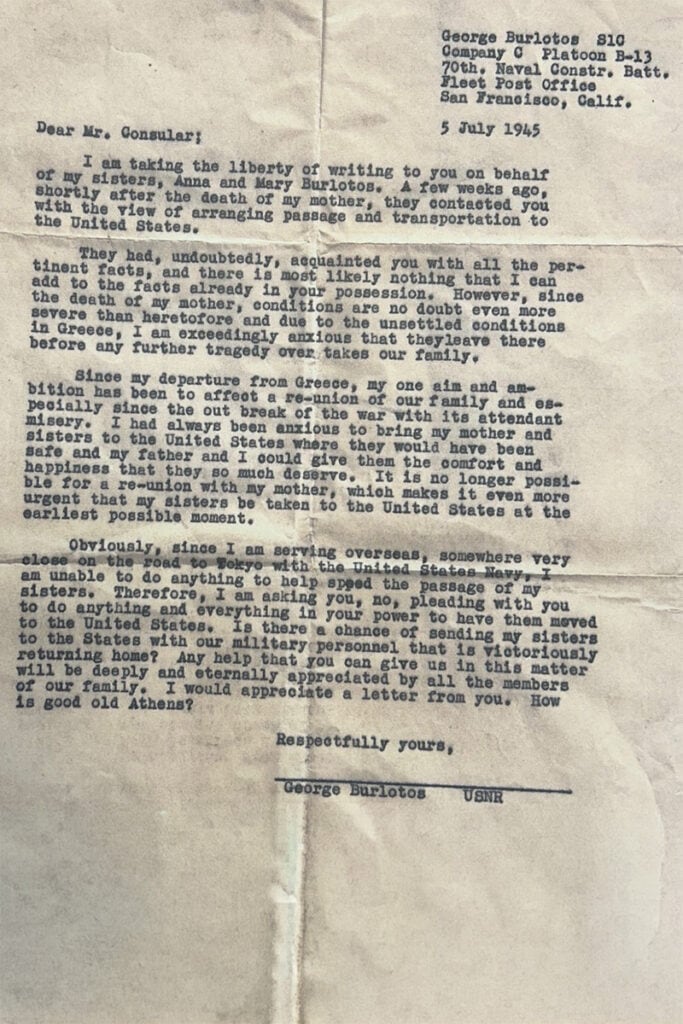
In June 1945, George received word of the sudden death of his mother. With his mother gone, George was desperate to care for his two younger sisters and get them back to the United States. In his July 5, 1945, letter to the American Consulate, he sought help for his sisters. He wrote to the Consulate while “serving overseas, somewhere very close on the road to Tokyo.”
I am amazed at how well the letter was written, considering he was just 21 years old and English was his second language. After a few more letters and communication with the Greek Consulate, American Red Cross, and Department of State, George was finally able to arrange his sisters’ safe return to the United States.