
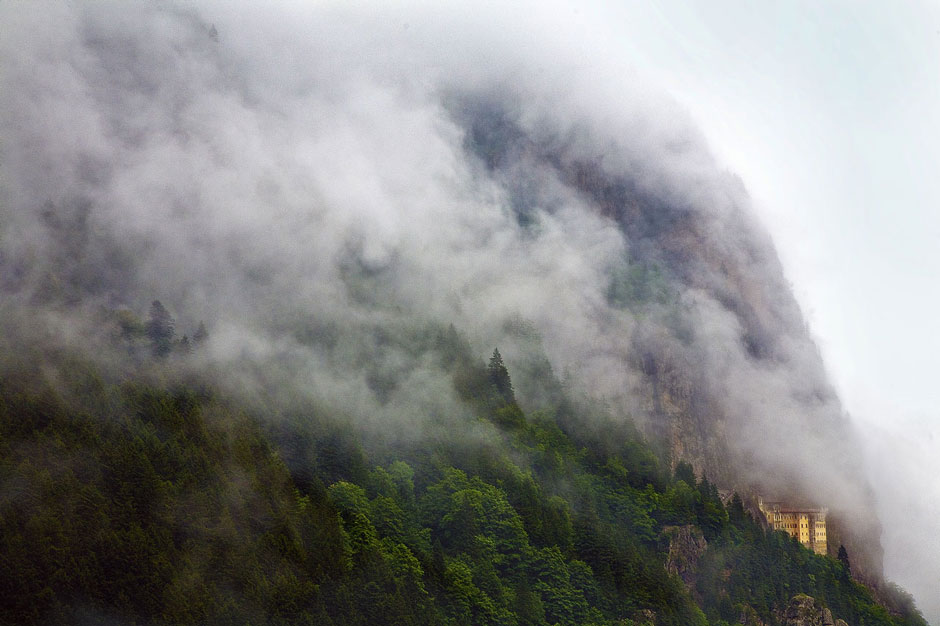
The Soumela Monastery (Turkish: Sümela Manastırı, Greek: Μονή Παναγίας Σουμελά, Moní Panagías Soumelá) is a Greek Orthodox monastery dedicated to the Virgin Mary (Panagia, meaning “All Holy” in Greek). It is built into the face of Mount Melá in the Maçka district of Trabzon Province, in present-day Turkey.
According to tradition, the monastery was founded in 386 AD during the reign of Emperor Theodosius I by two Athenian monks, Barnabas and Sophronios, who discovered an icon of the Virgin Mary—believed to have been painted by the Apostle Luke—in a cave on the mountain. Over the centuries, it became a spiritual center for the Pontian Greek community and a place of pilgrimage for Orthodox Christians throughout the Black Sea region.
Perched dramatically on a cliff at an altitude of about 1,200 meters (3,900 feet) and overlooking the Altındere Valley, Soumela is renowned for its unique architecture, frescoes, and breathtaking location. It flourished under Byzantine and later Ottoman rule, receiving imperial patronage and maintaining its religious influence until the early 20th century.
Following the population exchange between Greece and Turkey in 1923, the monastery was abandoned, and its sacred icon was relocated to Greece. Today, the Soumela Monastery is recognized as a UNESCO World Heritage Site, celebrated both for its historical and cultural significance and as a major attraction within Altındere National Park.
Photo: Eleftherios Kostans.