
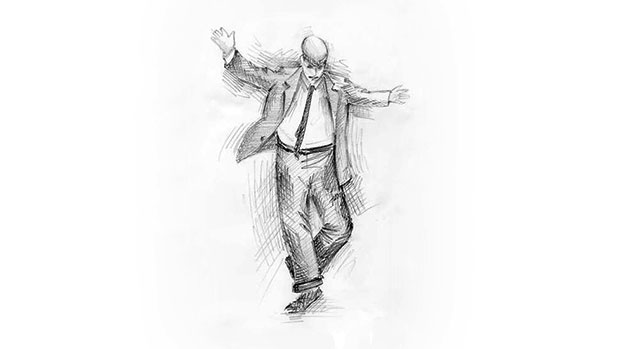
On any given Saturday night at church halls all over America, men, women, and children join hands and perform Greek dances to the tunes of the klarino, the lyra, and the bouzouki. At some point in the evening, as the dancers move in a counterclockwise direction, the music stops, the dance floor clears, and the bouzouki player starts playing a taximi.
A taximi is the moment when the musician, without any other band members joining in, performs a solo with his bouzouki, showcasing his playing ability and externalizing his inner feelings. As he plays, he suddenly stops in mid-stride and turns his head towards his other bandmates. He then gives them “the nod,” and it begins… the zeibekiko, and one by one, the people start filling the dance floor once again.
Ever wonder where this dance originated, how the zeibekiko started, and what it meant to those who danced to its tune? According to some historians, the word Zeybek is most likely Phrygian, derived from the god Zeus (Zey) and the word for bread (Bekos). It symbolizes the union of the spirit with the body.
The Zeybeks originated in ancient Thrace, Greece, where, during archaeological excavations, a rock called Gonikon, next to a tomb locals call the tomb of Orpheus, depicts various symbols and figures that look like people dancing with arms stretched.
In the Zeybeks of Asia Minor, Greek writer Thomas Korovinis says that the Zeybeks migrated around the 17th century to the Anatolian shoreline of the Aegean Sea, where they had a somewhat contradictory existence. They fought for their sovereignty against Ottoman rule and for justice by helping the elderly, protecting travelers from bandits, and giving money to the poor. On the other hand, they were part of the elite Ottoman fighting force that fought the Greeks during the 1922 war.
A Zeybek leader named Yörük Ali Efe summarized the task and involvement of the major Efe and Zeybeks as follows:
An individual, regardless of his courage and bravery, cannot claim he did a good deed for the population. He can only say that he had served his people.
The Zeybeks would sing songs of bravery and perform a sacred dance that reflected their honor and pride. The zeibekiko dance would start off slowly with small stutter steps in a circular motion with hands raised, simulating the movements of a hawk or an eagle with its wings expanded. With one sudden movement of the tips of his fingers, the guerrilla fighter would touch the ground, tap the heel of his boot, and hit his sword or whatever other weapon he was carrying.
The zeibekiko was exclusive to males who strictly performed solo. Korovinis says that:
The dance’s execution is based on clearly defined rules of decency and strict dancing etiquette. Anyone willing is allowed to get up and dance the zeibekiko, but for someone to “join in” during the dance is unacceptable. While an individual is dancing, it is also considered inappropriate and disrespectful to change or stop the song or to “order” or “request” (Greek: παραγγελιά) that another tune be played.
During the 1930s, the zeibekiko made its way to major metropolitan Turkish cities and was quickly embraced by people of the night, including thugs and criminals known as Daides (Greek: νταήδες). These people transformed the zeibekiko dance to reflect their isolation from the rest of society, showcasing loneliness, sorrow, and the perceived injustice and unfairness of the world upon them. It was danced with the head tilted downward and a face that showed no emotion by those who wanted to release built-up anger, resentment, and pain. This is the zeibekiko that was adopted by the Rebetes of Asia Minor, and was brought to the Greek mainland; that is how we have come to know it today.
In 1973, Greece, an incident occurred which was later made into a movie named Paragelia (English: order, request). During the late-night hours of February 25th, Nikos Koemtzis went to a club (bouzoukia) with a friend and his younger brother, Dimosthenis, to celebrate their recent release from jail (where they had served time for theft). Dimosthenis ordered from the band to play Markos Vambakaris’ Vergoules.
Not too far away at the club were 3 policemen who were very familiar with the Koemtzi brothers and their brushes with the law. The song began, and Demosthenis got on the dance floor to do a zeibekiko, when the policemen got on stage alongside him and started clapping and dancing ironically in his face, knowing very well that what they were doing was wrong. All of a sudden, Demosthenis’ brother Nikos jumped up from his seat and ran towards the policemen, screaming “Paragelia re!” (English: “It’s an order!”) He suddenly pulled a knife and fatally stabbed the 3 officers, injuring 7 others. Here’s a clip from the movie:
Another Greek cinema production featuring a famous zeibekiko was the movie Evdokia, considered by many to be the best Greek film ever made. In this film, a sergeant of the Greek army falls for a woman of the night, marries her, and, in typical Greek drama fashion, is taken on an emotional journey as she searches for answers in her life’s existence. In the following scene, the sergeant dances Manos Loizos’ amazing instrumental To zeimbekiko tis Evdokias (Evdokia’s zeimbekiko).
Watching several generations of Greeks dancing the zeibekiko recently at a Greek event included a pappou with his granddaughter in his hands, as well as a young man with his buddies. You soon realize that “this is what it’s about” and how far we have come in such a short period of time. No drama and no special requests, so that ONE individual dances head tilted downward while others have to sit in their seats and watch. We raise our heads, join hands, and dance in a way that is more telling of our spirit, our culture, and our history.
As George Dalaras sings in Giorti Zeibekidon in his album Mikra Asia:
Παλικάρια ένα κι ένα με σαλβάρια κεντημένα
και χρυσά κουμπιά
Έχουν τα σπαθιά στα χέρια και στο στόμα τα μαχαίρια
Γεια σας ρε παιδιά!