
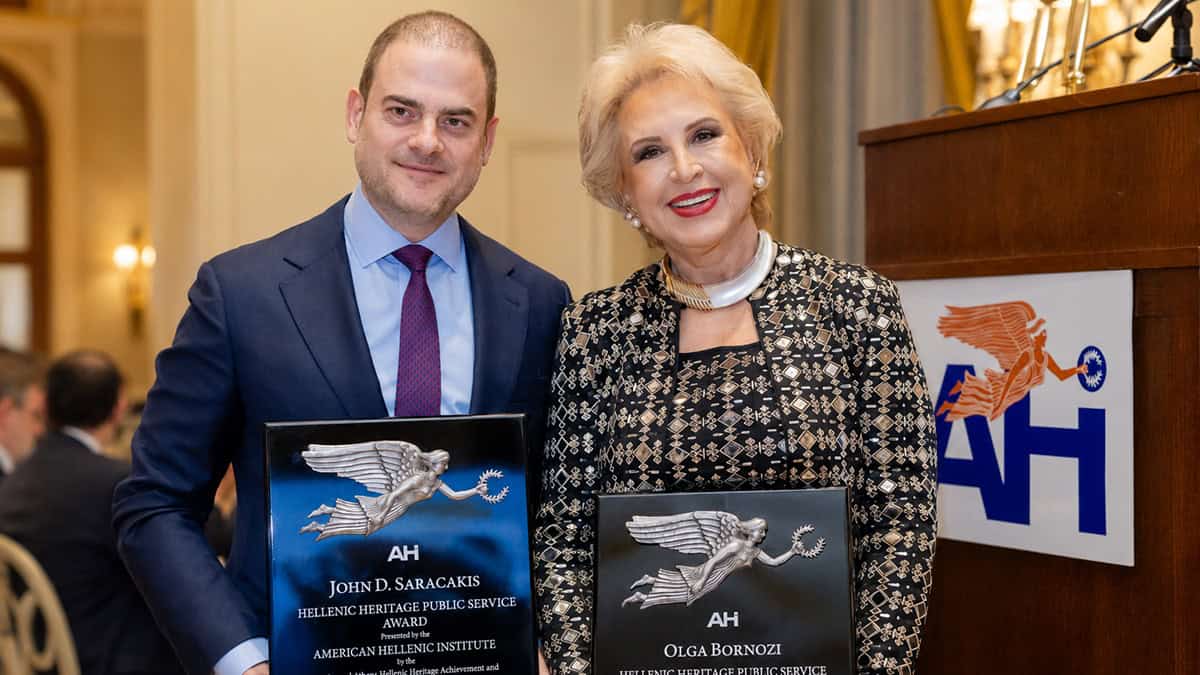
The American Hellenic Institute honored two business leaders in Athens this month, but the more interesting story is not the dinner itself. It is the kind of U.S.-Greece relationship the honorees represent: one built through investment forums, business chambers, industry networks, defense events, and access to official Washington and Athens.
AHI held its 21st Annual Athens Hellenic Heritage Achievement and Public Service Awards Dinner on May 7, 2026, at the Hotel Grande Bretagne in Athens. The honorees were Olga Bornozi, Managing Director of Capital Link Inc., and John D. Saracakis, Executive Chairman of the Saracakis Group of Companies and President of the American-Hellenic Chamber of Commerce.
Bornozi received the AHI Hellenic Heritage Public Service Award for her work promoting Greece as an international investment destination and strengthening U.S.-Greece economic ties through Capital Link. Saracakis received the AHI Hellenic Heritage Achievement Award for his business leadership and his role in deepening economic and institutional ties between Greece and the United States.
As an awards dinner, the event fit a familiar pattern in Greek-American institutional life. AHI brought together diplomats, government officials, business leaders, clergy, and members of the Greek-American and philhellene communities. U.S. Ambassador to Greece Kimberly Guilfoyle delivered remarks, and Greek Deputy Minister of Foreign Affairs Yiannis Loverdos officially represented the Greek government.
But the choice of honorees points to something more specific than ceremonial recognition.
Bornozi’s work through Capital Link is tied to Greece’s long-running effort to present itself as a credible destination for international capital. Capital Link’s Invest in Greece Forum in New York has become one of the recurring stages where Greek officials, listed companies, banks, investors, and diaspora business figures meet under a shared message: Greece is no longer only a story of crisis, but a market seeking capital and confidence.
Separately, Capital Link has also built a Wall Street ritual around that message. In December 2025, the New York Stock Exchange and Capital Link marked the 21st consecutive Greek American Issuer Day, held in connection with the 27th Annual Capital Link Invest in Greece Forum. The forum drew more than 1,000 participants and was held with the NYSE, the Athens Exchange Group, and major global investment banks and institutions.
That visibility is important, but it should not be overstated. Investment forums create access, attention, and introductions. They do not, by themselves, prove that capital will move. Their value is harder to measure than their photographs suggest.
Saracakis represents a different channel of influence. His family company traces its roots to Thessaloniki, where the founder, also named John D. Saracakis, established the business in 1922. It later became one of Greece’s major commercial and industrial groups. Its history includes the representation of international automotive and machinery brands, early ties to Volvo and Honda, and work in public transport. The company says its industrial sector manufactured 120 articulated buses for the Athens bus company in 1999, including the ATHÍNA model, which it describes as the first tri-axle articulated bus produced worldwide.
These details give Saracakis a different profile from Bornozi’s. Her world is investment visibility, capital markets, and Greece’s presentation to global investors. His background is rooted in industry, distribution, transport, and the practical machinery of Greek commerce.
His current role also gives the AHI recognition a contemporary edge. In July 2025, Saracakis was elected President of the American-Hellenic Chamber of Commerce. The Chamber described his election as coming at a pivotal time for Greece and the organization, with priorities that include strengthening Greece-U.S. ties and promoting Greek business in the United States.
One example is defense. In October 2025, the American-Hellenic Chamber of Commerce helped organize the Hellenic Pavilion at AUSA in Washington, D.C., where Greek defense-industry companies were presented to an American audience. The Chamber described Greece’s presence there as part of the country’s growing role in defense innovation and international collaboration.
Here too, the distinction matters. A pavilion at AUSA shows presence and ambition. It does not automatically mean contracts, technology transfer, or industrial depth. Still, it places Greek companies in the room at a time when the U.S.-Greece relationship has expanded well beyond cultural friendship and diaspora goodwill.
Guilfoyle’s presence at the AHI dinner added another layer. She is a partisan appointee with a public profile that reaches well beyond diplomacy. A former Fox News host and close ally of President Donald Trump, she became the first woman to serve as U.S. ambassador to Greece after taking up the post in November 2025. Her arrival came as the United States was working to expand energy ties through Greek port facilities and as U.S.-Greece military cooperation had deepened since 2018.
Her confirmation was also politically narrow. Reuters reported that the Senate confirmed a bloc of Trump nominees that included Guilfoyle by a 51-47 vote, with Republicans in favor and Democrats opposed. Earlier comments she made about Greeks during the debt crisis also resurfaced after her nomination. Kathimerini reported that, in 2015, she referred to Greeks as “freeloaders” during a Fox News discussion of the Greek referendum and bailout crisis.
That context does not erase the diplomatic role she now holds. But it does change the meaning of her appearance at a dinner built around Greek-American public service and U.S.-Greece economic ties. For organizations like AHI and AmCham Greece, access to a sitting ambassador is valuable. With Guilfoyle, that access also comes through a highly partisan figure whose appointment carried political baggage before she arrived in Athens.
That makes the room more interesting. Business groups and diaspora institutions often work by turning access into familiarity, and familiarity into influence. A politically charged ambassador can make that work more visible, but also more delicate. The question is not whether she gives supportive speeches about the U.S.-Greece relationship. The question is whether those public rituals translate into anything more durable: investment channels, policy attention, trade openings, defense cooperation, or leverage in Washington.
That is where the Bornozi-Saracakis pairing becomes useful. One honoree represents the investment-promotion side of the relationship, where Greece seeks credibility with markets and institutional investors. The other represents industry, chambers of commerce, and the strategic-business side of the relationship, including defense and technology forums.
The awards do not prove that these networks move capital or shape policy on their own. They do show where parts of Greek-American influence now operate: not only in cultural institutions and community life, but in the overlapping spaces of finance, industry, diplomacy, and strategy. For a community used to thinking of U.S.-Greece ties in emotional or historical terms, that is now where the practical story is unfolding.