
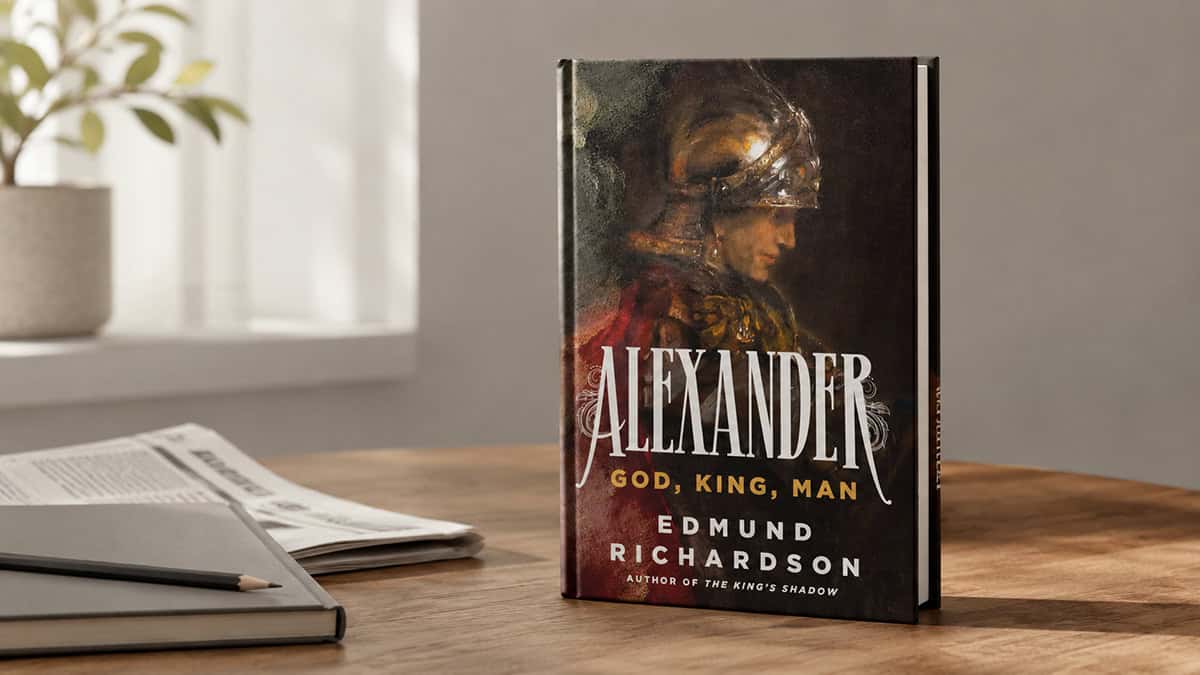
Edmund Richardson’s forthcoming biography is a chance to revisit the Macedonian king not only as a conqueror and symbol, but as a young ruler caught between history, myth, family, and power.
For many Greeks and Greek Americans, Alexander the Great arrives early. He arrives before the serious books. Before the footnotes. Before Arrian, Plutarch, Curtius, or the long arguments historians have had over what kind of ruler he really was. He arrives first as a name, a face, a statue, a school lesson, a museum image, a story passed around with pride. He belongs to childhood before he belongs to scholarship.
That familiarity can make him feel settled. Alexander becomes “the Great,” and the title does most of the work. The young king from ancient Macedon turns into marble. The victories become shorthand. The empire becomes a map. The human being disappears behind the symbol.
A forthcoming biography by Edmund Richardson, Alexander: God, King, Man, offers a timely reason to look again. The book, due from Bloomsbury in June 2026, is being presented by its publisher as a new biography based on recent discoveries and Richardson’s translations of ancient source material from twelve languages. Its own pitch is direct: instead of the legend, readers can meet Alexander the man. For a Greek-American audience, that invitation opens a slightly different question. What happens when a figure inherited as pride, symbol, and marble is allowed to become difficult again?
That question is worth asking because Alexander’s life still resists simplicity. Born in 356 BCE at Pella, in ancient Macedonia, Alexander was the son of Philip II and Olympias of Epirus. He inherited the throne in 336 BCE after Philip’s assassination and, within a few years, led his army east against the Persian Empire. His conquests carried Macedonian power from Greece and Egypt toward India and helped lay the foundations for the Hellenistic world.
Those facts are easy to summarize, but they explain only part of the story. Alexander was not only a battlefield figure. He was also a son, a political survivor, a student of heroic myth, and a ruler who learned how dangerous his own image could become. Ancient writers were already interested in that tension. Plutarch, writing centuries later, preserved stories about Olympias warning her son, rebuking the arrogance around him, and reminding him that power had a cost. In one passage, she complains that by raising his companions too high, Alexander was stripping himself bare.
By another later tradition, Olympias pushes back against the language of divine parentage around Alexander. The anecdote is useful not because it can be treated as a simple transcript of mother and son, but because it shows the kind of story later generations wanted to tell about him. Even in legend, someone had to pull Alexander back toward the human.
That is the more interesting Alexander for a diaspora audience. Not the flattened icon, but the restless figure underneath it.
Greek-American memory often carries historical figures across generations in polished form. That is understandable. Immigrant communities hold onto names, places, saints, heroes, battles, and symbols because they help preserve a sense of continuity. But heritage can also make certain figures too smooth. Alexander is one of them. He is invoked so often as greatness that the difficulty of his life can fade from view.
Even the word “Macedon” carries weight in modern Greek memory. In Alexander’s own time, it referred to the ancient kingdom from which he ruled, not the modern political arguments that later attached themselves to the name. For Greek readers, especially those shaped by the long dispute over Macedonia’s name and identity, that distinction is not abstract. It is part of why Alexander is rarely just an ancient figure, and why any serious return to him has to be careful with both history and memory.
Alexander belonged to ancient Macedon and to the wider Greek world of his time. He also belonged, through conquest, to Egypt, Persia, Central Asia, and the cities and kingdoms that followed him. The world he entered was not a simple stage for Greek glory. It was older, larger, and more complex than the heroic versions often allow.
The familiar military story remains astonishing. Alexander defeated Persian power, founded or reshaped cities, crossed deserts and mountains, and pushed his army farther east than many of his men wished to go. But the limits eventually appeared. At the Hyphasis River in 326 BCE, his soldiers refused to continue toward the Ganges valley. Arrian’s account presents the moment as one of the rare times Alexander had to yield, though even that yielding was handled through ritual. When the sacrifices for crossing the river produced unfavorable omens, Alexander had a way to turn back without appearing simply defeated by his own army. The image of the god had met exhaustion.
His power depended partly on the image of a ruler larger than ordinary life, and yet every stage of the campaign brought him back to the limits of the body. He was wounded repeatedly, carried grief and rage, drank heavily, and made brilliant decisions alongside destructive ones. He inspired loyalty and fear. He sought divine honors, and ancient writers already understood that his image was part of his power.
His death made the contradiction permanent. Alexander died in Babylon in 323 BCE, aged thirty-two, after ruling for less than thirteen years. His body was diverted to Egypt by Ptolemy and eventually placed in Alexandria, but the location of his tomb was later lost. His empire did not remain whole. His generals divided power, and the world after Alexander became a world of successor kingdoms.
The legend survived better than the empire.
That may be the real reason Alexander keeps returning. He is too large for one version and too human for the title that history gave him. To some, he is the model of youthful genius. To others, a warning about ambition without limits. To many Greeks, he is part of inherited pride. To historians, he is an argument that never ends.
Richardson’s book has not yet reached general readers, so this is not a review. But the attention around it is a useful opening. It gives Greek and Greek-American readers a chance to ask what we do with a figure we think we already know: whether we keep him as marble, or allow him to become strange again.
The second choice is harder, but more honest. Nearly 2,500 years later, Alexander still refuses to stay in the past, not only because he became “the Great,” but because beneath the title there remains someone more unsettling: a son of Olympias, a king of ancient Macedon, a conqueror learning the uses of myth, and a mortal man whose wounds, exhaustion, and early death finally cut through the myth built around him.