
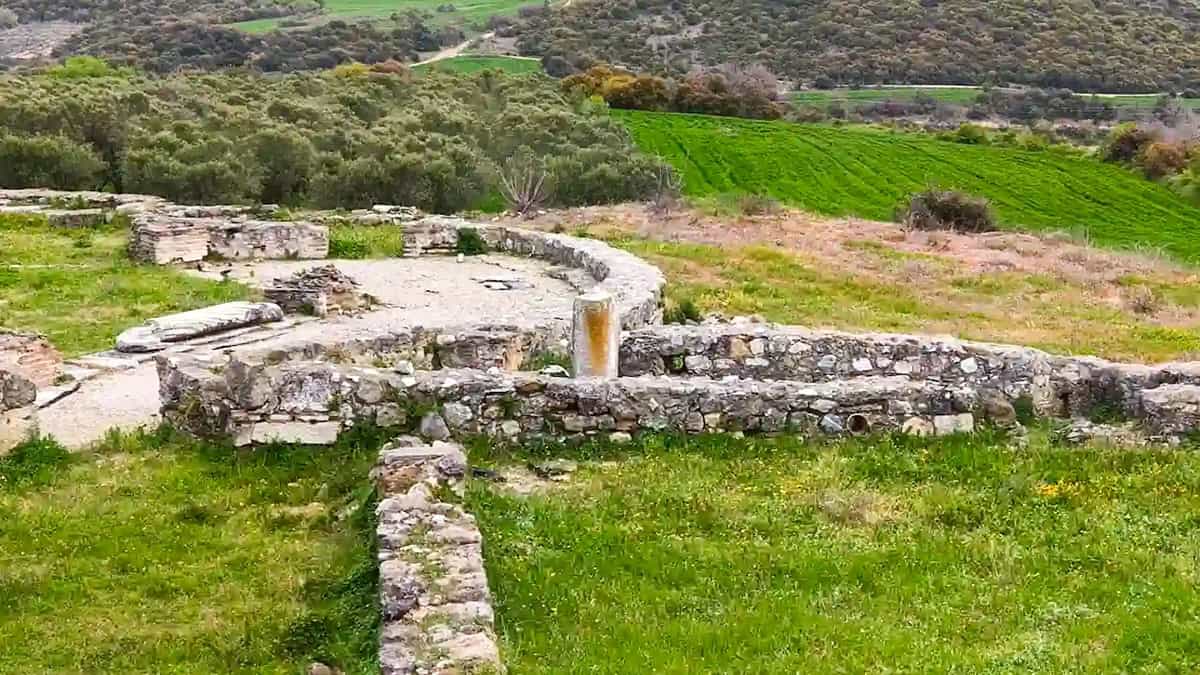
Amphipolis is usually remembered through the language of power and mystery. A strategic city near the Strymon River. A place tied to ancient Macedonia, the mines of Mount Pangaion, the Lion of Amphipolis, and, more recently, the Kasta Tomb.
The Kasta Tomb, uncovered in 2014, drew international attention because of its scale, sculptural decoration, and possible connection to the world that followed Alexander the Great. But Amphipolis was never only a place of monuments.
That attention has not faded. Greece’s Culture Ministry now expects the Kasta Tomb to open to visitors in early 2028, as restoration, conservation, and visitor facilities continue at the site.
The timing makes the contrast even sharper: while the tomb is being prepared for visitors, another kind of Amphipolis is coming into focus through the study of water, infrastructure, and the everyday systems that kept the city alive.
Cities do not live by monuments alone.
They live through roads, fields, workshops, defenses, and, above all, water. That quieter layer of Amphipolis is now at the center of a Spanish-led archaeological project that is mapping and studying the hydraulic system that supplied the ancient city for more than a thousand years.
The project, known as EAA/MYA, from Estudio de los Acueductos de Anfípolis and Μελέτη των Υδραγωγείων της Αμφίπολης, is led on the Spanish side by archaeologists Javier Martínez and Elena Sánchez of the University of Granada, in cooperation with Greece’s Ministry of Culture through the Ephorate of Antiquities of Serres. Its fourth field campaign was completed in April, after work carried out from March 27 to April 6, 2026.
The fourth campaign also included researchers and students from the University of Granada, with collaborators from the University of Salamanca and Aristotle University of Thessaloniki, giving the project a broader academic character beyond a single institution.
The aim is not simply to identify an ancient aqueduct. It is to reconstruct how water moved through a landscape and how that system changed as Amphipolis passed through different historical periods.
The University of Granada says researchers have identified three major construction phases in the hydraulic network: Classical, Roman, and Byzantine. That sequence allows them to reconstruct a water-supply system used across more than a millennium of the city’s history.
That is the real importance of the work. The system was not a single technical achievement frozen in one period. It was infrastructure that was adapted, repaired, expanded, and reused as the city and its surrounding countryside changed.
Amphipolis was founded as an Athenian colony in the fifth century BC, in a landscape of enormous strategic and economic value. The nearby Pangaion massif was associated with timber, metals, routes, and water. Earlier research had already pointed to the existence of conduits bringing water from the mountain toward the city, but the current project is carrying out the kind of systematic topographic and cartographic documentation needed to understand the network in detail.
The Spanish team’s work follows the path of the water from the slopes of Pangaion toward the urban center. The project has documented hydraulic conduits and related structures, while also helping researchers understand the rural landscape through which the system passed.
The Classical phase appears to belong to the earliest period of the city, when ceramic pipes formed part of the water system. In the Roman period, the infrastructure was reorganized and strengthened, with built conduits of greater capacity replacing or supplementing earlier elements.
In the Byzantine phase, the network continued to be repaired and adapted, showing that water management remained central to the life of the settlement long after its Classical foundation.
The contrast is revealing. The Kasta Tomb and the Lion of Amphipolis are visible, symbolic, and dramatic. A water system is quieter, but it tells us something more intimate: how a city endured.
Water reveals planning, labor, and the relationship between a city and its countryside. It shows how practical systems outlast political change.
The work around the aqueduct has also opened a wider view of the region. Surveying along the route of the hydraulic network has documented archaeological sites from several periods, including Classical-era farms, Iron Age settlements, middle-Byzantine fortifications, and defensive structures connected with the First World War.
That should not be read as one uninterrupted settlement in the same form from the Iron Age to the modern era. The better reading is more careful: the landscape around Amphipolis shows repeated human use, settlement, defense, cultivation, and strategic importance across many periods.
In that sense, the aqueduct becomes a guide through time. By following the infrastructure that carried water, archaeologists are also tracing the human geography of the wider Amphipolis region.
The first phase of the EAA/MYA project is planned to run through 2027, giving the team time to complete the mapping of the main sections of the hydraulic network and continue studying related sites along its route. Some reports have also pointed to the possibility of a second phase that could extend the work to 2032, though that should be understood as a possible continuation rather than a completed timetable.
The project also has a wider meaning for Spanish scholarship in Greece. Spanish classical studies organizations have long argued for a permanent Hellenic studies school or center in Athens, similar to the foreign archaeological schools maintained by other countries.
The Amphipolis project does not create that institution, but it gives the argument a concrete example: Spanish researchers working in Greece through official collaboration with Greek archaeological authorities, on a project designed to continue beyond a single campaign.
Amphipolis is often approached through kings, tombs, armies, and symbols. The water system brings the story closer to the ground.
A monument can tell us how a society wanted to be remembered. A water system tells us how it lived.