

On this day in 1913, the Hellenic Navy won the battle that shaped the modern map of the Aegean. The Battle of Lemnos, fought on January 5 according to the Julian calendar and January 18 by today’s reckoning, ended the Ottoman Empire’s attempt to break the Greek blockade at the Dardanelles. After this battle, the Ottoman fleet stayed inside the straits for the rest of the First Balkan War. Greek control of the Aegean was secure.
Why the Aegean Mattered
The First Balkan War was still intense on land, but at sea, the stakes were just as high. If the Ottoman fleet could move freely, it could shift troops from Asia Minor to Europe. If the Greek fleet held the Aegean, the Ottoman armies would have to fight without reinforcements.
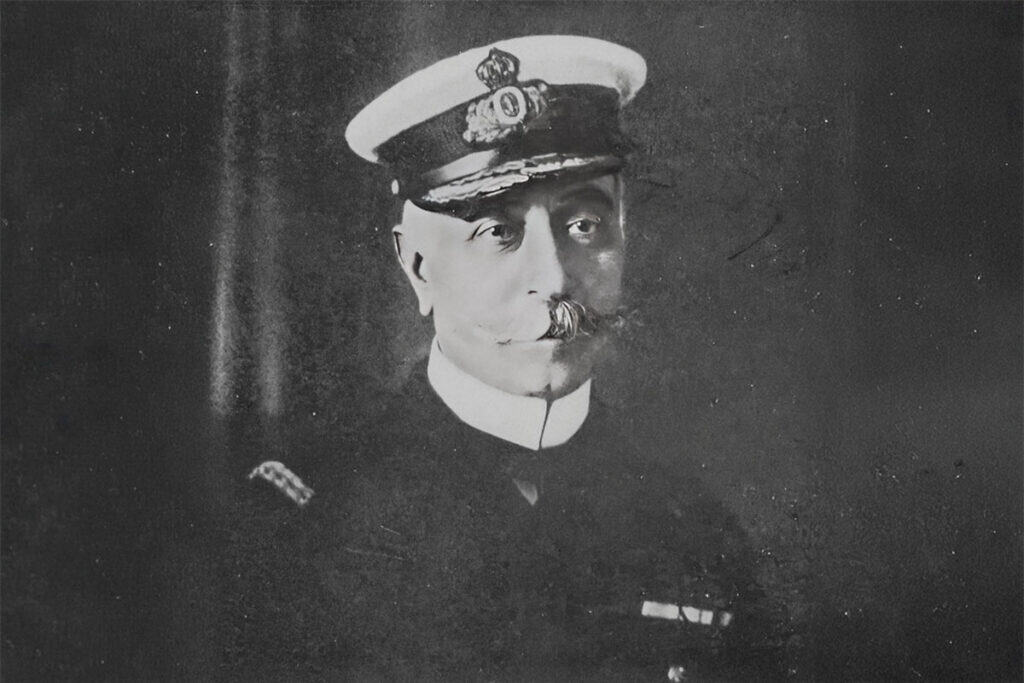
Just a month earlier at the Battle of Elli, Kountouriotis had used the Averof’s speed to break the Ottoman formation and force the entire enemy fleet back into the Dardanelles. That victory set the conditions for what happened at Lemnos and made clear that the Ottomans would attempt a second breakout.
Greece had captured Lemnos in October 1912 and turned Moudros Bay into a forward naval base facing the Dardanelles. From there, the Greek fleet could see every Ottoman movement. The Ottomans wanted another chance. They also wanted their Aegean islands back. For that, they needed to lure the Greeks away from the straits and disrupt their blockade.
The Ottoman Feint
In mid January the Ottomans tried a different approach. The cruiser Hamidiye slipped out of the Dardanelles at night, raided Greek positions and sank a transport at Syros. The attack created public pressure and Athens ordered Kountouriotis to take the Averof and pursue the raider.
He refused.
From the deck of the Averof he understood the real danger. If he chased Hamidiye the main Ottoman squadron could exit the straits and attempt to overwhelm the smaller Greek ships at Moudros. Kountouriotis recognized the raid as bait and held his fleet together, boilers hot, ready for the move he believed the Ottomans truly intended. That decision shaped everything that happened next.
Early on the morning of January 5, Greek patrol destroyers spotted the Ottoman battleships leaving the Dardanelles. Kountouriotis ordered the fleet to sail at 9:45. Soon, the two sides were steaming toward each other southeast of Lemnos.
The Battle off Lemnos
The Greek formation centered on the armored cruiser Georgios Averof, supported by the older battleships Spetsai, Hydra, and Psara, with destroyers screening the line. Approaching them were the Ottoman battleships Barbaros Hayreddin and Turgut Reis, the ironclad Mesûdiye, the cruiser Mecidiye, and several destroyers. The Ottomans carried heavier guns, but the Greeks had better accuracy and one modern ship that could outmaneuver the enemy.
At 11:34, the Ottoman ships opened fire from long range. The Greeks returned fire moments later. As the distance closed, Kountouriotis realized his older battleships could not maneuver quickly enough for the formation he needed. He raised the signal for Independent Action, which allowed the Averof to leave the formation and maneuver freely, using her speed to gain a decisive firing position.
The Averof surged ahead and began to cross the Ottoman line, bringing all her guns to bear. She struck the Ottoman flagship Barbaros Hayreddin repeatedly, destroying its central turret and damaging its fire control. Turgut Reis took seventeen hits, including one that opened a leak. Mesûdiye absorbed heavy fire from Hydra and Psara.
Ottoman gunners fired hundreds of shells but scored only two hits on the Averof, injuring one sailor. Greek gunnery was decisive. By midday the Ottoman line was collapsing and Captain Ramiz Bey ordered a retreat back toward the Dardanelles.
Kountouriotis did not let them go easily. The Averof pressed the chase and closed to within roughly 2,850 meters, close enough for the coastal forts at Seddulbahir and Kumkale to join the fight. She kept firing until the Ottoman battleships slipped under the protection of the strait’s guns. Only then did Kountouriotis break off the pursuit and regroup his fleet outside.
Both sides had fired about the same number of shells. The results told the story. The Ottomans suffered more than a hundred casualties across their three main ships. Barbaros Hayreddin alone had over thirty dead. Turgut Reis and Mesûdiye were badly damaged. The Greek fleet suffered one wounded sailor and no serious damage. The Ottoman navy never again attempted a breakout.
Aftermath and Legacy
News of the victory traveled quickly. In Athens, newspapers celebrated the battle as proof that the Aegean was now firmly in Greek hands, and sailors aboard the Averof later recalled the moment the Ottoman line broke as one of the defining memories of the war.
Ten days later, Greece confirmed that the Ottoman fleet remained trapped. On January 24, 1913, First Lieutenant Michael Moutoussis and Ensign Aristeidis Moraitinis flew a Maurice Farman hydroplane over the Dardanelles, mapped the positions of the Ottoman ships, and dropped four small bombs before mechanical trouble forced them to land at sea. A Greek destroyer rescued them. Their mission is considered the first naval aviation operation in history.
The Battle of Lemnos locked the Ottoman fleet inside the Dardanelles and gave Greece full control of the Aegean. It secured the liberation of the remaining islands and denied the Ottoman army the reinforcements it needed. Allied commanders later acknowledged that Greek naval dominance was a decisive factor in the outcome of the First Balkan War.
The victory also defined Admiral Kountouriotis as one of Greece’s great naval leaders. His refusal to chase a diversion and his bold maneuver with the Averof changed the course of the conflict.
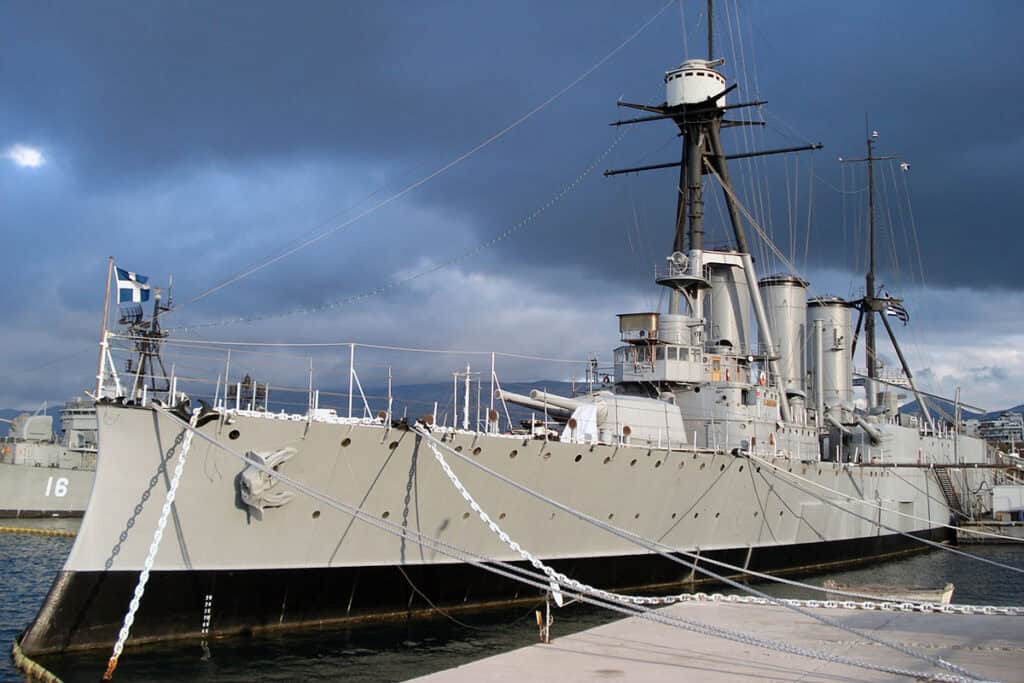
Today, the Georgios Averof survives as a museum ship in Paleo Faliro. Visitors can walk her decks, stand beneath the heavy guns that fired at Lemnos, and see the ship that secured the Aegean more than a century ago.