
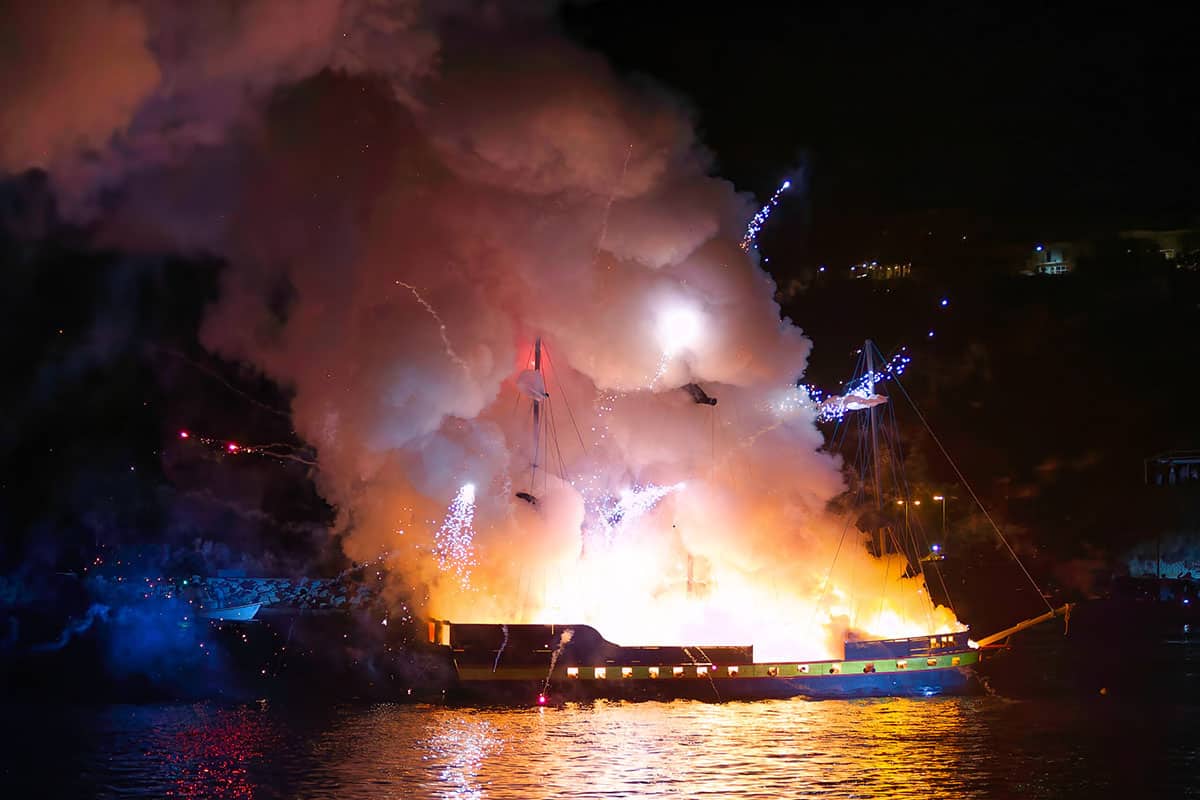
On October 20, 1827, the waters of Navarino Bay on the western coast of the Peloponnese turned into thunder and smoke. Within a few hours, the allied fleets of Britain, France, and Russia had destroyed the Ottoman-Egyptian armada. It was not only a naval triumph but a turning point in the Greek struggle for independence.
Discover the full story behind the 1827 naval victory in “The Accidental Hero Of Greece: Admiral Codrington And The Battle of Navarino 1827.”
For more than six years, the Greeks had been fighting against overwhelming odds. Villages were burned, cities starved, and Ibrahim Pasha’s army from Egypt had ravaged the Peloponnese. The Great Powers of Europe watched from a distance, torn between sympathy for the Greek cause and fear of destabilizing the Ottoman Empire.
That changed after the fall of Missolonghi in 1826. The destruction of that city and reports of atrocities shocked public opinion across Europe. Governments that had once hesitated now decided to act, as described in Britannica’s account of the battle.
A Sea That Changed History
In the summer of 1827, British Admiral Edward Codrington, French Admiral Henri de Rigny, and Russian Admiral Lodewijk van Heiden were ordered to enforce an armistice between the Greeks and the Ottomans. Their mission was peacekeeping, not war.
Yet when the allied fleet entered Navarino Bay on October 20, the air was heavy with tension. Approximately seventy-eight Ottoman and Egyptian ships lay anchored inside the crescent-shaped bay, armed and ready.
The allies sailed in two lines and dropped anchor within the Ottoman formation, hoping to persuade Ibrahim Pasha to withdraw. Then, through confusion or accident, a single shot was fired. Within moments, the calm harbor erupted into a close-range firefight.
Ships locked hulls. Cannon smoke rolled across the bay. Codrington’s flagship, HMS Asia, an 84-gun ship of the line, was hit repeatedly but stayed in action, its crew firing broadside after broadside at the Egyptian frigates.
A chain of explosions followed as the Ottoman powder magazines caught fire. By nightfall, the allied fleets were battered but afloat. The Ottoman-Egyptian navy was gone, with approximately sixty ships destroyed or left burning. Allied losses numbered 181 killed and 480 wounded, while the Ottoman-Egyptian side suffered between 3,000 and 4,000 casualties.
Navarino became the last great naval battle fought entirely by sailing ships.
From Bay to Nation
The outcome of the battle reshaped the Greek War of Independence. With no fleet to support his campaign, Ibrahim Pasha was forced to withdraw from the Peloponnese, and Ottoman control of the Aegean began to collapse.
Two years later, the Treaty of Adrianople confirmed Greek autonomy, and the London Protocol of 1830 formally recognized Greece as an independent state. A later London Conference in 1832 defined the new nation’s borders and established the monarchy under King Otto of Bavaria.
Even in Britain, where the government initially worried about the consequences of the battle, the public rejoiced. Paintings, poems, and songs celebrated the victory. Naval officers were decorated. In Greece, Navarino became a symbol of justice and divine favor, a moment when the wind and the sea themselves seemed to side with freedom.
The Memory Lives in Pylos
Nearly two centuries later, the town of Pylos still keeps the memory of Navarino alive. Three Admirals Square stands at the heart of town, with statues of Codrington, de Rigny, and van Heiden looking out toward the bay where they fought.
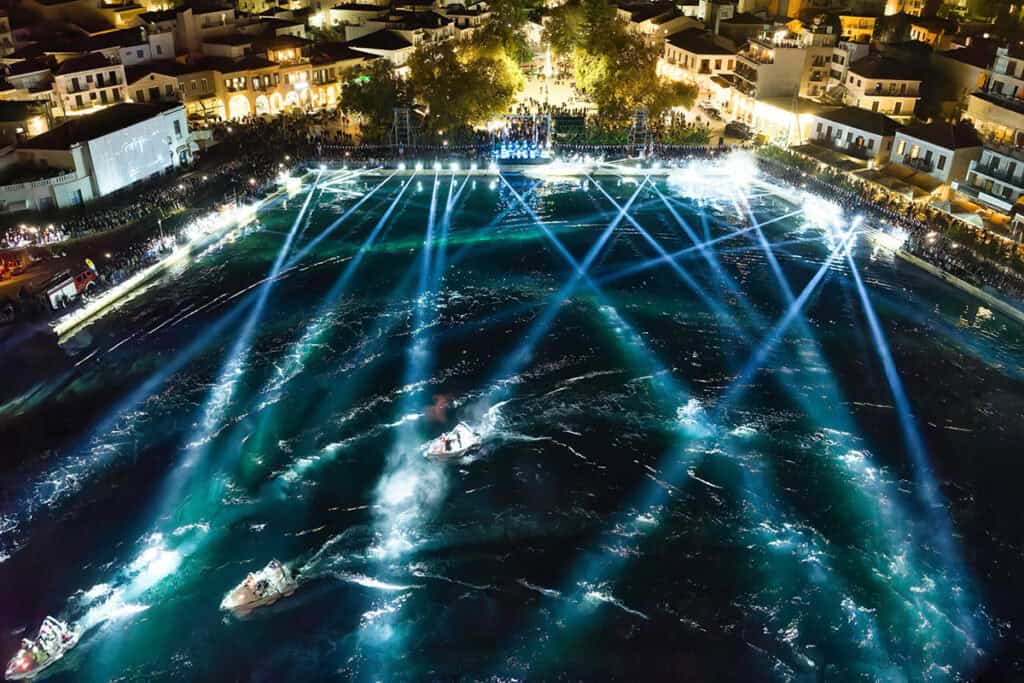
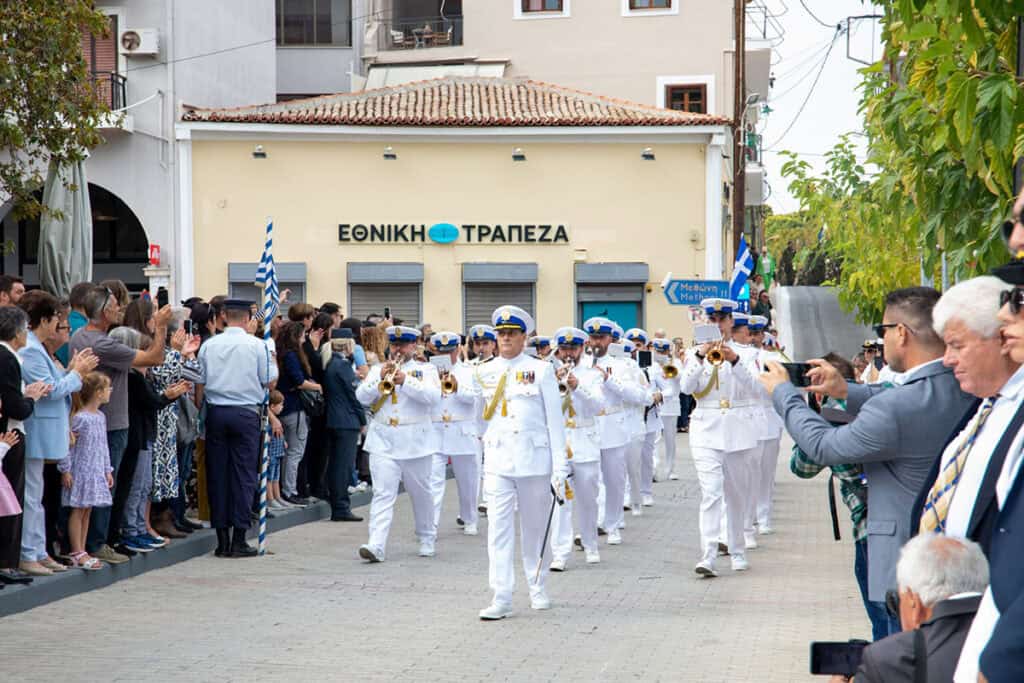
Each October, the square fills with flags, music, and delegations from Greece, Britain, France, and Russia. Wreaths are laid, and the air carries a mix of ceremony and celebration. The annual Navarinia events last several days, bringing exhibitions, concerts, and parades to the town, and culminate today, October 20, with the official commemoration and evening reenactment in Navarino Bay.
The ceremonies begin in the morning with the raising of flags and the doxology at the Church of the Dormition of the Theotokos, followed by a parade along the waterfront. At 8:00 p.m., the focus turns to the bay, where the spectacular reenactment of the 1827 battle takes place, complete with traditional boats, light, and fireworks.
More details are available on the Municipality of Pylos–Nestor website, Pylos Online, and Costa Navarino’s feature on Navarinia.
Echoes Across the Sea
The Battle of Navarino was more than a clash of fleets. It was a moment that changed the fate of Greece and influenced the balance of power in Europe. What began as a tense standoff in a quiet bay ended with a victory that opened the way for Greek independence.
If you want the bigger picture behind these events, Alexander Billinis explains it in Another Lesson from 1821.
Today, Navarino stands as a reminder of what can happen when nations act together to defend what is right. The anniversary brings people from across Greece and abroad to Pylos, where history is remembered through ceremony, music, and the annual reenactment of the battle.
Almost two hundred years later, the Battle of Navarino remains one of the defining moments in modern Greek history and a lasting symbol of cooperation between nations.
Featured image: The dramatic reenactment of the 1827 Battle of Navarino, captured during the 2024 Navarinia celebrations in Pylos. Photo courtesy of the Municipality of Pylos–Nestor.