
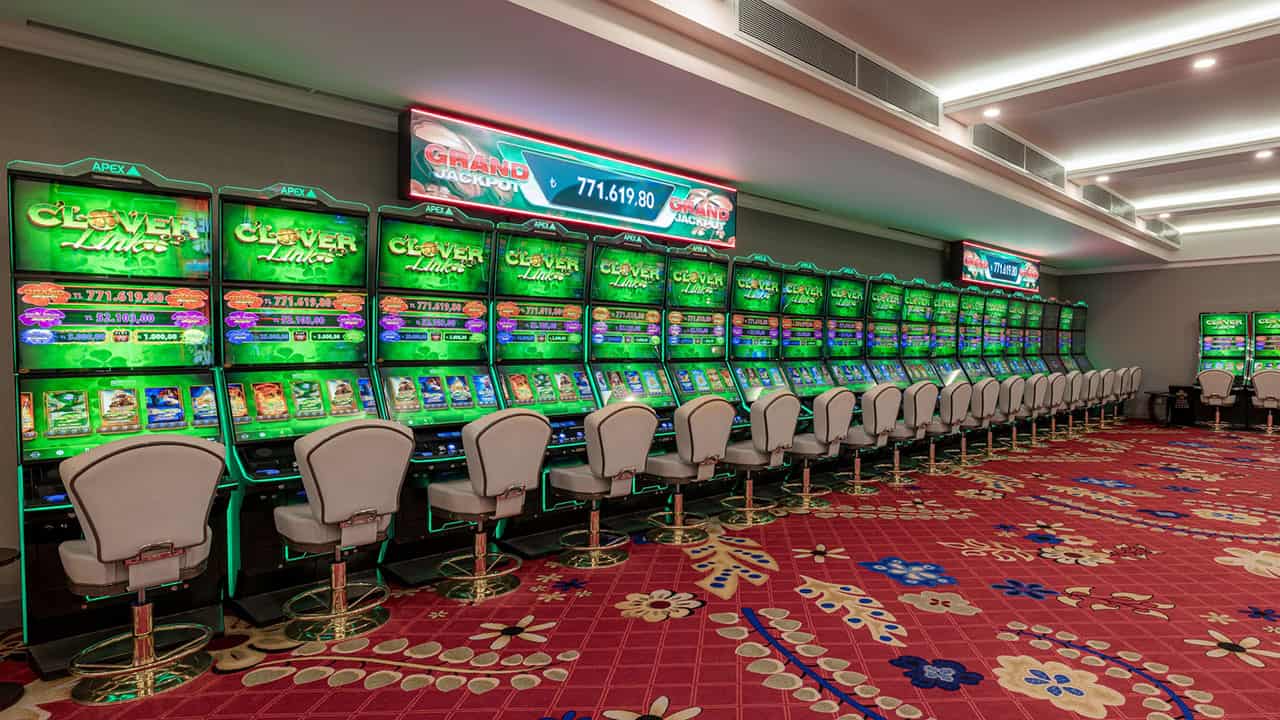
News from Cyprus always reaches us in the diaspora with more weight than a headline alone. It is never just about policies or statistics. It stirs memories of family stories, summers on the island, and the question of whether reunification will ever be more than a hope. That is why the news that the Turkish-occupied north plans to expand its casinos struck such a chord.
The National Herald recently covered this development, drawing on reporting from the Financial Times. In June, the authorities installed after the 1974 Turkish invasion pushed through a law that will allow the number of casinos in the occupied territory to double from thirty-two to sixty-four.
What deserves equal attention are the voices inside the north that opposed the decision. The debate stretched through the night in the assembly, with members of the Republican Turkish Party calling the law a betrayal of society. They warned that casinos will now be permitted within a hundred meters of schools and pointed out that the ban, once meant to keep locals from gambling, has been reduced to a fifty-euro fine.
Economists added their own alarms. Mertkan Hamit, who works with the World Bank, said plainly: “We have openly introduced the crime economy into our system.” Others noted that since the pandemic, elements from the darker side of finance have taken hold, and doubling the casino sector only deepens that dependence.
Officials of the occupation administration defended the expansion by promising oversight and jobs. They spoke of cooperation with Turkey’s financial crime agency and predicted tens of thousands of new positions. Olgun Amcaoğlu, responsible for economic matters under the regime, claimed on television that thirty-two new licenses would mean twenty-eight thousand new jobs. The figure was never substantiated, and the gambling tax system has shifted repeatedly, leaving little clarity about what the authorities actually collect.
The casino industry in the north is dominated by Turkish business interests. The largest operator is Merit Casinos, run by Net Holding of Turkey, alongside Kaya Artemis of Kaya Holding and Cratos Premium, built by Boz Group. These enterprises take advantage of the gambling ban inside Turkey, using the occupied territory as an extension. Unlike the south, where Hong Kong’s Melco Resorts built the City of Dreams Mediterranean under EU oversight, the north attracts no global players. Ownership runs almost entirely through Turkey, or Turkish-Cypriot capital, with little transparency.
That absence of international accountability is exactly what worries watchdogs. The U.S. State Department’s 2025 International Narcotics Control Strategy Report found that money laundering in the occupied north is concentrated in casinos, real estate, and unregulated cryptocurrency exchanges. It noted 34 active casinos by late 2024, a weak and outdated legal framework, and a financial intelligence unit isolated from international cooperation. Its conclusion was blunt: the casino sector is poorly regulated and highly vulnerable to laundering.
Kyrenia has become the hub of this mini–Las Vegas, hosting more than a dozen casinos along its waterfront. Smaller operations extend into Bafra, Famagusta, and Nicosia, but Kyrenia is where the industry is concentrated. For critics, this concentration ties the local economy more tightly to Turkish operators and pushes the occupied territory further into dependency on tourism and gambling.
Beyond Cyprus, the response has been quiet. The European Union cannot intervene directly, since its laws are suspended in the occupied north. That gap leaves casinos operating with minimal oversight, in stark contrast to the strict rules enforced within EU territory. The Organized Crime and Corruption Reporting Project reported that the new law removes the cap on casino licenses, allows casinos into city centers, including just 100 meters from schools, and scales down penalties so much that it “turns the territory into a gambling hotspot amid lax oversight,” raising serious concerns about money laundering.
These warnings matter, but they are not the whole story. For us in America who carry Cyprus in our hearts, the casino debate is not just about economics or regulations. It is about the direction of an island that remains divided. Every move that ties the occupied north more closely to gambling and shadow finance pushes reconciliation further out of reach. It turns Cyprus into a place where one side looks across the divide and sees not a partner but an economy built on vice.
Casinos may keep the lights on, but they also carry a cost that is harder to measure. They lock an economy into habits that are difficult to undo, and they cloud the hope of reunification.
Cyprus deserves more than to have its future wagered away in this way. It deserves stability, dignity, and the chance for both communities to imagine a shared tomorrow.
Featured image: Merit Crystal Cove Hotel & Casino in the occupied north, one of the largest Turkish-owned casino operators in Kyrenia. Photo: Facebook.