
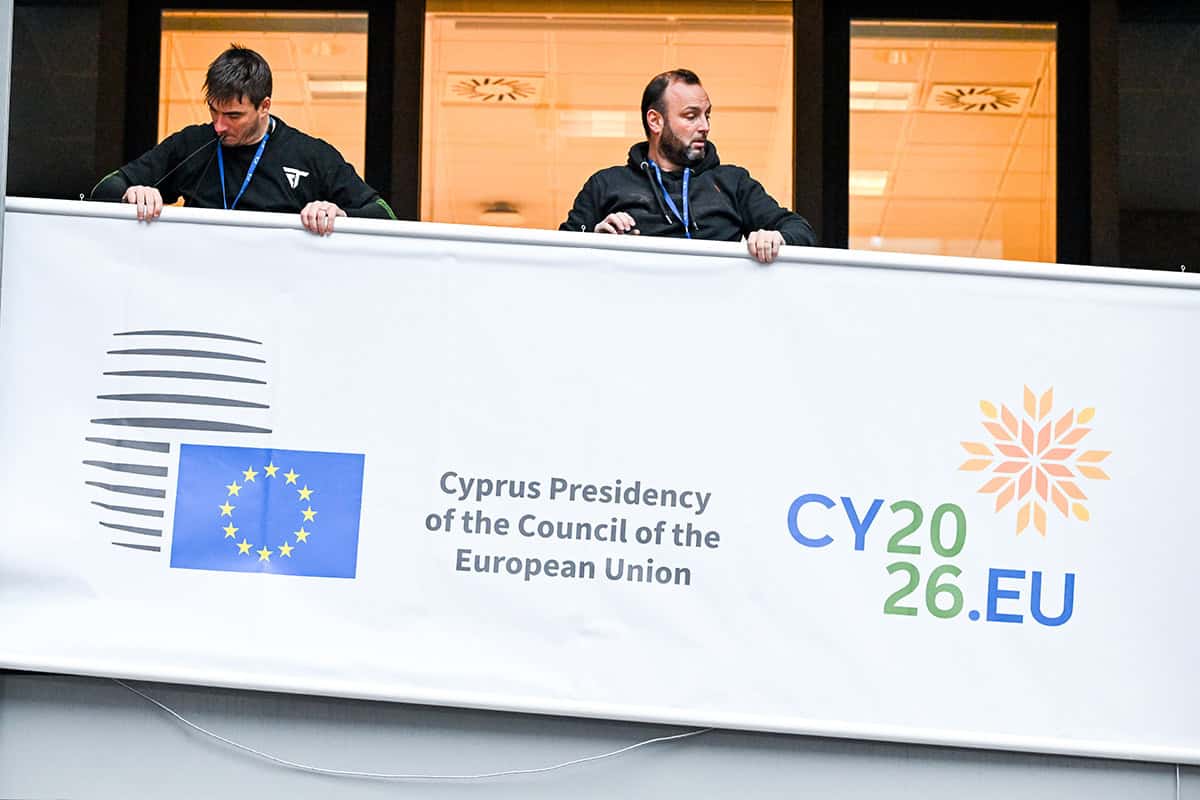
Now that Cyprus has assumed the rotating presidency of the Council of the European Union, expectations tend to outpace reality. The moment is often framed as leadership and influence. For a small, Greek-speaking island that has lived with division for more than half a century, the symbolism is undeniable. The power, however, is narrower and more procedural than the headlines suggest.
That distinction matters. It explains why the presidency can feel historic without being transformative, especially to Greeks abroad who know how often visibility and authority are confused.
A moment heavy with symbolism
For six months, Cyprus sits at the center of the EU’s day-to-day machinery. Cypriot ministers chair Council meetings. Cypriot diplomats broker compromises. Nicosia hosts delegations and informal gatherings that briefly place the island at the heart of European decision-making.
For a country of roughly one million people, divided since 1974 and internationally recognized only in its southern, EU-governed part, this visibility carries weight. It signals continuity and belonging. Cyprus is not a peripheral observer of Europe, but an active participant in its institutional life.
There is also a historical echo. Cyprus last held the presidency in 2012, during a period of acute financial strain. Banks were under severe pressure, public debt was rising sharply, from about 74 percent of GDP at the start of the presidency to roughly 84 percent by the end of the year, and the government was negotiating a bailout that would be finalized a few months after the presidency ended. That Cyprus managed to carry out the role at all, under those conditions, became a quiet test of whether it could still meet its European obligations.
That presidency is remembered for something else as well. Amid the eurozone crisis, Cyprus helped coordinate early discussions around banking supervision and financial integration, contributing to momentum that later became the EU’s banking union. It was not legislative innovation, but agenda management and brokerage, proof that procedure itself can still produce lasting outcomes.
Today, the contrast is stark. Public finances are steadier, growth has returned, and Cyprus presents itself as a regional connector between Europe, the Eastern Mediterranean, and the Middle East. The presidency becomes a way of saying: we recovered, we remained credible, and we are trusted again with responsibility.
For Greek-Americans, the arc is familiar. It mirrors a broader Hellenic story of endurance, recovery, and the slow rebuilding of confidence after crisis.
What the presidency actually allows Cyprus to do
Despite the symbolism, the EU Council presidency is not an executive role. Cyprus does not “run Europe,” and it does not set EU policy on its own.
Setting the pace and the order of discussion
Cyprus helps decide which issues move forward and when. By allocating time on agendas and in working groups, it can keep certain topics alive, especially where agreement already exists but momentum has slowed. In the EU, attention often determines outcomes.
Chairing negotiations and brokering compromise
Presidencies act as intermediaries. They listen, draft compromise language, and try to bridge gaps between member states. This work rarely makes headlines, but it is where many decisions take shape.
Framing regional conversations
Cyprus brings lived experience to discussions on migration, energy security, and Eastern Mediterranean stability. Its geographical position on migration routes, particularly flows from Africa via Libya and from the Middle East, gives it a perspective that more distant member states may lack. That experience allows Cyprus to frame debates around implementation challenges that purely bureaucratic presidencies might overlook.
Turning agreements into action
Migration offers a concrete example. Much of the EU’s framework already exists on paper. Presidencies often succeed by pushing implementation rather than rewriting policy. Cyprus can help coordinate practical steps on asylum procedures, returns, and cooperation with third countries, moving stalled agreements closer to real-world application.
These are incremental tools, not dramatic ones. But in a system built on consensus and process, incremental tools are often the only ones available.
The hard limits Cyprus cannot escape
The presidency cannot solve the Cyprus problem
Holding the EU gavel does not give Cyprus leverage to resolve its division. The role offers no shortcut around international frameworks and no authority to force concessions. Using the presidency to press national grievances would undermine its credibility as an impartial broker.
Cyprus cannot set EU foreign policy on its own
Major foreign policy decisions require broad consensus, often unanimity. The EU’s strategic direction is shaped primarily by the European Council and the largest member states. Cyprus can influence tone and discussion, but not dictate outcomes.
Cyprus cannot force enlargement or strategic autonomy
Ideas like EU enlargement, defense integration, or “strategic autonomy” unfold over years, not months. A six-month presidency can maintain momentum, but it cannot rewrite treaties, budgets, or voting rules. Much of the legislative agenda Cyprus works with was already agreed before it assumed the presidency, as part of the EU’s 18-month program (under the “trio presidency” system, three consecutive presidencies coordinate priorities to ensure continuity).
Visibility does not remove vulnerability
Being at the center of EU meetings does not shield Cyprus from regional instability. The island remains exposed to developments in the Middle East, relations with Turkey, and migration pressures that no presidency can control.
The veto paradox and the Turkey question
One of the most misunderstood sources of Cyprus’ leverage has little to do with the presidency itself: veto power.
Like every EU member state, Cyprus can block decisions in areas that require unanimity, particularly in foreign and security policy. This is ordinary membership power, not presidency power. Yet because of long-standing tensions with Turkey, Cyprus has exercised this leverage more visibly than most.
The presidency neither creates nor removes this veto. What it does create is a test. Cyprus has invited Turkish President Erdoğan to an April summit and signaled cautious openness to discussions around visa facilitation for Turkish business travelers, gestures that balance underlying veto power on defense and cooperation initiatives with an effort to avoid open confrontation.
Decades-old disputes are not resolved through procedural authority. At best, the presidency can create space for conversation without pretending that conversation equals resolution.
When global crises take over
Every presidency begins with priorities. Few end that way.
External crises have a way of overwhelming carefully planned agendas. In Cyprus’ previous presidency, the eurozone crisis dominated everything. Today, the backdrop is no less heavy: the war in Ukraine, instability in the Middle East, geopolitical competition, and persistent migration pressures.
In such moments, the presidency becomes reactive rather than strategic. Its role is to coordinate, to keep the machinery moving, and to help implement decisions taken elsewhere. Cyprus’ emphasis on humanitarian coordination and continuity reflects this reality. It is stewardship, not command.
Why symbolism counts, even without power
If the powers are so limited, why does the presidency matter at all?
Because presence matters. Being seen operating competently at the center of Europe carries meaning that cannot be measured in legislative output. It reinforces Cyprus’ place in the European system and demonstrates that small states can manage responsibility with professionalism and restraint.
For Greek-Americans, this resonates on a deeper level. Influence is not always about setting the agenda. Often, it is about consistency, credibility, and knowing the limits of power. The diaspora experience has long been shaped by those same lessons.
Cyprus’ presidency will not transform Europe. It will not resolve the island’s division or redraw the region’s geopolitical map. What it can do is quieter and more durable. It can show that Cyprus belongs at the table, understands the system it operates in, and knows how to work within it without illusion.
In a European Union built on process rather than spectacle, that may be the most honest measure of success.