
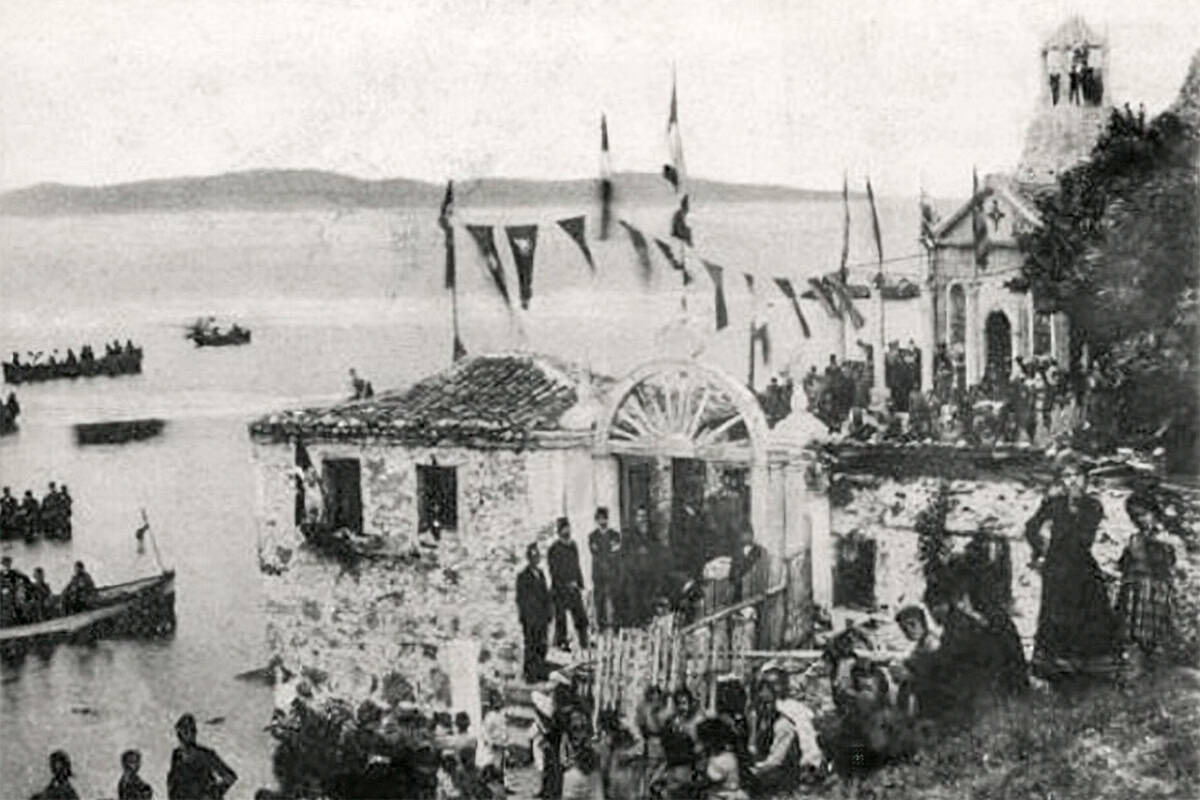
In one town near the Sea of Marmara, Easter meant sending food across religious lines, not as a gesture but as an obligation.
The memory comes from Angelis Mavridis, who grew up in Sarikioi, near Panormos, today’s Bandırma, in northwestern Asia Minor. By the time his testimony was recorded decades later, the world he describes no longer existed. His account is preserved in the Archive of Oral Tradition of the Center for Asia Minor Studies, described as the largest and oldest oral history collection in Greece and among the most important in Europe. The testimony is published by pontosnews.gr.
For centuries, Asia Minor was home to Greek-speaking Christian communities living alongside Muslim Turks, Armenians, and others under Ottoman rule. These were not uniform conditions, and relationships varied from place to place, but in many towns, daily life developed through proximity, habit, and local expectations.
That world began to come under increasing pressure in the early twentieth century, as the Ottoman Empire weakened and a series of wars reshaped the region. During the First World War and its aftermath, violence, forced labor, deportations, and, ultimately, the compulsory population exchange between Greece and Turkey led to the removal of these communities from the places where they had lived for generations.
Mavridis grew up before that rupture, in a town where the older patterns still held.
“When Easter came,” he recalled, “every Christian had a Turkish friend, a saïntits, that is, like a godfather. To him, we had to send eggs and tsoureki.” The word matters. Saïntits was not casual. It described a recognized social bond, something closer to obligation than choice, and the exchange followed from that bond. It was expected, not negotiated. Turks, he said, waited for it and treated the Easter offerings as something special, sending sweets in return during their own religious holidays.
Mavridis presents these interactions as part of everyday life. At the Resurrection service on Easter night, gunshots marked the celebration. If the gendarme intervened, the moment could end informally. Someone caught firing might hand over an egg and be told to move along. Local Turks, he said, showed respect for Christian practices. They honored the priest, and some passed beneath the Epitaphios, the Good Friday bier carried in procession. The Virgin Mary was known as Meryem Ana, a name also used in Muslim tradition.
Social expectations extended into daily life as well. If you were invited to a meal, you were expected to eat, even a little. Refusing was taken as an insult, regardless of whether the table was Christian or Muslim.
In the wider area, Panormos itself was a mixed town before 1922, with Greek, Turkish, and Armenian populations living side by side, though Mavridis’ account focuses mainly on relations between Greeks and Turks.
Mavridis is clear about where that world began to change. “Until the Hürriyet,” he said, referring to the constitutional period beginning in 1908, “we lived very well.” Even as tensions grew, he recalled that they did not experience serious harm at first, including during the Balkan Wars.
“From the Seferberlik onward, the bad things began,” he said, referring to the general mobilization that accompanied the Ottoman entry into the First World War.
During that period, Greeks were also conscripted, not into regular combat units but into labor formations, from which few returned. “Whoever survived then, survived,” he said, noting that most of those who were taken did not return. Hunger followed, and as a small child, he was forced to work in the fields for bread.
Fear became part of daily life. He recalled nights when families left their homes and slept elsewhere, sometimes in Turkish houses they knew, sometimes in places like the basement of a school, as rumors spread about possible attacks.
Even then, the situation was not uniform. In some cases, local authorities did not allow violence to take place. When the Greek army later entered the area, he noted that no harm was done to the Turkish population.
But as conditions worsened and armed groups passed through the region, the sense of stability broke down. In nearby communities, people fled or were attacked, and uncertainty spread from place to place.
Today, Bandırma is a modern port city. The communities described in his account are no longer there. What remains is the record, not as a model or a lesson, but as a description of how people lived in a specific place under specific conditions before those conditions changed.
Read the full testimony:
https://www.pontosnews.gr/837210/pontos/genoktonia/martyria-aggeli-mayridi-zoysame-poly-adelfika-me-toys-toyrkoys-apo/