

In July 2025, off the coast of Epanomi near Thessaloniki, the water looked peaceful. Tourists walked the long Ammoglossa sandbar, the strip of land that makes this beach famous. The sea is shallow on top of it, only to drop sharply just a few steps to either side. It is beautiful, but every year rescuers warn visitors that what looks calm can become dangerous in minutes.
On a windy day in early July, a Hungarian father and his 10-year-old daughter stepped off the sandbar, unaware that the bottom vanished beneath them. In seconds the current caught them, pulled them past the shallow zone and began carrying them farther from the beach.
Farther out, 21-year-old kite surfer Anastasios (“Anastasis”) Garipis was training with friends. The water was rough and the wind strong, the kind of conditions that push athletes to test their limits.
Then he saw two small heads where no heads should be.
The landscape of danger
To understand the rescue, it helps to know Epanomi.
The beach sits at a meeting point of shallow sand formations, a river mouth with unpredictable outflows and fast-moving currents. The Thermaic Gulf itself is known for strong lateral currents that can pull swimmers sideways and then outward with little warning. Local rescuers say that in recent years they have seen a steady increase in incidents.
One rescue leader put it simply.
“Almost every day, someone is pulled out.“
Garipis and his training partners knew the risks well. That day, the winds pushed them closer to the river mouth, a place where the surface looks calmer but hides sudden drops and undertows.
It was from there that Anastasis noticed something strange. Two faint shapes drifting in open water.
Running toward danger
Some stories involve hesitation. This one does not.
Anastasis later described the moment.
“I saw two heads in the middle of nowhere, and I went.”
When he reached the father and daughter, they were exhausted, panicked and struggling to stay above the surface. He pushed his kite board toward them so they could stay afloat and tried to steady them in the chop.
The water was cold. Anastasis wore a wetsuit and they wore only swimsuits. Even he began to go numb after a while. But he stayed with them, keeping them calm as the current carried all three farther out.
He did not know their names or their story. He saw fear, exhaustion and helplessness in their faces, and compassion moved him before thought could. What he did next came from a place where instinct and empathy meet.
Forty-five minutes in the open sea
For twenty to thirty minutes, Anastasis stayed alone with the father and daughter.
Then Iset Segura, an international wing-foiling champion from Spain who had also been training that day, reached the group after noticing the distress. Together, they held the pair afloat for roughly forty-five minutes. The current was too strong to fight. All they could do was hold on and wait for help.
As Segura later told the Hungarian outlet Telex,
“The current was so strong it was nearly impossible to swim.”
A small vessel from a local hunting association, operated by a member named Christos Alexakis and alerted by the Greek Coast Guard, was the first motorized craft to reach them. With the help of Coast Guard officers, emergency medics and police, the family was brought safely back to shore.
The moment the world saw it
The rescue was captured on a head-mounted camera worn during training, showing the moment the father and daughter were located in the open water and later approached by the rescue boat. The footage was posted online by Anastasis’ father, Stelios Garipis, and quickly spread across Greek and Hungarian media, where it was shared by news outlets and water safety organizations.
It became one of the most widely viewed rescue videos of the summer.
A dangerous season
Just one month later, in almost the same location, a Romanian father and his two children, ages 13 and 15, were swept away by the same current. A winter swimmer named Evangelos Papaioannou reached them on a stand-up paddleboard and brought all three to safety.
Local volunteer groups have repeatedly warned that the combination of strong currents, sand formations and rising visitor numbers makes Epanomi one of the most deceptive beaches in the region.
The common thread in these high-profile rescues is that they were initiated by experienced civilians who acted immediately.
From Epanomi to Budapest
Months passed. Life returned to its routine. Then an unexpected invitation arrived.
In early November 2025, Hungarian President Tamás Sulyok held a formal ceremony at the Presidential Palace in Budapest to honor the two athletes. Greek and Spanish diplomats were present, and the rescued family attended as well.
There, he awarded Anastasios Garipis and Iset Segura the Gold Medal of Honor, Hungary’s highest state distinction. It was the first time in Hungarian history that the medal was awarded to foreign citizens.
The ceremony lasted three hours and opened with the Greek national anthem. It was solemn, emotional and symbolic, the kind of ceremony that signals more than gratitude. It signaled recognition of a shared European value.
President Sulyok called the rescue a wonderful example of humanity, heroism and selflessness. He said the two young athletes showed what real humanity means and described their actions as a message of hope and solidarity for the Europe of the future.
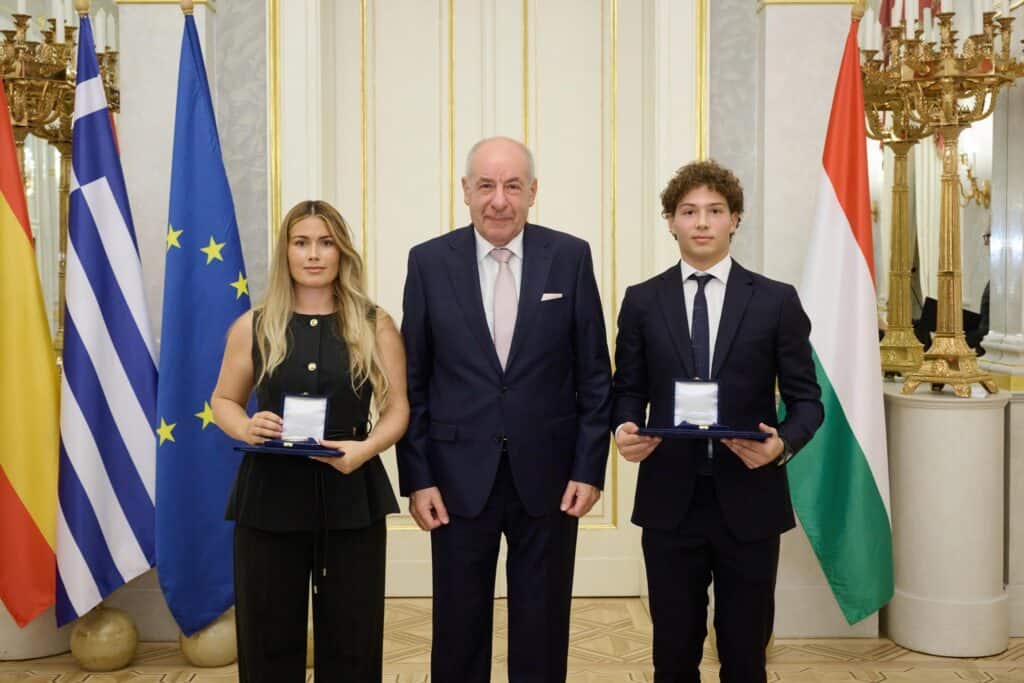
“Freedom is made of responsibility”
When Anastasis stepped to the podium, he spoke quietly.
He said he never imagined he would stand before a president for doing what human nature dictates, helping two people in need.
He spoke about growing up in the sea and learning to respect it. Then he added a line many people would later quote.
“The sea taught me that freedom is made of responsibility. The responsibility to get everyone to shore.“
Beside him, Iset said that anyone would have done the same, that there is always a moment when our humanity reveals itself.
Their words matched the video. Calm, matter of fact, deeply human.
Compassion and civil courage
There is a name for what happened that day. Civil courage. But civil courage does not rise on its own. It grows out of compassion, the quiet belief that another person’s fear matters as much as your own comfort.
Anastasis did not know the family. He did not know if anyone else had seen them. He did not know how long he could withstand the cold or whether help would arrive in time.
He simply went because compassion pushed him forward and civil courage carried him the rest of the way.
There is nothing more human, and nothing more heroic, than that.