
Greece has joined nine other European Union countries in asking Brussels to reconsider ETS2, a carbon-pricing system expected to increase the cost of gasoline, diesel and fossil fuels used for heating when it becomes fully operational in 2028.
The group also includes Italy, Poland, Bulgaria, Cyprus, Czechia, Estonia, Hungary, Romania and Slovakia. The countries argue that Europeans should not face another climate-related cost during a period of economic and geopolitical pressure. Reuters reported that, taken together, the ten countries have enough votes in the EU system to block amendments they oppose.
Their intervention has not stopped the system. ETS2 is already established in EU law, and the joint appeal cannot suspend it on its own. Changing its timetable or central rules would require action through the EU legislative process involving the European Commission, EU governments in the Council and the European Parliament.
ETS2 is often described as a “carbon fuel tax,” but that shorthand can be misleading. It is not a fixed tax of several cents per liter set directly by Brussels.
It is the EU’s second and separate emissions-trading system, covering fuels used in buildings, road transportation and certain smaller industries. The original EU Emissions Trading System, often called ETS1, covers power generation, heavy industry, aviation and maritime transport. The two systems have separate allowance markets.
Under ETS2, fuel suppliers will have to buy allowances covering the carbon dioxide released when the fuels they sell are burned. Motorists and homeowners will not purchase those allowances themselves, but they are likely to bear much of the cost through higher prices.
That result is not simply an unwanted side effect. Making fossil fuels more expensive is part of how ETS2 is intended to work.
Climate change is the official reason
ETS2 is first and foremost a climate policy.
The EU created the system because emissions from road transportation, buildings and smaller industries were not declining quickly enough to meet its climate targets. Greenhouse-gas emissions from burning gasoline, diesel, heating oil and natural gas contribute to climate change, even when they come from millions of individual cars, homes and small businesses rather than a limited number of large industrial plants.
ETS2 is intended to help reduce emissions in the sectors it covers by 42% from 2005 levels by 2030. It forms part of the EU’s wider effort to reduce net emissions by at least 55% from 1990 levels by 2030 and reach climate neutrality by 2050, according to the European Commission.
The policy follows a basic economic argument. When the price of a product reflects more of the environmental damage created by using it, consumers and businesses have a reason to use less or choose something cleaner.
For transportation, policymakers expect the carbon price to improve the financial case for more efficient vehicles, electric cars, public transportation and reduced fuel use. For buildings, they expect it to encourage insulation, heat pumps, solar water heaters and alternatives to oil or gas heating.
The higher price is therefore the instrument, not simply the consequence.
War and energy security add urgency
Climate change is the official reason for ETS2, but recent wars have strengthened the energy-security case for reducing fossil-fuel consumption.
Russia’s full-scale invasion of Ukraine in February 2022 and the subsequent disruption of Russian gas supplies helped drive European gas and electricity prices to record levels. The crisis exposed the risks of relying heavily on one foreign supplier and placed severe pressure on households, businesses and national budgets.
The EU responded through REPowerEU, a strategy intended to reduce dependence on Russian fossil fuels while accelerating renewable energy, efficiency improvements and energy savings. European energy prices have fallen from their 2022 peaks, but the experience showed how quickly a foreign-policy crisis can reach household electricity and heating bills.
The wider conflict involving Iran, Israel and the United States has exposed a different vulnerability. Fighting and restrictions around the Strait of Hormuz pushed oil prices to a one-month high in mid-July. Reuters put the share of global oil flows passing through the strait before the latest disruption at roughly one-fifth.
Using less oil and gas could make Europe less exposed to conflicts, blockades and decisions made by foreign governments. The transition, however, will take years. In the meantime, European households can face both geopolitical price shocks and the additional carbon cost intended to reduce that dependence.
Europe has also changed where it buys its energy.
Eurostat data show that in the first quarter of 2026, the United States was the EU’s largest supplier of petroleum oils, with a 17.8% share, narrowly ahead of Norway. The United States also supplied 57.4% of EU liquefied natural gas imports, up from 24% in early 2021.
Norway remained the leading source of pipeline gas, while Russia still supplied 17.3% of EU LNG imports.
The shift has reduced Europe’s previous dependence on Russian pipelines, but it has not ended reliance on imported energy. Part of that dependence has moved toward American exporters, LNG terminals and international shipping routes.
ETS2 is therefore tied to two related goals. The official purpose is to reduce greenhouse-gas emissions and limit climate change. Using less fossil fuel could also reduce Europe’s exposure to wars and concentrated foreign suppliers.
The political difficulty is whether households and businesses receive viable alternatives before the higher cost reaches them.
How will ETS2 work?
The legal obligation will fall upstream, on fuel suppliers rather than individual drivers and households.
Suppliers will monitor the emissions associated with the gasoline, diesel, heating oil, natural gas and other covered fuels they place on the market. They will then surrender one allowance for each metric ton of carbon dioxide represented by those fuel sales.
The allowances will be sold through auctions. Their market price will vary according to supply and demand, while the total number available will decline over time.
Suppliers began monitoring emissions in 2025, with reports covering those emissions due in 2026. Auctions of ETS2 allowances are scheduled to begin in January 2027, ahead of the system becoming fully operational in 2028.
When the Commission released its July 17 proposal to revise the main EU emissions market, it excluded ETS2 from that proposal. The Commission said ETS2 is due for a separate review by 2029.
Electricity used in homes is not directly placed under ETS2 because large electricity producers are already covered by ETS1. The newer system focuses on fossil fuels burned directly in vehicles, homes and other covered activities.
Why will the cost reach consumers?
A fuel supplier that must purchase carbon allowances acquires a new operating cost. The company can absorb part of that expense through a smaller profit margin, reduce other costs or incorporate it into the price charged to customers.
The exact division will depend on competition, demand and market conditions. It would therefore be too absolute to say consumers will always pay every cent.
Substantial pass-through is nevertheless expected. ETS2 is designed to change the relative price of fossil-fuel use. If suppliers absorbed the entire charge and retail prices remained unchanged, motorists and households would receive little financial reason to reduce consumption or invest in alternatives.
A driver may see the cost in the pump price. A household may see it in a heating bill. A transportation company may add part of its higher diesel expense to delivery charges, which can then appear in the prices of food and other goods.
Supporters argue that auction revenue will return to the economy through climate investments and assistance for vulnerable households. Critics respond that higher prices may arrive faster and more reliably than the programs intended to help people avoid them.
How much could ETS2 add to fuel costs?
The increase cannot yet be stated as a fixed amount. It will depend on the market price of ETS2 allowances, the fuel involved, supplier pass-through, taxation and any national relief measures in place.
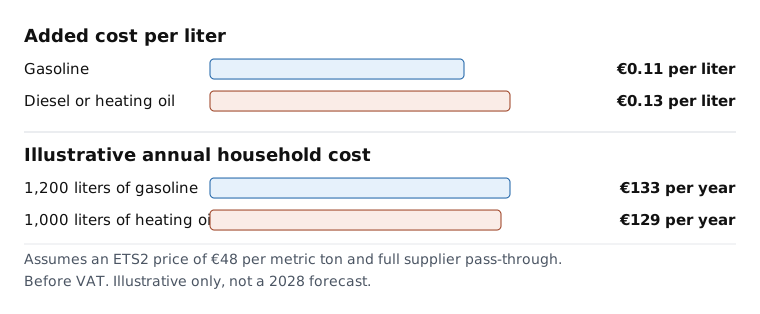
At a carbon price of €48 per metric ton, using standard fuel-emission factors and assuming full supplier pass-through, the carbon component would be approximately 11 cents per liter of gasoline and 13 cents per liter of diesel or heating oil, before VAT.
What does Brussels expect households to do?
ETS2 assumes that higher fossil-fuel prices will influence future decisions.
A household replacing an old car may choose a more efficient or electric model. A homeowner may decide that insulation or a heat pump offers a better long-term return. Businesses may replace delivery vehicles or reduce fuel consumption.
Those responses are easier for people who have savings, access to credit and genuine alternatives.
A worker in rural Greece may have no practical choice but to drive. Residents of islands and smaller towns may have limited public transportation. A renter cannot independently renovate an apartment building, while a landlord may have little financial reason to invest when the tenant pays the energy bill.
A price can encourage someone to choose between available options. It cannot create a bus route, give a tenant control over a building or provide the money required for a renovation.
The carbon price can therefore arrive before the alternative does.
Greece’s housing shortage adds another complication
Beyond fuel prices, Greece’s ability to adapt to ETS2 is constrained by an ageing housing stock and a much wider renovation backlog.
Greece is facing a shortage of affordable housing while a large number of properties remain closed, neglected or unavailable for long-term use.
A Bank of Greece study, citing the 2021 census, referred to approximately 794,000 vacant dwellings. The same study found that 83.5% of Greek homes were more than 25 years old, meaning they predated many modern construction and energy-efficiency standards.
Not all vacant homes are located in areas with strong demand or could be returned to use quickly. Some require extensive repairs or are affected by inheritance, ownership and planning problems.
Returning suitable properties to use could add homes to the long-term market. Renovating them to modern standards could also reduce the energy their future occupants would otherwise need for heating and cooling.
Closed homes generally consume little energy, so the vacant-property problem is not itself caused by ETS2. It does reveal the scale of Greece’s renovation backlog. Programs intended to improve occupied homes will compete for financing, contractors, energy inspectors and administrative capacity with efforts to return neglected properties to the housing market.
Greece already taxes fuel heavily
ETS2 will not automatically replace the fuel taxes EU countries already collect. Unless Athens changes its own tax policy, the carbon cost will be added to the existing price structure.
Greek Finance Ministry rates set the excise duty at €700 per 1,000 liters, or 70 cents per liter, for unleaded gasoline and €410 per 1,000 liters, or 41 cents per liter, for road diesel.
EU minimum excise rates are €359 per 1,000 liters for gasoline and €330 for diesel. Greece therefore has considerably more room to reduce the gasoline duty than the diesel duty.
In most of Greece, fuel is also subject to the standard 24% value-added tax. A reduced standard rate of 17% applies on qualifying Aegean islands.
Because VAT is percentage-based, an ETS2 cost incorporated into the taxable selling price would normally increase the amount of VAT collected as well.
This raises an obvious question. If ETS2 increases fuel prices, why not lower the taxes already imposed and keep the final price relatively stable?
Could Greece lower fuel taxes without hurting the budget?
The government could reduce part of the existing excise duty, but ETS2 does not require it to do so.
A broad tax reduction would provide immediate relief to drivers and households using fossil fuels. It would also help high-income consumers and people who use the most fuel, making it considerably more expensive than targeted assistance.
It would also weaken the price signal ETS2 is intended to create. If Athens removed one cent of excise duty for every cent added by the carbon market, consumers would have less financial reason to conserve fuel or move toward cleaner alternatives.
Leaving the taxes unchanged creates the opposite problem. The new carbon cost would be added to a price that already contains substantial excise duty and VAT, shifting more of the immediate burden to households and businesses.
Governments can instead provide targeted payments, expand heating assistance, accelerate renovation programs, improve public transportation, direct more help to island and remote households or use temporary tax relief while maintaining required climate spending elsewhere.
Each choice distributes the cost differently. Broad tax reductions reach more people but cost more and weaken the carbon-price signal. Targeted programs preserve more of the incentive but can miss eligible households or arrive too late.
There is also a direct fiscal cost.
On a modified cash basis, the Greek state budget recorded €4.36 billion in excise duties on energy products in 2025, along with €2.045 billion in VAT on petroleum products and their derivatives. The categories include more than gasoline and road diesel, but they show the scale of energy-tax revenue, according to the Finance Ministry’s 2025 budget execution report.
A permanent tax reduction would require the government to accept a smaller surplus, reduce spending, raise another tax or find another recurring source of revenue.
In its April 2026 Annual Progress Report, the Finance Ministry projected a primary surplus of 3.2% of gross domestic product and an overall surplus of 0.2% for 2026. It also expected public debt to decline from 146.1% of GDP at the end of 2025 to 136.8% at the end of 2026.
These are official projections rather than completed outcomes. A fuel-tax reduction would not necessarily return Greece to a deficit, but it would narrow the budget’s margin and could slow debt reduction unless the lost revenue were offset elsewhere.
ETS2 auction revenue cannot simply be treated as unrestricted replacement income. EU rules require member states to direct ETS2 revenue, or an equivalent financial amount, toward eligible climate and social measures.
An across-the-board fuel-tax cut would not itself meet that requirement. Greece could still reduce fuel taxes, but it would have to maintain the required climate and social spending elsewhere in its budget.
There is also a longer-term fiscal and external-balance question. If fossil-fuel consumption falls, the state would collect less volume-based excise duty. Fuel-related VAT revenue could also decline, although the result would depend on how retail prices change.
At the same time, lower fossil-fuel use could reduce Greece’s energy-import bill if domestically generated renewable electricity, efficiency improvements and electrification replace imported oil and gas. That could improve the country’s trade balance and reduce its exposure to international energy-price shocks.
The benefit is not automatic. It would depend on what replaces the imported fuel, how much equipment or electricity Greece must import during the transition, changes in international prices, and the effect on the country’s own fuel exports. Any improvement in the trade balance would also not flow directly into the state budget or fully replace lost fuel-tax revenue.
Greece will eventually have to decide how to replace part of the general revenue now collected from gasoline, diesel and heating fuels, even if lower energy imports benefit the wider economy.
Why Greece is particularly exposed
The effect of ETS2 will differ according to income, housing quality, location and access to transportation.
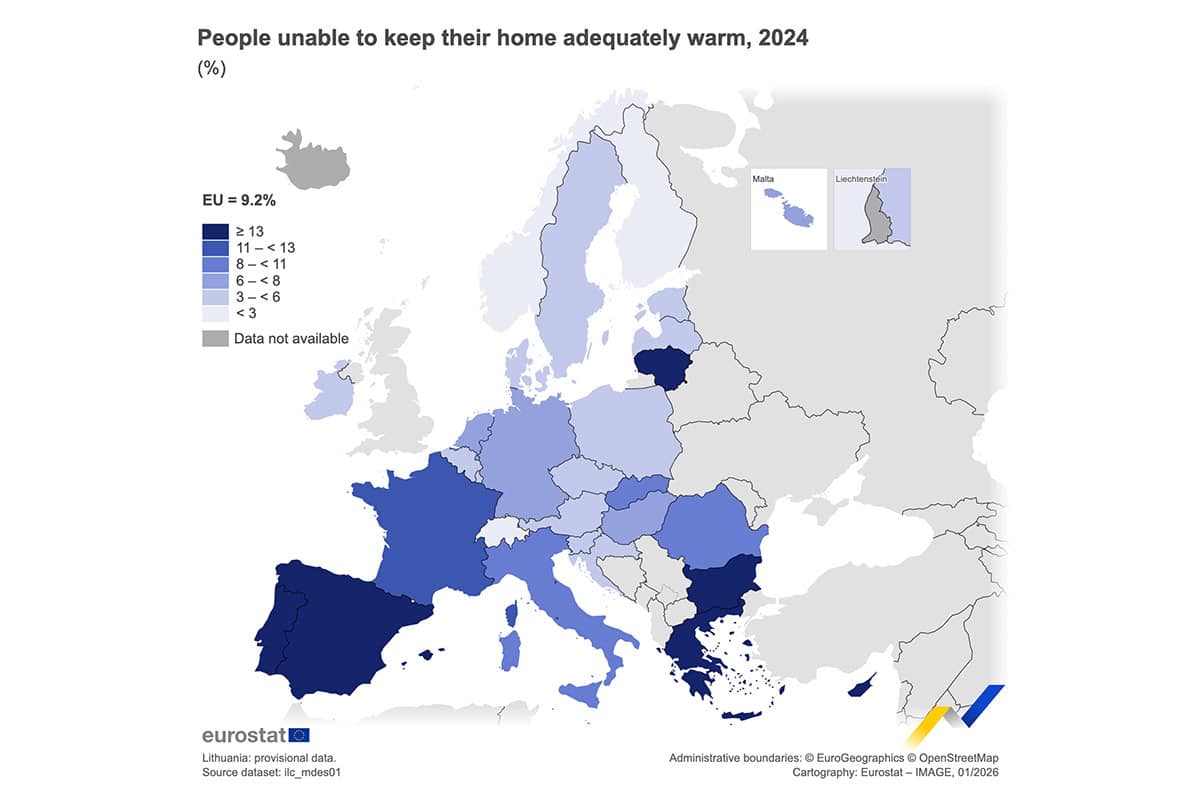
In 2024, 19% of people in Greece said they were unable to keep their homes adequately warm, tied with Bulgaria for the highest share in the EU, according to Eurostat.
People living in inefficient homes face higher heating needs. Rural, peri-urban and island households are more likely to depend on cars. Lower-income families are less able to purchase an electric vehicle or pay for major renovations before fuel costs rise.
For these households, a higher price may not produce an immediate change in behavior. It may simply reduce the money available for food, housing and other needs.
What support is Greece proposing?
The EU established the Social Climate Fund to help vulnerable households and microbusinesses manage the effects of ETS2.
Greece submitted a proposed €5.3 billion Social Climate Plan to the European Commission in March. It contains 25 measures intended to reach approximately 1.5 million households and 70,000 microbusinesses.
The proposals include energy renovations for 62,000 homes, support for at least 170,000 households installing heat pumps and 110,000 installing solar water heaters, public-transport investment, electric-vehicle leasing and assistance for microbusinesses replacing commercial vehicles.
The proposed increase in heating assistance would not go to every household. It would provide approximately €100 more per year between 2027 and 2032 to about 780,000 households already receiving Greece’s heating allowance.
The measures are outlined in the Greek government’s Social Climate Plan announcement
The plan remains subject to European Commission assessment. Its measures should not yet be treated as finalized programs, and eligibility rules, application dates, and final allocations will depend on approval and implementation.
Delivering programs of that size will require enough contractors, regional support services, energy inspectors and administrative capacity. Delays could leave households paying the carbon cost before the renovations or transportation alternatives intended to protect them are available.
Will ETS2 prices be controlled?
ETS2 does not have a firm legal price cap.
Current rules allow additional allowances to be released if the market price rises above €45 per metric ton in 2020 prices, adjusted for inflation, or if prices increase too rapidly. Releasing more allowances is intended to reduce pressure on the market, but it does not guarantee that the price will remain below the threshold.
In June 2026, representatives of EU governments and the European Parliament reached a provisional agreement to strengthen that safeguard. The agreement would increase the number of allowances released when the threshold is crossed from 20 million to 40 million. Formal adoption is still required, according to the Council of the EU.
What happens next?
The ten-country intervention has opened a political dispute, but it has not changed the current timetable.
EU governments and the European Parliament can seek amendments as negotiations continue around the wider carbon-market framework. Germany and Sweden are among the countries that have supported retaining ETS2.
The issues to watch are whether ETS2 remains on schedule for 2028, whether its price safeguards are formally adopted or strengthened further, whether Greece’s Social Climate Plan is approved and whether Athens proposes changes to existing fuel taxes.
The test will be whether Greece can give households realistic ways to use less fossil fuel before the higher cost reaches them, without weakening the climate policy or creating another gap in the state budget.