
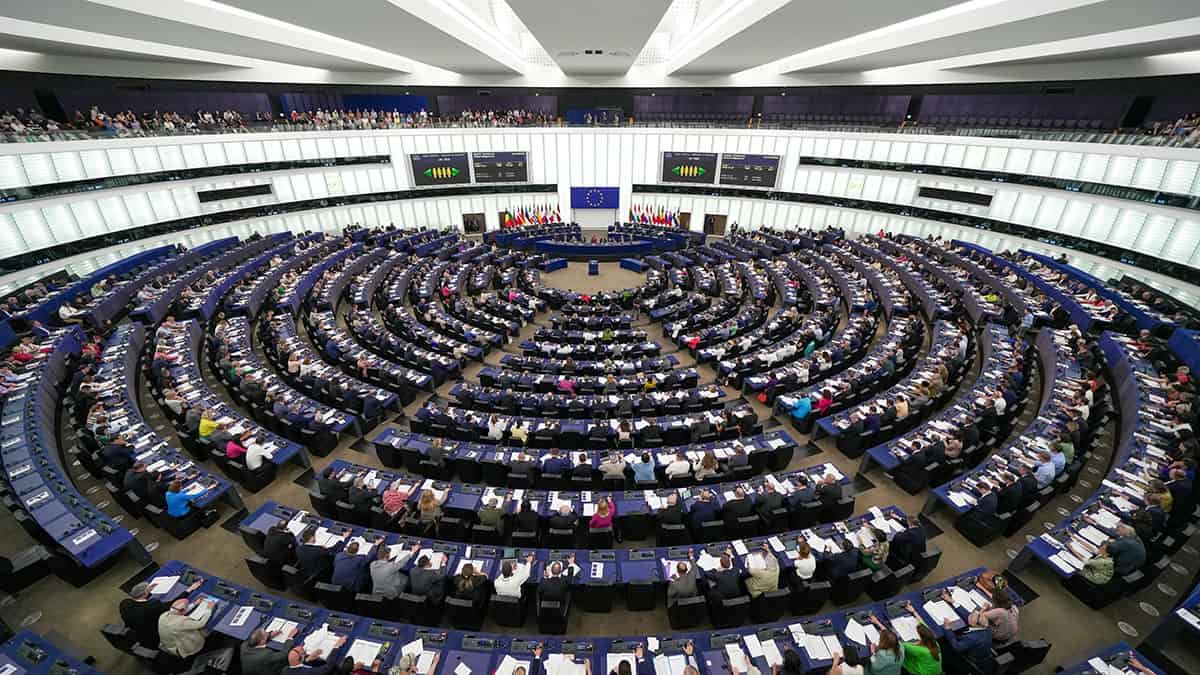
The European Parliament has adopted a measure recognizing one of the least publicly acknowledged parts of the Cyprus tragedy: the suffering of women and girls affected by crimes during the 1974 Turkish invasion and its aftermath.
The resolution, formally titled The impact of the 1974 Turkish invasion on Cypriot women and girls, and the crimes committed by Turkish forces and consequences on gender equality, was handled through the Parliament’s Committee on Women’s Rights and Gender Equality. The European Parliament procedure file lists the file under gender equality, women’s rights, and human rights, with Cyprus and Türkiye identified as the geographical areas concerned. It records a plenary debate on July 7, 2026, followed by a vote-results entry on July 8.
The final version passed by a wide margin. In the Parliament’s official roll-call vote record for July 8, item 12 lists resolution B10-0333/2026 as adopted with 575 votes in favor, 33 against, and 43 abstentions.
The vote put most of Parliament behind the text, but it was not unanimous. MEPs split over whether the measure should be read mainly as a human-rights recognition text, as part of the EU’s women, peace, and security agenda, or as a politically charged intervention in EU-Turkey relations.
The disagreement was not limited to Cyprus and Turkey. Separate votes were requested on wording related to sexual and reproductive health and safe and legal abortion, drawing part of the debate into a familiar European Parliament fight over gender and reproductive-rights language. Some objections concerned the geopolitical use of the Cyprus issue. Others concerned the policy language attached to the recognition of survivors.
The same roll-call record shows that attempts to change the text failed by wide margins. Two amendments from the Patriots for Europe group were rejected, while the section setting out the resolution’s historical premise passed 625 to 7, with 25 abstentions. Taken together, the votes indicate that opposition was real but limited, and that Parliament largely preserved the resolution’s core language before adoption.
The measure shifts attention to women and girls whose experiences of conflict-related sexual violence, displacement, stigma, family separation, and trauma were often left outside the formal record. Cyprus has long been discussed through territory, diplomacy, security, missing persons, property, and occupation.
For many survivors, silence became part of the harm. Wartime sexual violence is often hidden by shame imposed on victims, fear of public exposure, weak institutional support, and social pressure to protect family honor rather than name the violence. In Cyprus, many women carried those consequences privately, even as 1974 remained central to public memory.
A European Parliament briefing prepared for the committee’s 2025 mission to Nicosia noted that women were particularly affected by sexual and gender-based violence during the invasion, and that much of the trauma remained under-addressed because of stigma. By adopting the measure, Parliament placed those experiences in Europe’s human-rights record.
Survivor recognition quickly collided with geopolitical objections. Irmhild Bossdorf, a German AfD MEP, was among those who objected to the resolution’s framing, arguing that women’s suffering was being used in a broader political dispute and folded into the Parliament’s gender-mainstreaming agenda. The objection does not erase the final vote, the human-rights record, or the long-documented silence around conflict-related sexual violence in Cyprus.
MEPs also raised ethnic selectivity. The resolution’s central focus is on women and girls affected by crimes during the 1974 Turkish invasion. At the same time, the wider history of Cyprus includes violence suffered by civilians in both communities. During the parliamentary debate, an AKEL MEP raised the claim that Turkish Cypriot women were also subjected to sexual violence by Greek Cypriot paramilitaries.
The claim complicates the resolution without undoing its focus. Recognition of one group of victims does not require the erasure of another. Nor does acknowledging violence against Turkish Cypriot civilians flatten the legal and historical record of the invasion and continuing occupation. A survivor-centered frame depends on truth, documentation, and accountability across the record.
Parliament materials also point to survivor-support efforts meant to reach both Greek Cypriot and Turkish Cypriot women affected by wartime sexual violence. The ZOE vs War Violence Foundation launched the “Life Again” program to support survivors, especially those affected by the 1974 invasion, and the briefing notes that the program was expected to be translated into Turkish.
The resolution also sits beside existing European case law. In Cyprus v. Turkey, the European Court of Human Rights found Turkey responsible for multiple violations of the European Convention on Human Rights arising from the situation in northern Cyprus after 1974. The new Parliament measure does not replace that legal history. It adds a gender-specific layer to it, focusing attention on women and girls whose suffering was too often hidden behind broader diplomatic language.
Timing sharpened the resistance. The measure arrived in a week when EU-Turkey relations, NATO diplomacy, and other Turkey-related parliamentary business were already in view. That timing does not invalidate the resolution, but it helps explain why some MEPs treated it not only as a recognition text, but also as part of a wider argument over Europe’s posture toward Turkey.
For survivors and their families, recognition is not the same as justice or repair. But it is a step toward making their experiences part of the public record rather than leaving them in private silence.