
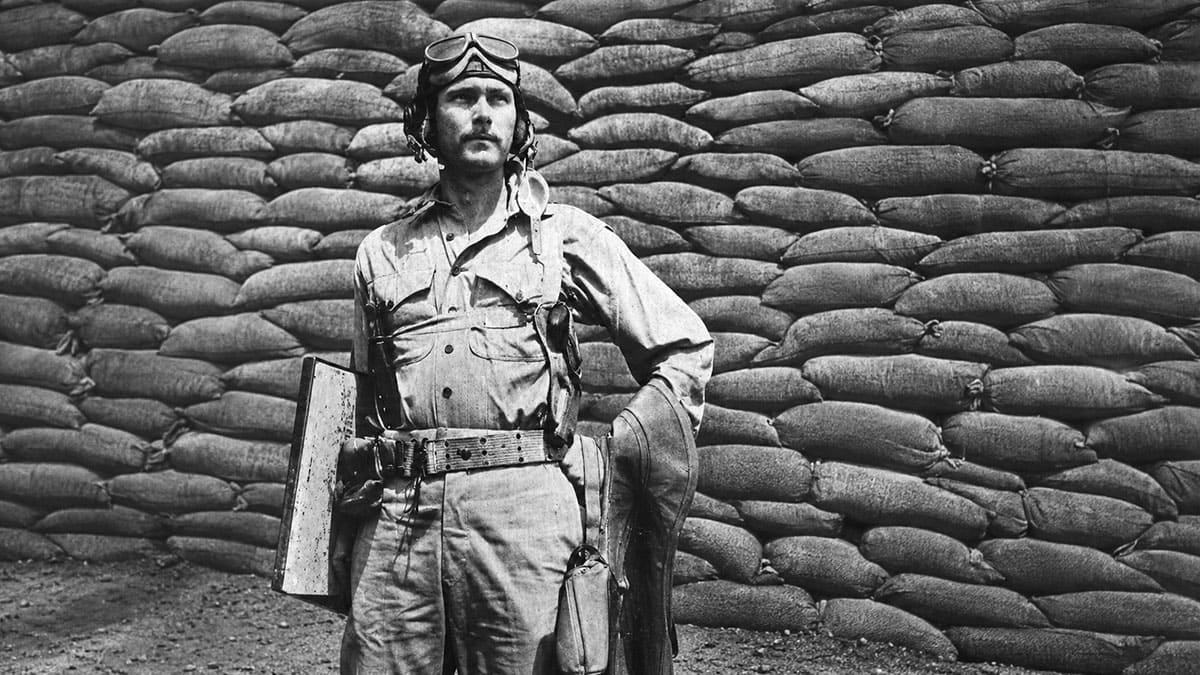
In May 1948, an American correspondent was found dead in Thessaloniki Bay. His murder became one of the darkest cases involving journalism, power, and politics in Greece’s Civil War.
On the morning of May 16, 1948, the body of George Polk was discovered floating in Thessaloniki Bay. The discovery date is clear. The exact date of the murder is not.
He was 34 years old, a CBS correspondent covering Greece at a moment when the country was being torn apart by civil war. His hands and feet were bound. He had been blindfolded. He had been shot in the back of the head.
The killing shocked the United States and Greece, but the shock did not produce a clean answer. Instead, it opened a story that still sits uneasily between journalism, Greek state power, American influence, and the search for truth in a country at war with itself.
For Greek Americans, the case is not only an American journalism story. It is also part of the unresolved memory of the Greek Civil War, a conflict many families carried quietly across the Atlantic.
Polk had come to Greece at a volatile time. The Second World War had ended only three years earlier, but Greece had not found peace. The country was in the middle of a brutal civil war between the U.S.-backed government and the communist-led Democratic Army. The Truman Doctrine had placed Greece at the center of America’s new global struggle against communism. Aid, military support, and political pressure were flowing into the country.
Polk was not simply repeating the version preferred by the Greek authorities and their foreign backers. He had reported critically on the Greek authorities, on corruption, and on the way American aid was being used. In a 1947 article for Harper’s, he called the U.S. aid program in Greece a poor investment because of misuse and corruption. He also reportedly challenged senior Greek political figures over allegations involving money abroad.
That made him a problem for people who wanted the Greek war reported within clear political boundaries.
By early May 1948, Polk was trying to do something even more sensitive. He wanted to reach Markos Vafeiadis, the communist guerrilla leader, for an interview. In the political climate of 1948, even seeking such an interview could be read by Greek authorities as more than reporting. It could be treated as a breach in the political battle over who controlled the story of the war.
Polk left Athens for northern Greece around May 7. The details of his final movements remain disputed. Some accounts say he had planned to travel farther east and changed plans because of weather. Others place him in Thessaloniki trying to arrange passage toward the guerrilla side. What is clear is that he disappeared shortly after arriving in the north.
A few days later, his military identity card was mailed to local police. His notebook, agenda, and some papers were missing.
Then came the body in the bay.
From the beginning, the physical evidence pointed away from a random killing. Polk’s money and many personal items were still with him. Robbery made little sense. Summaries of the forensic record suggested that the shooting was close-range and execution-like. Some investigators believed the body may have been tied after death.
The murder looked controlled, deliberate, and political.
The Greek investigation moved toward a communist explanation. Authorities accused communist-linked figures of killing Polk and placed a Thessaloniki journalist, Grigoris Staktopoulos, at the center of the trial. Staktopoulos was accused of helping arrange Polk’s contact with the killers. In 1949, he was convicted as an accomplice and sentenced to life in prison. Two alleged communist participants, Evangelos Vasvanas and Adam Mouzenidis, were convicted in absentia.
The verdict closed the file. It did not settle the murder.
Writers and researchers returned to the story from different angles. Edmund Keeley’s The Salonika Bay Murder treated the record with caution. Elias Vlanton’s Who Killed George Polk? challenged the prosecution’s account from the standpoint of press failure and political pressure. Broader Greek Civil War scholarship, including the work of John O. Iatrides, helps place the murder inside the larger world in which it unfolded.
Kati Marton’s The Polk Conspiracy pressed harder toward a theory involving right-wing figures, Greek security circles, and a wider cover-up involving powerful Greek, British, and American interests. In a 2015 interview with Truthout, Marton described Polk’s reporting as uncompromising and said it had put him in conflict with Athens, London, and Washington.
Over time, the evidence against Staktopoulos became more and more difficult to defend. His confession was described as coerced. He said he had been tortured. The prosecution relied heavily on disputed handwriting evidence connected to the envelope that contained Polk’s identity card. Subsequent reviews found major weaknesses in the evidence and procedure.
In 2003, a Greek Supreme Court prosecutor reportedly argued that the case should be reopened and that Staktopoulos should be posthumously cleared. According to Kathimerini, the prosecutor also called for the posthumous clearing of the two communist fighters convicted in absentia, saying one had been killed a month before Polk’s murder and that the other had died in exile.
Those claims have to be handled carefully, because they belonged to a legal effort that did not ultimately overturn the conviction. But they are part of why the communist-conspiracy narrative came to look less like a solved murder and more like a politically useful story.
Staktopoulos did not disappear after the trial. His sentence was reduced, and he was released in 1960 after more than a decade in prison. He spent the rest of his life trying to clear his name. He died in 1998 without seeing the conviction overturned. In January 2004, Greece’s Supreme Court rejected his widow’s appeal for a posthumous retrial, leaving the court record officially closed even as the historical record grew more doubtful.
The doubts were not only retrospective. Even at the time, American journalists and investigators were uneasy. CBS and others questioned whether the Greek authorities had explored all possibilities. Declassified U.S. material showed that early intelligence assessments were not as certain as the public narrative became. Some reports noted possible right-wing threats. Others warned that a scapegoat might be produced.
Under pressure from American journalists, a committee associated with Walter Lippmann examined the murder, but its work has remained controversial. Its chief counsel was General William “Wild Bill” Donovan, the former head of the Office of Strategic Services. Critics argued that this placed limits on how far the inquiry was likely to push into politically explosive territory.
Another investigator, James G. L. Kellis, later described obstruction from Greek officials and even from some in the American embassy. He came to believe that the communist theory was implausible and that the inquiry had been steered away from more dangerous possibilities.
The murder happened in a Greece where the government side had the backing of the United States, where anti-communism was becoming the dominant language of power, and where inconvenient facts could be recast as enemy propaganda. The communist explanation fit the politics of the moment. A killing connected to right-wing or security-linked actors would have been far more damaging to the Greek government and its American supporters.
Scholarship and archival work have not produced a final named killer. They have produced something almost as important: a serious challenge to the 1949 verdict.
Critics have often looked instead toward right-wing, para-state, or security-linked Greek actors. In the Greek Civil War context, this means people operating in the gray zone between formal security forces, anti-communist militias, police networks, and political protection. That does not mean the Greek state as an institution can be named as the murderer. It means the possible zone of responsibility may have included people close to the machinery of state power, anti-communist enforcement, or local security networks.
Even that conclusion must be stated carefully. There is no surviving document that definitively names the shooter or the person who ordered the murder. Some key records are missing. The original envelope and handwriting materials central to the trial were later reported missing from the court record. In 2007, the National Security Archive reported that the CIA had lost documents concerning its investigation of Polk’s murder and had destroyed its FOIA file on Polk documents, citing a letter from Archivist of the United States Allen Weinstein.
Missing records do not prove who killed Polk. But in a story already shaped by coercion claims, disputed evidence, and political pressure, their absence has deepened suspicion.
In 1949, Long Island University established the George Polk Awards in his memory. The award became one of American journalism’s major honors, but its origin is not ceremonial. It begins with a body in Thessaloniki Bay and a murder that still resists closure.
The most honest conclusion is also the most uncomfortable one.
George Polk was murdered. The 1949 conviction is not strong enough to close the crime. The record strongly suggests that Staktopoulos was scapegoated. Suspicion has long turned toward anti-communist security circles, but the evidence still does not identify the killers. Nearly eight decades later, Polk’s death remains one of the unresolved crimes of the Greek Civil War.