
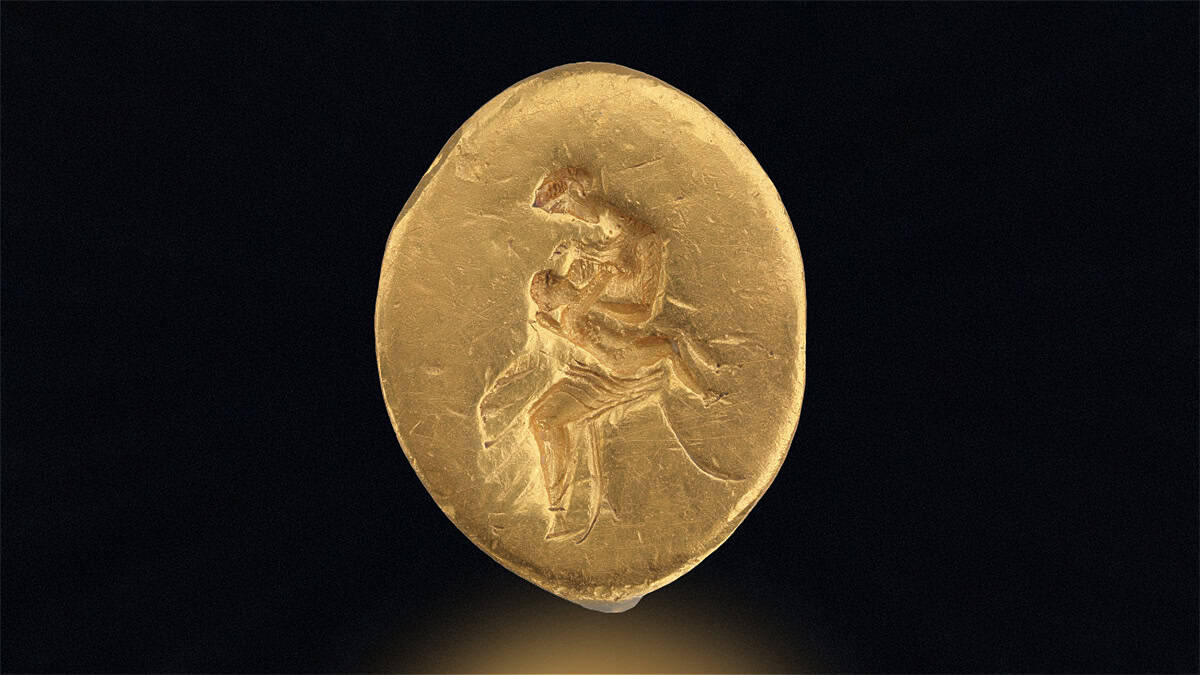
In the quiet galleries of Thessaloniki’s Archaeological Museum, a gold ring barely two centimeters across draws visitors into a story of intimacy and craft. Carved on its tiny bezel is a mother nursing her child, a scene so gentle and private that it surprises even those who know the museum’s famous royal treasures.
The ring, catalog number ΜΘ 5420, came to light in February 1938 when military works near the old Sedes airfield in Thermi cut through an undisturbed cist grave known as Tomb Γ. Archaeologist Nikos Kotzias recorded the find: a chamber with painted geometric bands and stylized palmettes, its timber roof probably once draped with a star-patterned fabric that created a symbolic sky for the young woman buried inside. Her grave goods included fine pottery, cosmetic vessels, and several pieces of jewelry that confirmed her elite status. Among them, the ring stood out immediately.
Dated to about 330–320 BC, the piece is crafted from high-karat gold with a bezel measuring 1.65 by 2.07 centimeters. On this minuscule surface the ancient goldsmith engraved a seated woman wearing a long sleeved chiton, a himation and a sakkos head covering. She cradles a nude child, one hand supporting its back while the other gently raises its chin toward her breast. The child rests a small palm against the mother’s opposite breast, a touch that gives the scene a sense of quiet reciprocity. The woman sits on a klismos chair whose curved legs and low back are rendered with equal care. Scratches and softened edges show the ring was worn for years before it was placed in the tomb.
Maternal imagery appears elsewhere in late Classical art. Attic grave reliefs sometimes depict mothers and infants, most famously the Ampharete monument from the Kerameikos cemetery in Athens. Votive figures of the kourotrophos, the nurturing mother, also reach back to earlier Greek tradition. Yet on personal jewelry scenes of breastfeeding are exceptionally rare, which makes this ring stand apart even among the finest Macedonian goldwork.
Why it was made and how it was used remain open questions. Some scholars see a keepsake of motherhood, perhaps marking the birth of a child or the hope for one. Others read it as an emblem of an elite woman’s role as nurturer within her household, or as a funerary gift offered by loved ones to honor that role after death. Without an inscription the meaning is left to inference, but the exceptional craftsmanship suggests it was commissioned by someone of wealth and influence.
Metallurgical and stylistic analyses support this. The high-karat gold matches other late Classical Macedonian workshop products. Tool marks reveal the use of micro chisels and burins similar to those on other high status rings in the museum’s collection, though no exact parallel for the subject has been found. Comparable rings from Sindos share the same proportions but differ in imagery, which underscores the singularity of the nursing mother motif.
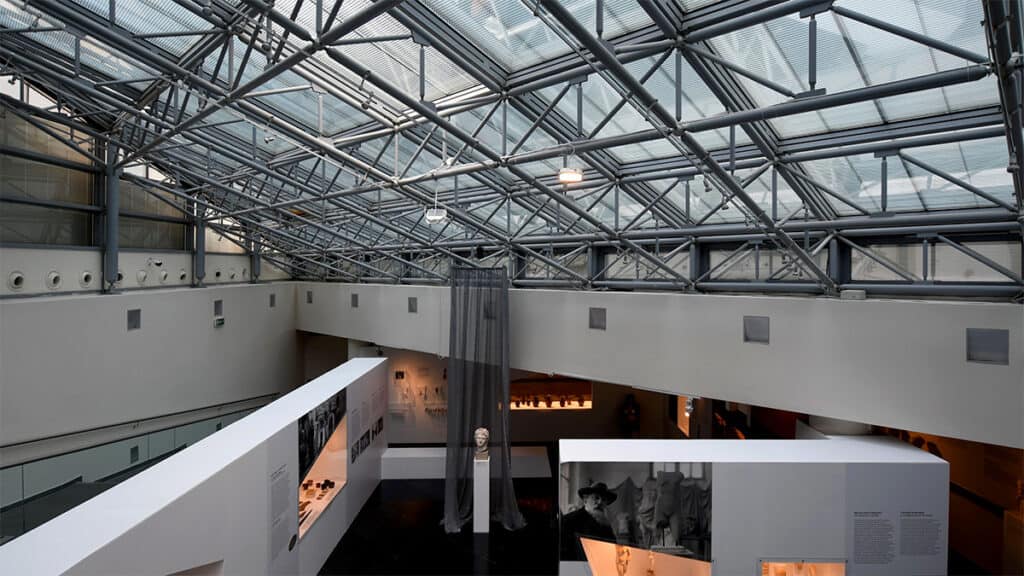
Since 2017, the Archaeological Museum of Thessaloniki has used its Exhibit of the Month program to draw attention to such hidden treasures. The program, led by Dr. Anastasia Gadolou, highlights objects that broaden our understanding of ancient life and invite visitors of all ages to connect with the past. For August 2025, the museum placed the ring in its “Gold of the Macedonians” gallery, where careful lighting brings out every fold of drapery and every strand of the child’s hair.
The nursing scene speaks not only to private affection but also to how ancient Macedonians chose to represent the roles of women and the ideals of family within a society of power and display. It is both a personal relic and a public statement: a reminder that in an age of kings and battles, the quiet bond between mother and child could be honored in gold and preserved for millennia.