
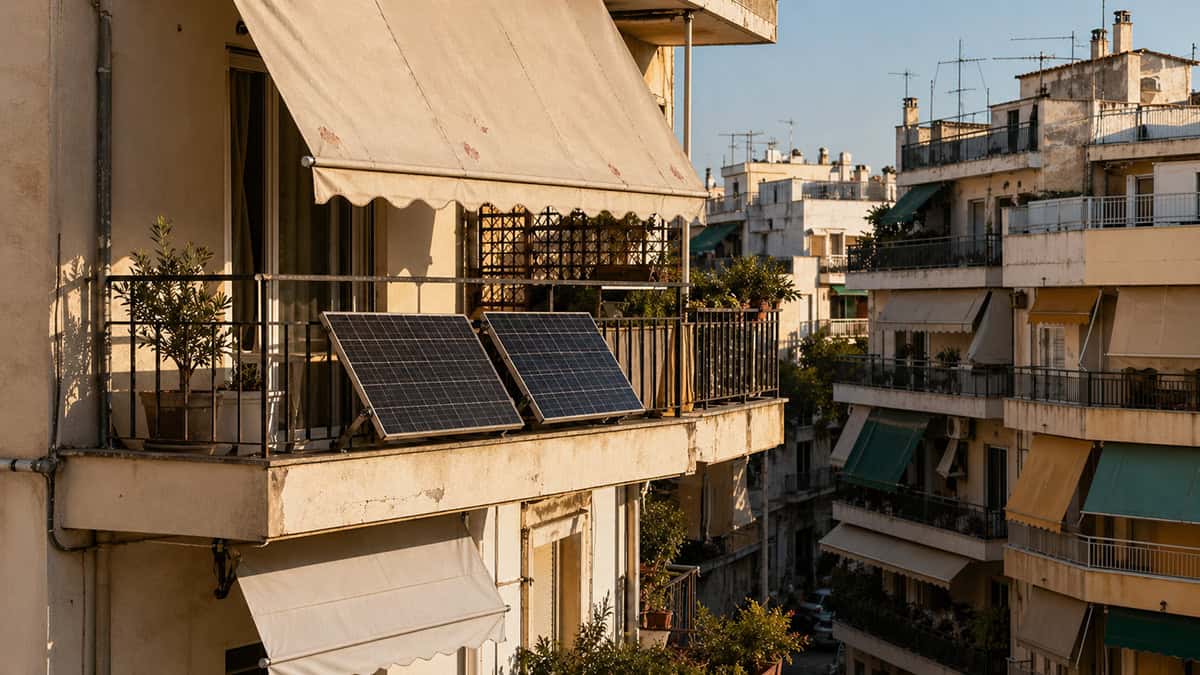
Greece has approved a renewable-energy bill that opens the way for small balcony photovoltaic systems, joining a European trend that has already taken hold in Germany and is beginning to reach the United States.
For years, solar energy in Greece usually meant one of two things: panels on the roof of a family house, or large photovoltaic parks spread across open land.
Now the idea is getting smaller.
Under the renewable-energy bill approved by Parliament on April 30, Greece is preparing to open the way for small “balcony photovoltaics”, compact solar systems that can be installed on balconies, terraces, pergolas, or other limited outdoor spaces. The systems under discussion are expected to be small, typically two panels of about 400 watts each, connected to a microinverter of up to 800 watts. Kathimerini reported that the legislation provides for a ministerial decision, expected in May, that would allow installation through a simple notification to the electricity distribution operator.
That 800-watt figure is not random. It reflects a broader European direction. SolarPower Europe notes that plug-in solar usually consists of one or two small photovoltaic modules that can be plugged into a grounded home power socket, and its policy briefing links the 800W threshold to the EU framework for simplifying very small generators.
In plain language, Europe is making room for a new kind of solar: small enough for ordinary homes, useful for apartment residents, but still regulated enough to protect the grid and the building.
What balcony solar actually does
A typical balcony solar setup includes one or two photovoltaic panels, a small microinverter, mounting equipment, and a cable that connects the system to the home’s electrical installation. The electricity produced during sunny hours is used inside the home by whatever is running at that moment, such as a refrigerator, router, computer, lights, television, washing machine, or small appliance.
It is not a replacement for a full rooftop photovoltaic system. It will not power an entire apartment.
Its purpose is more modest. It reduces part of the electricity a household buys from the grid, especially when the household uses electricity during the day.
That distinction matters. Balcony solar should not be sold as “free electricity.” It is better understood as a small self-consumption tool.
In Greece, that could still matter. Many people live in apartments. Many do not control a roof. Others may own an apartment but not have practical access to shared roof space. Stelios Psomas, an adviser to the Hellenic Association of Photovoltaic Companies, told Kathimerini that the technology is especially relevant in Greece, where 60% of the population lives in apartment buildings.
For those households, a balcony system may become the first realistic way to participate in solar energy.
The Greek question is not just solar. It is the polykatoikia.
This is where Greece has its own complication.
In Greek cities, the apartment building, the polykatoikia, is not just a building type. It is a legal and social arrangement. Apartments are owned separately, while parts of the building, including many exterior and structural elements, are shared.
That makes balcony solar more complicated than it looks.
If a solar panel is placed inside a private balcony, is it treated as part of the owner’s exclusive use of the apartment? Or does it affect the exterior appearance, façade, railing, or common parts of the building in a way that requires approval from the building assembly?
That may sound like a small legal detail. It is not. It could decide whether balcony solar becomes widely usable in Greece or remains trapped in building-by-building disputes.
Greece has already moved on to one related issue. Under Law 5215/2025, decisions for renewable-energy and storage systems installed by collective self-consumers in common building areas can be approved by a 51% majority of co-ownership shares, provided the installation covers no more than 40% of the common roof area.
But that does not fully answer the balcony-solar question. A collective rooftop system in a common area is not the same thing as a small plug-in panel attached to, or placed within, a private balcony.
That distinction matters. If Greece treats balcony PV as a simple household device, adoption could spread quickly. If every installation becomes a building-assembly dispute over appearance, common property, or façade alteration, the market may remain limited.
Austria has already dealt with a similar problem. In September 2024, Austria amended its Condominium Act so that small balcony solar systems are treated as a privileged modification: co-owners must be notified, and if they do not object within two months, consent is deemed granted.
Greece will need its own answer. Without one, the policy may sound broad on paper but become narrower in practice.
What could a Greek household save?
The economics are not dramatic, but they are real.
Kathimerini reported that a typical Greek balcony PV system may cost about €500 to €1,000 and could reduce annual electricity bills by about 15% to 25%, depending on use and conditions. Greek household electricity prices averaged €0.2263 per kilowatt-hour in the first half of 2025, according to Eurostat data.
Greece also has strong solar potential, but not every city or balcony will perform the same. Northern Greece is not Attica, Crete, or the Cyclades. A shaded balcony in Thessaloniki will not produce like an open south-facing balcony in Athens.
A realistic way to think about it is this: an 800W balcony system might produce a meaningful amount of daytime electricity, but the household benefits most from the electricity it uses immediately. If no one is home during sunny hours and little is running, the savings fall. If a household shifts some use into the day, the system becomes more useful.
This is the consumer truth: balcony solar works best when people use electricity while the sun is producing. Run the dishwasher, laundry, laptop charging, or air conditioning during daylight hours, and the system has a better chance of paying for itself.
Net billing will decide the real value
The implementing framework is still pending. EnergyPress reported on April 24 that a modified ministerial decision for net billing is in its final stage and is expected, barring delays, in May. The same report said 5,730 applications had been submitted to HEDNO (Hellenic Electricity Distribution Network Operator, known in Greek as DEDDIE) for photovoltaic self-production systems under net-billing and virtual net-billing, known in Greek law as “synchronized offsetting” and “virtual synchronized offsetting,” totaling 328 MW. Procedural and technical obstacles had left many projects short of licensing maturity.
That decision will matter more than the announcement itself.
Will households receive any credit for electricity they do not use immediately? Will surplus electricity simply flow into the grid without compensation? Will HEDNO require only a simple notification or a more formal procedure? Will specific safety certifications be required for panels, plugs, inverters, and mounting systems?
Many plug-in solar frameworks keep these systems outside normal net-metering or net-billing programs because the quantities are small and the administrative burden of compensation may be larger than the value of the surplus electricity. Utah’s law excludes portable solar generation devices from net-metering rules, and Maine’s new law says eligible plug-in systems may not be used for net energy billing.
Greek consumers should understand this before buying anything. The real return will likely come from self-consumption, not from selling power back to the grid.
Germany shows what happens when the rules are clear
Germany is the country most often cited in discussions of balcony solar. The systems are widely known there as Balkonkraftwerke, or balcony power plants.
Germany passed the million-system mark in June 2025, when Heise reported that the market register showed 1,031,298 balcony power plants with a combined gross output of 956 MW. The growth continued through the year: Germany’s Federal Network Agency said it registered about 430,000 new plug-in balcony solar installations in 2025, accounting for about 0.5 GW of new solar capacity.
Germany’s success is not only about sunlight. Germany has far less sun than Greece. The real lesson is regulatory clarity.
German rules allow plug-in solar systems with installed module capacity of up to 2,000 watts and inverter output of up to 800 VA, with registration through the country’s market master data register.
In December 2025, Germany’s electrical standards body published DIN VDE V 0126-95, the first dedicated product standard for plug-in solar devices. The standard defines technical requirements for plug-in solar devices as complete systems and permits connection through standard household Schuko plugs under defined limits.
That may sound technical, but it matters for Greece. Greece will face the same basic choice: should small balcony systems be treated as simple consumer products, or as electrical installations requiring professional intervention?
If Greece follows a simple model, the market could grow quickly. If the rules are too cautious or unclear, adoption may remain limited.
Europe is moving, but not everywhere at the same speed
Germany is the leading market, but it is not alone.
Austria allows plug-in systems up to 800W AC and has simplified apartment-building consent rules for owners. Belgium authorized plug-in solar panels on the market in 2025, with use permitted from April 17, 2025, provided devices are approved by Synergrid and total power does not exceed 800 watts. Italy has also simplified rules for small plug-and-play renewable systems under 800 watts, while France permits plug-in PV under a different framework, with more attention to municipal registration and building appearance when the system is attached to an exterior façade or balcony.
The 800W figure usually refers to inverter or AC output. Panel capacity can be higher in some systems, as Germany’s rules show. That distinction matters because a system may have more panel capacity but still feed no more than 800W into the home.
Sweden and Hungary show the other side of the policy choice. SolarPower Europe describes plug-in PV as legal in nearly all EU member states except Sweden and Hungary. Sweden blocks standard plug-in grid connection and allows such systems only off-grid under stricter conditions, while Hungary prohibits balcony PV installations.
That puts Greece at a decision point. The country is not deciding whether balcony solar exists. It already exists. Greece is deciding whether to make it ordinary.
Storage is the next chapter
The first version of balcony solar is simple: produce electricity during the day and use it immediately.
The next version adds a small battery.
Storage changes the economics because it lets a household save some midday solar power for evening use. That matters for apartment dwellers, who may consume more electricity after work, especially for cooking, lighting, entertainment, and air conditioning.
Germany is already moving in that direction. SolarPower Europe says small-scale battery storage for plug-in solar is rising in Europe, with the number of batteries under 2 kWh increasing 24-fold in Germany between 2023 and 2024.
For Greece, storage should not be treated as an afterthought. If the country creates rules for balcony PV now, it will eventually need rules for balcony PV with batteries too.
The United States is starting to follow
For Greek Americans, the U.S. comparison is useful because America has moved more slowly on this specific type of solar.
Traditional rooftop solar is common in many states. Plug-in balcony solar is different. It has faced barriers from electrical codes, utility interconnection rules, safety standards, landlord concerns, and the fact that many American rules were designed for rooftop systems, not small portable devices.
That is beginning to change.
Utah became the first U.S. state to create a clear legal category for portable solar generation devices in 2025. The law defines a portable solar generation device as a movable photovoltaic device with a maximum output of 1,200 watts, designed to connect through a standard 120-volt outlet and intended mainly to offset part of the customer’s electricity use. It exempts qualifying devices from standard interconnection requirements and keeps them outside net-metering rules.
Maine followed in April 2026. The new law allows eligible plug-in photovoltaic and battery systems with an export capacity of up to 1,200 watts. Maine creates a two-tier structure: systems with combined inverter output up to 420 watts may be installed more simply, while systems above 420 watts and up to 1,200 watts require installation by a licensed electrician, a dedicated circuit, and utility notification within 30 days. The law also prohibits these systems from being used for net energy billing.
Virginia also enacted plug-in solar legislation in April 2026. HB 395 was approved by the governor as Chapter 1052, with a general effective date of July 1, 2026, while some consumer-facing provisions take effect January 1, 2027. The law covers small portable solar generation devices, limits utility approval and fee requirements, excludes the devices from net metering, and prevents localities from banning qualifying devices on residential structures.
By signing date, the order is Utah, Maine, Virginia; Virginia’s legislature passed its bill before Maine’s.
Either way, the important point is that U.S. policy is now moving state by state.
What Greece still needs to clarify
For Greece, the next step is not another speech. It is the fine print.
The final framework needs to answer practical questions clearly.
- Can a renter install a balcony photovoltaic system?
- Does an apartment owner need approval from the building assembly?
- Does a landlord have the right to object?
- Will the system require a licensed electrician?
- Will Greece allow standard household-plug connection for compliant systems, as Germany now does under specific limits?
- Will HEDNO use a simple notification platform?
- Will surplus electricity receive any credit, or will savings depend only on self-consumption?
- Will batteries be allowed?
- What happens if the household moves?
Those questions will decide whether balcony solar becomes useful for ordinary people or remains a niche product for energy enthusiasts.
The strongest version of the policy would be modest, safe, and practical. It would not promise that a balcony panel can transform household finances. It would simply allow apartment residents to reduce part of their energy use without entering the same process required for a full rooftop installation.
That would be a meaningful change in a country where the balcony is part of daily life.
For now, Greece is not yet where Germany is. But it is moving in that direction.
And if the final rules are clear, the next chapter of Greek solar energy may not begin on a roof or in a field.
It may begin on a balcony.