
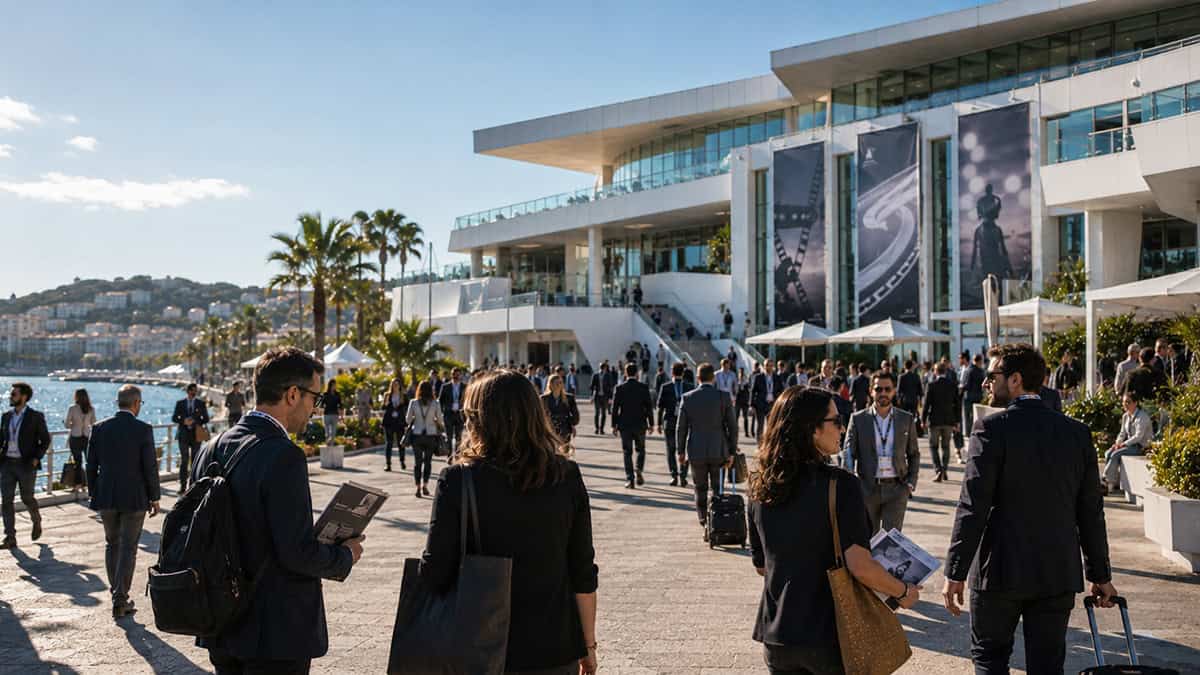
At Cannes, countries do not come only to be admired. They come to sell, finance, partner, and prove that their film industries can compete beyond their own borders.
That is why Greece’s selection as the 2027 Country of Honour at the Marché du Film matters. The honor gives Greece a rare place at the center of one of the film industry’s most important global markets. The harder question is whether the country can turn that visibility into something more durable: co-productions, distribution, investment, stronger infrastructure, and a clearer international identity for Greek cinema.
The 2027 program will take place during the 80th Festival de Cannes and will be presented under the slogan “Ride the Greek Wave.” According to reporting summarized in the Greek Foreign Ministry’s international media bulletin, the spotlight will highlight an audiovisual sector that contributes about 1.9 billion euros to the Greek economy, supports roughly 44,000 jobs, and includes nearly 3,000 businesses.
The Marché du Film is not the red carpet side of Cannes. It is the business engine beside it, where producers, sales agents, distributors, financiers, festival programmers, streamers, and national film bodies compete for attention in a crowded global marketplace.
Greece is not arriving at Cannes alone. Every year, countries with larger budgets, deeper production pipelines, mature film commissions, and aggressive tax incentives pitch themselves as co-production partners and shooting destinations.
Beautiful locations are not enough. Nearly every country has scenery. Many have rebates. Many have trained crews. Greece has to show what makes its screen economy distinct.
Part of the answer is obvious, but not sufficient: Greece is internationally recognizable. Its light, islands, cities, archaeological sites, and landscapes already carry meaning for global audiences. Foreign productions know how to use that image. So does tourism.
But if the Cannes pitch stops there, Greece risks becoming a backdrop rather than a producer of culture.
What Greece needs to demonstrate is capacity: that it can host international productions while also supporting its own filmmakers, producers, crews, writers, composers, post-production professionals, and original stories.
A country can appear constantly on screen and still struggle to get its own work financed, distributed, and seen. Cannes 2027 will not solve that problem by itself, but it will reveal how seriously Greece is trying to bridge those two sides of the industry.
Recent Country of Honour programs show what the opportunity can become when it is treated as a business platform rather than a ceremonial label. Brazil’s 2025 program and Japan’s 2026 program were not built only around national pride. They created points of contact between national industries and the people who can finance, buy, sell, program, and distribute their work.
For Greece, the value of the spotlight comes down to execution: which companies show up, how ready the projects are, and what actually gets discussed in those meetings.
The EKKOMED piece of the story is important, but it also needs perspective. Recent funding activity shows that Greece has a domestic pipeline and public-sector support. But just over 1 million euros across 20 projects is modest by international industry standards.
It is a sign of activity, not proof of scale. Greece is not arriving at Cannes as an industrial power. It is arriving as a smaller screen economy trying to make a cultural moment work as an industry argument.
The international image of Greek cinema is also more complicated than a slogan can capture. For many outside Greece, the first modern name that comes to mind is Yorgos Lanthimos. His success helps because it proves that Greek creative work can travel globally without relying on postcard Greece. It complicates the pitch for the same reason.
The “Greek Weird Wave” opened a door, but it is not an industry strategy. If “Ride the Greek Wave” is going to mean anything beyond a tagline, Greece has to show breadth: commercial production, independent cinema, documentaries, animation, genre work, emerging directors, and professional services that can support both local and international projects.
There is still a tourism dividend here, but it should remain secondary. Film has long shaped how foreigners imagine Greece, and that visibility can affect travel, destination branding, and the emotional pull of place.
At Cannes, though, the point is not to sell Greece as a destination. It is to sell it as a place where serious work gets made.
The full 2027 program has not yet been publicly detailed, so caution is warranted. The announcement is significant, but the outcome is not guaranteed. The test will come later, when the screening slate, panels, exhibitors, production companies, institutional partners, and meetings are made public.
Cannes 2027 gives Greece a real opening to step beyond the familiar image of a beautiful country where other people come to shoot, and to argue that Greek cinema and the Greek audiovisual sector are not only visible, but ready to compete.