
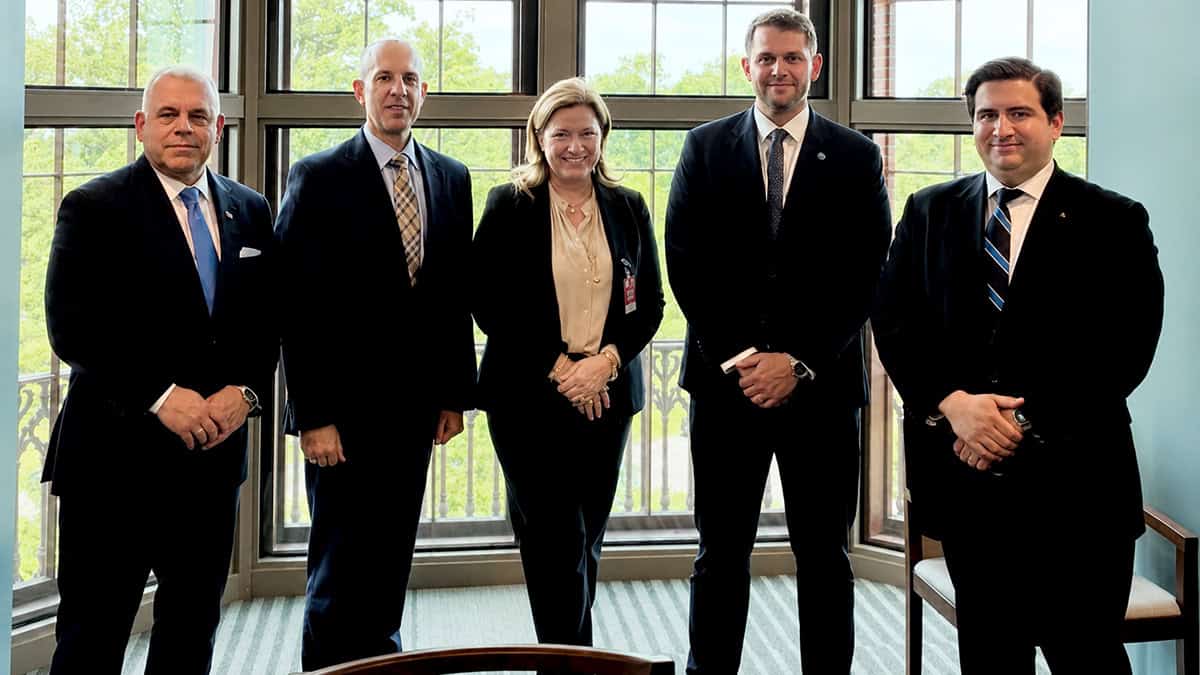
Philadelphia is heading into one of the most visible years its Greek-American community has seen in a generation. In July, the city is scheduled to host the 104th AHEPA Supreme Convention during America’s 250th anniversary year, following its annual Greek Independence Day Parade. Into that moment stepped Maira Myrogianni, Greece’s Secretary General for Greeks Abroad and Public Diplomacy, who made Philadelphia one of three U.S. stops on a May 8 to 15 visit aimed at strengthening Athens’ ties to communities like this one.
What she brought was less ceremony than agenda. In a Cosmos Philly interview and a follow-up briefing in New York, Myrogianni outlined youth and student programs already running this summer, a proposed heritage initiative that would send young Greek Americans not just to Athens but to the islands and regions their families actually come from, new outreach aimed at mid-career adults ages 35 to 45, and the rollout of postal voting for Greeks abroad. For Philadelphia’s parishes, Greek schools, and families, the test is whether any of it arrives.
It was Myrogianni’s first visit to the city in her current role. She described Philadelphia’s Greek-American community as strong and said the Federation of Hellenic-American Societies of Philadelphia struck her as active and closely connected to the people it represents. The visit, she said, was a chance to walk through Greece’s broader strategy for the diaspora, along with scholarships, English-language university programs in Greece, and the new postal-voting law passed by the Hellenic Parliament earlier this spring.
Schools at the center
After the Philadelphia stop, Myrogianni laid out the General Secretariat’s priorities at a briefing with reporters at the Greek Consulate General in New York: younger generations, Greek-language education, stronger consular services, digitization, and closer cooperation with diaspora organizations, according to the Athens-Macedonian News Agency (AMNA). She called the government’s approach a dynamic plan built on continuing dialogue with the omogeneia, the Greek communities abroad, and placed Greek-language education at its core.
She also acknowledged what those communities already know. Greek schools in the diaspora run on a mix of parish support, parent commitment, local fundraising, and teachers asked to do more with limited resources. Myrogianni said the Greek state is moving to support educators abroad through new legislation increasing teacher allowances, along with training programs for local teachers.
Her plans extend beyond the classroom to festivals, creative activities, diaspora student newspapers, and hospitality programs tied to culture, the environment, traditional dance, and shipping.
In the Cosmos Philly interview, Myrogianni said some student programs are already being implemented this summer and will be repeated annually, with the Greek Consulate providing the details and dates to interested families.
A more personal kind of homeland
The idea she returned to most was a heritage program still taking shape: helping young Greek Americans visit the specific places their families came from, rather than connecting only through Athens. A student with roots in Chios should be able to visit Chios, she said, and someone from the Peloponnese should be able to see what life there looks like today.
For many Greek-American families, that distinction is the whole point. Greece is not an abstract homeland but a village, an island, a church courtyard, a family story repeated for generations. A program built around those places speaks to a different kind of belonging.
A second idea from the New York briefing pointed in the same direction. Myrogianni said new programs for Greeks abroad, ages 35 to 45, are under consideration. Most diaspora outreach focuses on children, teenagers, or college students. Reaching mid-career adults, many of them parents raising the next generation of Greek Americans, would be a notably different bet.
One room in Philadelphia
In Philadelphia, the Ministry of Foreign Affairs said Myrogianni met with Federation representatives, including President Judge Harry Karapalides, Vice President Michael Economou, Georgia Chletcos, and John Vasiliou, with talks centered on cultural preservation and support for the local community. The stop also included a visit to Astra Foods, owned by John Vasiliou, where the conversation turned to the Greek-American business community’s role in economic life, and a stop at St. George Greek Orthodox Cathedral, where she met with Father Anastasios.
Her broader rounds reached AHEPA, Pontian, Chian, and Epirot associations, Odyssey Charter School of Delaware, Hellenic News of America, and parishes including St. Demetrios in Upper Darby, St. Thomas in Cherry Hill, and Holy Trinity in Wilmington.
On the civic side, Myrogianni met Philadelphia officials Jazelle Jones, Pierre-Olivier Lugez, and Charles Ellison. Pennsylvania State Senator Maria Collett also participated, giving the visit a state-level civic dimension beyond the usual community circuit.
What struck Myrogianni, she told Cosmos Philly, was having the Federation, an elected official, the Greek Consulate, and the Greek government in a single room, talking through the parade, the 250th-anniversary celebrations, and the community’s day-to-day concerns. When those voices speak together, she said, cooperation comes more easily.
The practical test
During the Philadelphia talks, Myrogianni also discussed postal voting and efforts to upgrade consular services, according to the Ministry of Foreign Affairs. AMNA reported that she framed postal voting as a new reality for the diaspora, with a special platform and courier system that would let voters receive and return ballots from where they live.
For Greek Americans far from a consular office, that kind of access, along with faster handling of passports, citizenship files, and registry records, is where Greece feels close or distant in everyday life.
The larger question is whether the renewed attention turns into support communities can feel. Teacher training, better consular access, stronger youth programs, regional heritage visits, and clearer postal-voting guidance are all areas where the diaspora has heard promises before. The official accounts describe priorities and meetings. The work now is showing how much reaches Greek schools, families, and organizations on the ground.
Myrogianni said her visit was brief but hopes to return, and that what matters most is keeping the relationship alive between visits through regular contact and joint work with local communities. Every visit, she said, should produce something new.
For now, the stop placed Philadelphia squarely inside Greece’s current diaspora strategy. It was a reminder that the omogeneia lives not only in national organizations and diplomatic centers but in the schools, churches, societies, businesses, and family networks of communities like this one.