
At a red light on Egnatia in Thessaloniki, a woman sat in her car with a laptop open on the steering wheel. She typed away as if she were in an office. Right next to her, a police car pulled up. One officer laughed, the other shook his head, and when the light turned green, everyone drove on. No ticket, no warning, just silent frustration.
That image captures road safety in Greece: strict laws exist on paper, but enforcement is weak. Drivers know it, and the police often just sigh.
It is not a new problem. In a Thessaloniki courtroom in the 1990s, a judge read aloud the report of an officer: “The accused was caught driving at 160 kilometers per hour in a zone limited to 80.” Before the judge could continue, the man, a Greek from Germany on vacation, jumped up and shouted: «Ψέμματα, ψέμματα κύριε πρόεδρε, το αμάξι μου πάει 200!» (“Lies, lies Your Honor, my car goes 200!”). The room laughed, but the punchline was deadly serious: even Greeks who live abroad under strict driving cultures often drop those habits the moment they return, sometimes pushing the limits even further than the locals.
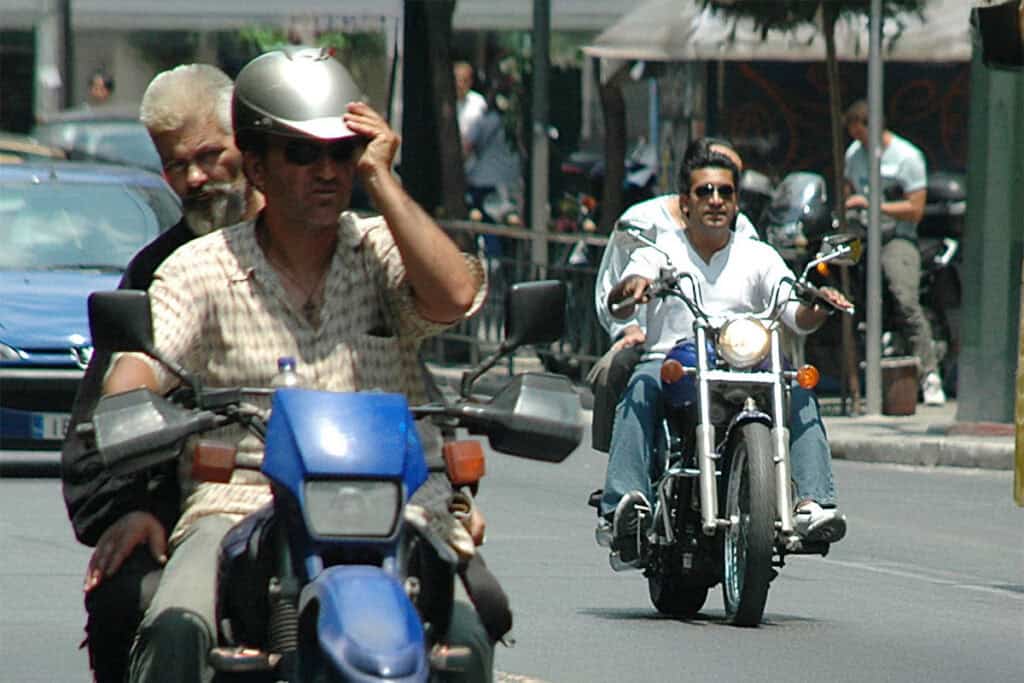
Meanwhile, Greek Americans who rent cars in the summer are stunned by what they see: scooters weaving through traffic, families riding without seatbelts, mountain roads taken at racing speed.
Why Greece Ranks Among Europe’s Most Dangerous Roads
The shrug comes at a heavy price. According to the European Road Safety Observatory, National Road Safety Profile 2024 – Greece, the country recorded 637 confirmed road deaths in 2023, equal to 61 fatalities per million inhabitants, compared to an EU average of 45. That puts the country near the bottom of the European ranking, 25th of 27 member states in 2024, ahead only of Bulgaria and Romania, as reported by RoadPol.
The problem grows worse in the summer, when millions of tourists swell the roads. Road tourism from Germany has declined, as most travelers now arrive by air and rent cars. But traffic from Greece’s Balkan neighbors has surged. INSETE figures published in Greek Travel Pages show that road arrivals into Greece reached 6.3 million vehicles in the first seven months of 2024, a 13.8 percent increase compared with the same period in 2023. Crossings at Promahonas on the Bulgarian border and Evzoni on the North Macedonian border accounted for over 3 million entries combined, highlighting the scale of seasonal pressure on Greece’s roads.
Road Safety in Greece: Key Facts
- Fatalities 2023: 637 people killed (ELSTAT, Road Accidents 2023 Report)
- Rate per million inhabitants: 61 (EU average 45, European Commission)
- Serious injuries 2023: 664 cases (ELSTAT, Road Accidents 2023 Report)
- Trend 2013–2023: –28% (879 → 637 deaths)
- Trend 2019–2023: –7% (688 → 637 deaths)
- Vehicles: Average car age in Greece is approximately 17 years vs. 12.3 years across the EU (ACEA)
- Seatbelts/Helmets: 71% front use, 56% rear; 80% riders, 65% passengers (EU far higher, ERSO observations)
- Enforcement: ETSC’s 16th Road Safety PIN Report shows Greece issued per 1,000 people: 19 speeding tickets (EU 140), 1.3 for phones (EU 4.4), 2.8 for seatbelts (EU 5.7)

The Pain Behind the Numbers
Every figure hides a face, a name, a family that will never be the same. Parents who will never see their children grow up, children who will grow up without a mother or father, and friends whose tables will always have an empty chair.
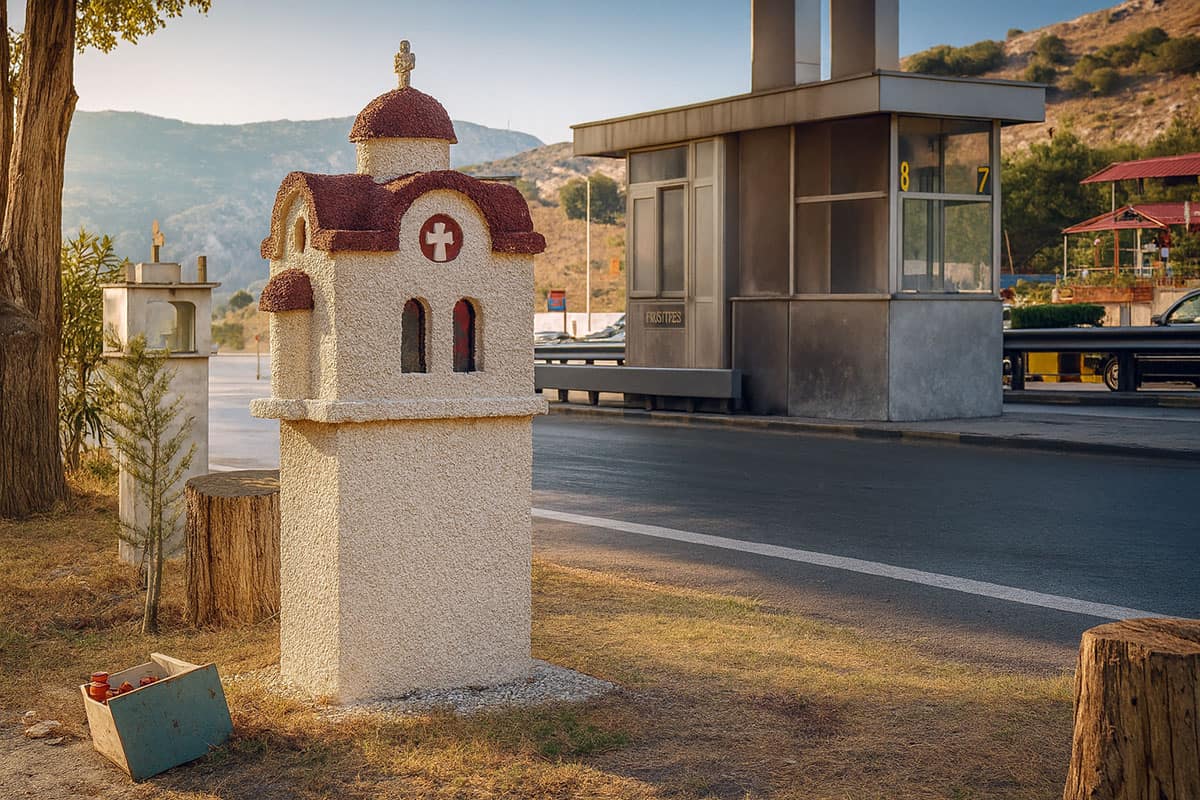
Roadside shrines across Greece, little white chapels filled with candles and photographs, tell the story better than any statistic. They mark the spot where life ended suddenly, where laughter was cut short, and where grief became permanent.
And the suffering does not end there. Court proceedings can stretch on for years, forcing families to relive the night of the crash again and again through testimony, evidence, and legal filings. A 2023 Supreme Court decision (Areios Pagos 808/2023, summarized by Conflictoflaws.net) confirmed that relatives are recognized as direct victims, entitled to moral damages under both domestic and EU rules. Yet in practice, the drawn-out trials and the burden of proof often make justice feel like punishment rather than relief.
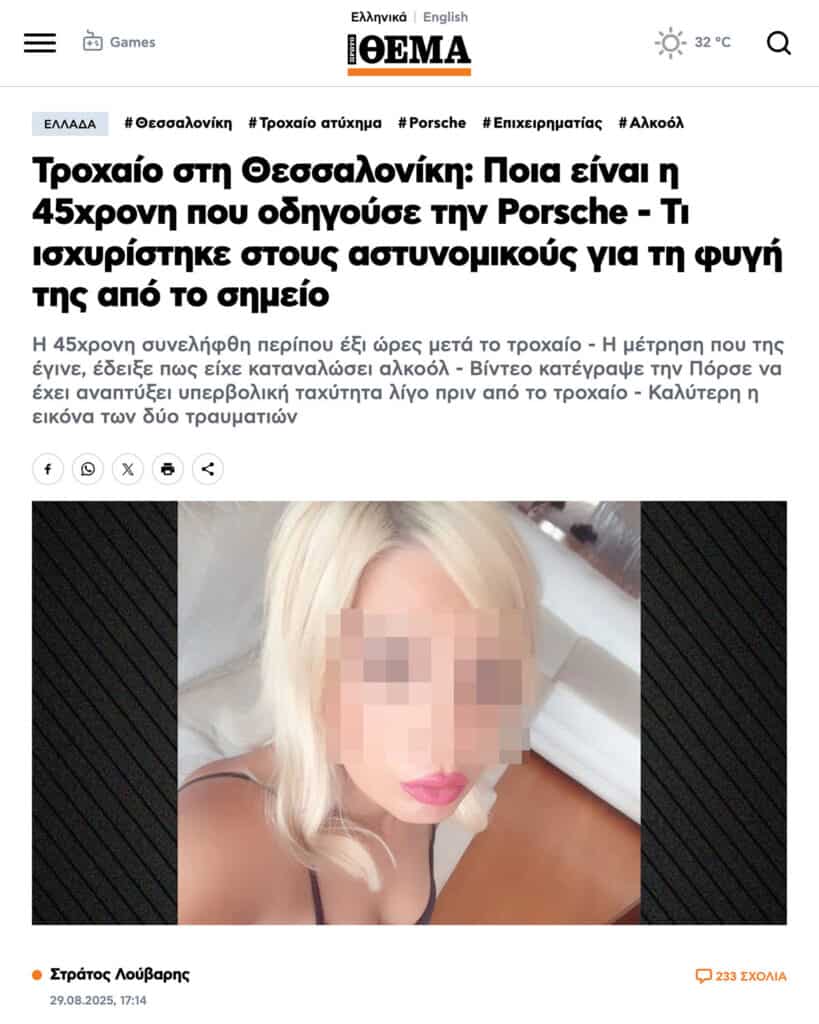
And there is another layer. When an expensive car is involved in a fatal crash, society rarely waits for the courts. The driver is automatically condemned in the public eye, seen as reckless or privileged. It is an echo of old divisions between ο λαός, the working people, and the wealthy. The media often feeds that narrative without question, shaping the story around class resentment instead of examining the facts. For the families left behind, that judgment can feel like another injustice: grief mixed with resentment, tragedy recast as class conflict.
For the diaspora, the contrast is striking. Greek Americans often describe driving in Greece as a shock: highways that suddenly narrow, cars overtaking on blind curves, pedestrians stepping into traffic without warning. At the rental counter, many quietly ask for an automatic. Back home, it is second nature, but in Greece, where manuals still rule the roads, that choice alone sets them apart.
Greeks from Germany tell a different story. In Stuttgart or Munich, they obey strict rules, endure frequent inspections, and live with the constant risk of heavy fines. But when they come to Greece for vacation, something shifts. The rules feel optional, and the freedom to bend them is embraced almost as part of being back home.
A train crash can shock the whole nation. A car crash, even one of hundreds each year, rarely draws more than a short column in the local paper. For the families left behind, the grief is the same, only quieter.
Rules on Paper, Chaos on the Roads
On paper, Greece has some of the strictest road safety rules in the EU. Helmets are mandatory for motorcyclists, seatbelts for all passengers, speed limits are clear, and fines for drunk driving or mobile phone use are steep.
In practice, the rules are widely ignored. Seatbelt use is only 71 percent in the front and 56 percent in the back, with helmet use at 80 percent for riders and 65 percent for passengers. All of these are well below EU averages. Enforcement is equally weak. ETSC notes that in 2020 Greece issued just 19 speeding tickets per 1,000 people compared to an EU average of nearly 140, with similarly low figures for phone and seatbelt violations.
Sometimes enforcement even seems misplaced. Police may fine drivers if their footwear is deemed unsafe, such as flip-flops that could slip off the pedal, while at the same time allowing widespread phone use. Texting at red lights is routine, scrolling while steering is common, and video calls behind the wheel are no longer unusual. The Thessaloniki laptop incident may sound extreme, but anyone who has spent time in Greece has seen scenes almost as shocking. Police officers admit their frustration: they stop one driver, but five more pass by doing the same thing.
What It Will Take to Save Lives
Few people understand speed better than Tasos Markouizos, the former rally driver better known as Iaveris. After a career in motorsports, he dedicated himself to raising awareness of road safety. He has described the decades of road deaths in Greece as nothing less than a “genocide.” The estimate that more than 120,000 people have been killed since the 1970s is widely cited by campaigners but remains an advocacy calculation, not an official total.

His message is blunt: fines and occasional crackdowns will not work. Road safety has to be taught from the ground up, starting in elementary school. Children, he argues, should grow up with road discipline as second nature, because trying to change habits in adulthood is nearly impossible.
Progress has been made. Between 2012 and 2021, Greece cut fatalities by 37 percent, outpacing the EU average reduction of 25 percent, according to the European Commission. New highways and safer cars have helped. Yet this progress hides a deeper imbalance. The major motorways, many built with EU funds, are among the safest in Europe.
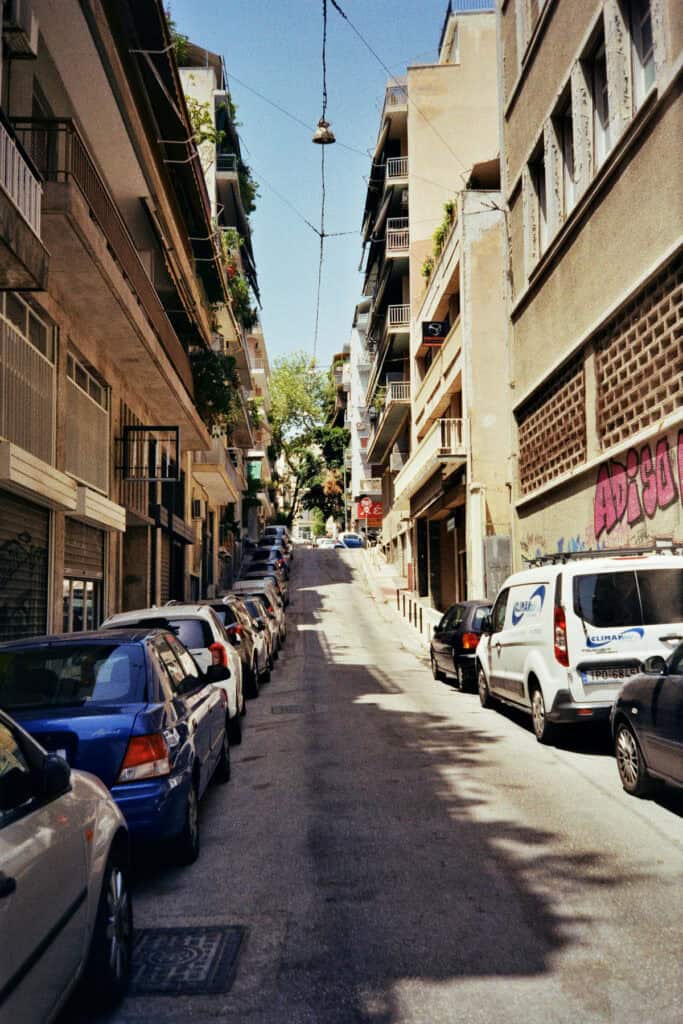
But the secondary and rural roads are often neglected, with poor signage, weak lighting, and little police presence. In the cities, where traffic is densest, pedestrians, cyclists, and motorcyclists pay the highest price. Sidewalks are often narrow, broken, or missing altogether, and even where they do exist, they are frequently blocked by parked cars. People end up walking in the street itself, turning even a short trip into a daily risk.
The government has announced new initiatives, including the installation of nearly 1,400 traffic cameras at intersections by 2026, with 388 due in 2025 and another 1,000 in 2026, as confirmed by Deputy Minister of Infrastructure and Transport Vasilis Oikonomou in Liberal. The same package includes a reduction of urban speed limits from 50 to 30 km/h in residential areas and stricter rules for electric scooters and bicycles. Whether these measures bring sustained change will depend on consistent enforcement and a cultural shift toward accountability.
Successful programs elsewhere show what works. Sweden’s “Vision Zero” strategy cut road deaths in half over two decades by redesigning roads, lowering urban speed limits to 30 km/h, and expanding automated enforcement. France reduced fatalities through strict drink-driving controls, while Spain achieved steady progress with widespread speed cameras. These examples prove that systemic change, not occasional campaigns, is the path to safety.
Greek newspapers have put it bluntly: every year, the country loses the equivalent of a small city to traffic accidents. Not to war, not to natural disaster, but to ordinary roads. And yet the perception of this loss is strangely muted. A train crash can shock a nation. In contrast, a single car crash, even one of hundreds annually, hardly registers. Two years after the Tempi rail disaster, which killed 57 people, Greece’s roads still claim nearly 600 lives each year, ten times more, but without triggering the national response it deserves.
Because in the end, there is no κακιά ώρα, no “bad hour” of fate. Accidents are not luck. They are choices behind the wheel. And in Greece, too often the response is just κάνε το σταυρό σου, make the sign of the cross, and hope.