
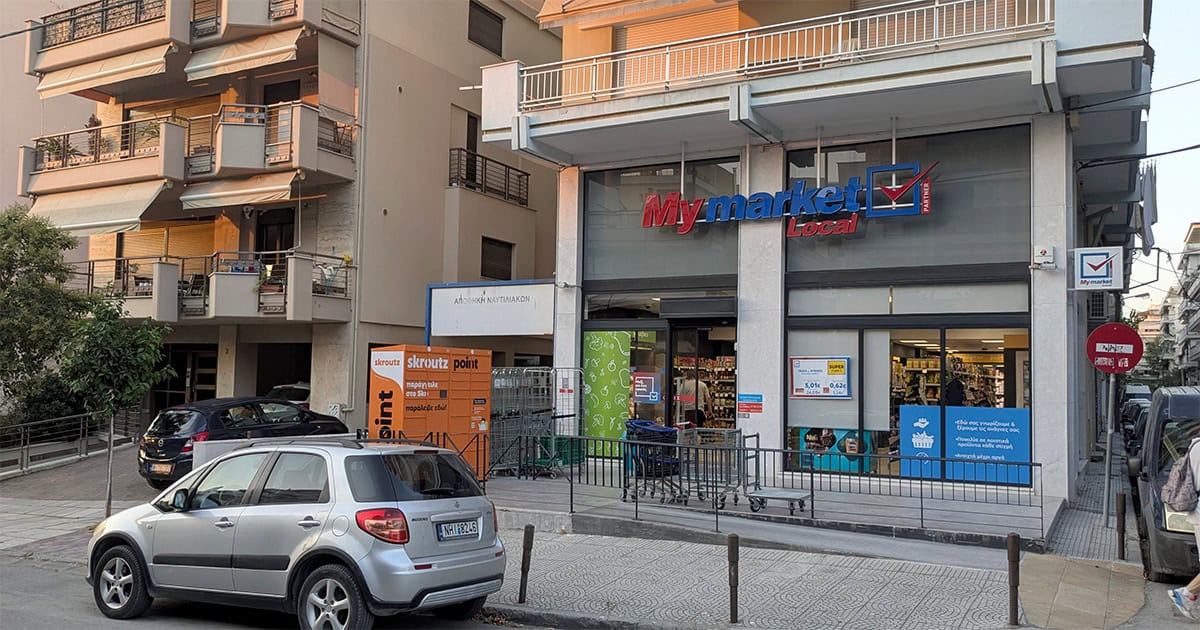
Walk through any Greek city today and you’ll notice something’s changing. The big-box supermarkets haven’t disappeared, but smaller, sleeker versions are appearing on every corner. Minimarkets, express stores, local franchises. In Athens and Thessaloniki, they’ve become part of daily life. On the islands, they’ve already taken over. And this year, they’re not just convenient, they’re redefining what grocery shopping looks like in Greece.
More people are shopping close to home. After the pandemic, fewer are willing to drive across town for a big weekly haul. They’d rather stop by a neighborhood store, pick up what they need for the day, and move on. Supermarkets have taken note. Instead of investing in massive locations on the city outskirts, major chains are opening compact, high-turnover shops tucked into apartment blocks, busy streets, and tourist zones.
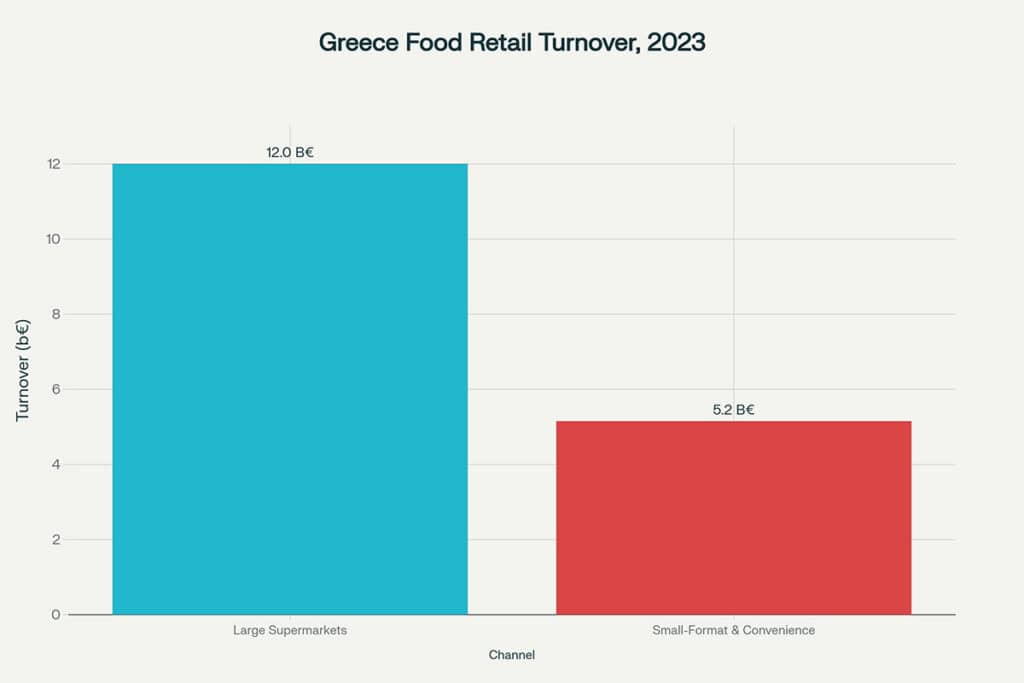
The numbers explain why. In 2023, small-format grocery stores, including minimarkets, kiosks, and convenience franchises, brought in about €5.15 billion in sales. Organized supermarkets over 400 square meters earned close to €11.8 billion. Large stores still account for most food-at-home spending, but smaller formats are growing faster, especially in dense urban areas and seasonal destinations.
Tourism adds another layer. In 2023, Greece welcomed around 32.7 million visitors. By mid-2024, the number had climbed past 40 million, setting a new record. These travelers are not filling carts for the week. They are grabbing bottled water, snacks, sunscreen, and a cold drink near their hotel or rental.
Some of Greece’s largest supermarket brands are leaning into this shift. AB Vassilopoulos is expanding its Shop & Go network through franchise partners, with more than 180 new points planned and €60 million in annual investment through 2025. My Market is testing its Local format in central Athens. Masoutis has launched new franchised locations across smaller towns and islands.
A few German friends recently asked me to help them find an Airbnb in Thessaloniki, not just anywhere, but specifically near a 4 ALL. They had stayed near one the previous summer and went there daily. For them, it wasn’t just a place to grab something quick. It became part of the trip. Morning coffee from the counter, cold beers in the afternoon, late-night snacks before bed. It had everything they needed without feeling like a grocery store. More than that, it felt local. That 4 ALL on Sofouli Street hadn’t always been there. A few years ago, it was a Chinese outlet. Before that, a café. And before that, a car showroom. The building hasn’t changed much. What it sells, and what it means to the neighborhood, keeps shifting.
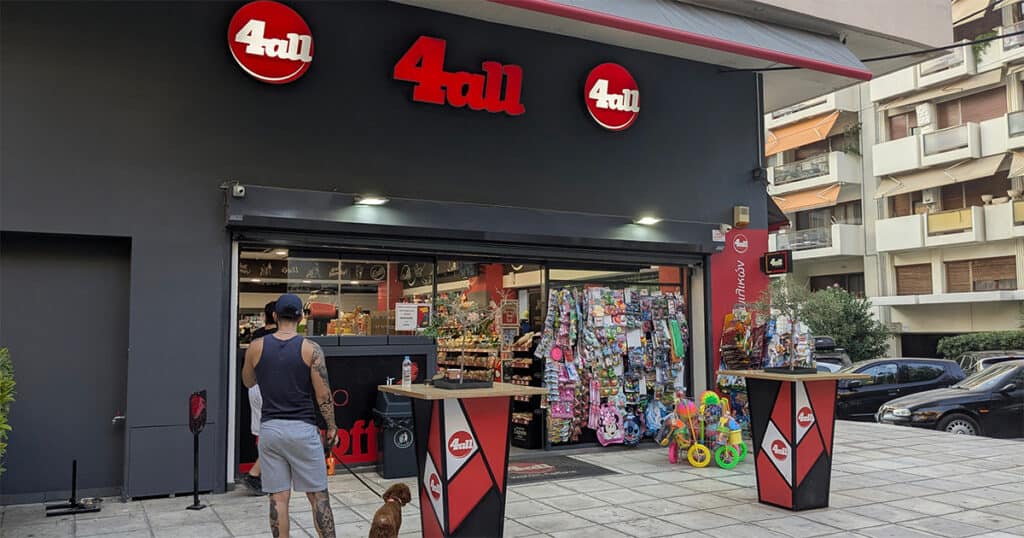
Chains that were once secondary are now everywhere, many operating 24 hours and offering espresso alongside groceries. Brands like OK! Anytime Markets and KIOSKY’S have leaned into the hybrid model. Their franchise guides highlight in-store coffee bars as key profit centers. It’s not just a side business. It’s part of the store’s identity.
This isn’t just a shift in consumer habits. It’s a structural change in how retail space is used. Larger supermarkets face high overhead and zoning barriers in dense cities. Smaller shops are cheaper to operate and quicker to open, especially with franchisor support. AB’s franchise system has become a popular entry point for new entrepreneurs.
But to some, these new shops represent more than efficiency. They also mark the loss of something personal. The old corner store wasn’t just convenient. It was where the owner knew your name, not just your buying patterns.
Still, none of this is entirely new. Greece has always had minimarkets in one form or another. Long before today’s branded express stores, there were the μπακάλικα — family-run grocers that stocked everything from lentils and tomato paste to soap and cigarettes. They were part of the street, part of the neighborhood. As supermarkets expanded in the 1990s and early 2000s, many of these small shops disappeared or struggled to modernize. Today, they’re facing pressure again, but this time from their closest descendants.
Franchise-backed minimarkets are also squeezing out independent kiosks. Between 2021 and 2023, kiosk ownership fell by more than 4 percent, while chains expanded over 12 percent, according to ELSTAT data. Some kiosks survive on loyal customers. Others are gradually losing foot traffic to brighter, cleaner, better-stocked alternatives just a few steps away.
Sklavenitis has taken a different path. Unlike other chains, it has not introduced a compact store format. Instead, it has focused on logistics and scale, supporting large supermarkets and rapid delivery through e-food. While others shrink the footprint, Sklavenitis is aiming to dominate fulfillment and inventory depth.
The shift toward smaller, closer shopping is not just a Greek phenomenon. In the United States, companies like Kroger and Whole Foods have been experimenting with compact formats. But progress has been slower. In many American cities, car culture and zoning laws still favor large suburban stores. Greece’s older infrastructure makes compact formats a more natural fit.
Some of these small-format shops now double as delivery hubs. OK! offers one-hour fulfillment. Traditional grocers like Sklavenitis rely on digital platforms to connect physical inventory with same-day e-commerce. The minimarket is no longer just a place to shop. It’s a node in the logistics network.
In the end, this is not just a shift in retail. It’s a reflection of how people live. Whether you’re grabbing tomatoes after work or bottled water on vacation, the shop is already nearby. Whether it’s a Shop & Go or a 4 ALL with a barista and a plastic stool outside, the corner store is once again the heart of the neighborhood.
Maybe it always was.