

When you walk through a Greek island in summer, it can feel like the whole world has arrived. Harbors overflow with yachts and cruise ships, cafés hum with every language imaginable, and the whitewashed alleys of Santorini or Mykonos glow like postcards come to life.
It’s the kind of success story Greece once dreamed of, until you look closer.
According to the World Travel and Tourism Council, tourism now makes up more than 21 percent of Greece’s GDP, one of the highest rates in the world. In 2024, more than 33 million visitors came to a country of just 10 million people. Revenues rose another 12 percent in 2025, and Americans alone are visiting Greek islands at rates nearly 65 percent higher than last year.
But behind those glittering numbers is a different story, one of strained infrastructure, vanishing local life, and an economy that’s pricing its own people out of the very paradise they built.
A Success Story That Went Too Far
After the financial collapse of the 2010s, tourism became Greece’s lifeline. When factories closed and jobs disappeared, the sea and the sun never failed. The government poured everything into attracting visitors, and for a while, it worked.
Santorini now welcomes 3.5 million visitors a year, more than 200 times its resident population. Mykonos hosts nearly 300 tourists for every local. Seven Greek islands rank among the 30 most visited in the world.
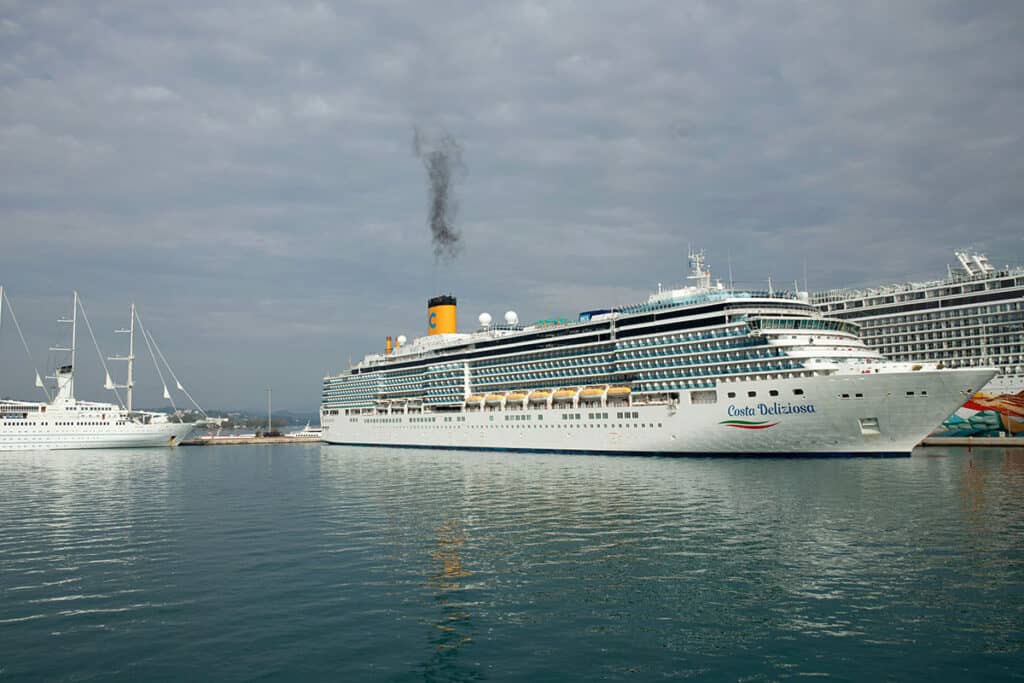
But that same success is now showing its limits. A recent report by the National Bank of Greece describes a system on the verge of collapse: harbors built in the 1960s trying to handle cruise ships 65 times larger than what they were designed for, power grids flickering under summer demand, and raw sewage spilling into harbors.
In Zakynthos, a landfill containing 530,000 tons of garbage sits inside a protected national park, defying EU orders to close. Across Greece, illegal dumps and weak sewage systems have already cost the country €149 million in EU fines.
Meanwhile, islands like Sifnos are running out of water. During a 2025 drought, locals endured ten-day water cuts while hotels kept their pools full.
The Hidden Cost of a Tourism Machine
Greece’s islands were never built to handle the pressures of global tourism. Their roads, harbors, and power lines were designed for fishing villages and small ferries, not fleets of cruise ships and luxury resorts. What began as a model for economic recovery has become a nationwide infrastructure trap.
Ports and Transport
Most island ports were last expanded in the 1970s. On Santorini, passengers from as many as eight cruise ships disembark into a single harbor with limited docking space. To reach Fira, 150 meters above sea level, there’s only a cable car that fits 1,200 people per hour. During peak hours, tourists stand in the sun for hours waiting to board, while others climb the steep donkey path carved into volcanic rock. In an emergency, such as the 7.4-magnitude earthquake that struck nearby in May 2024, Santorini has no port capable of evacuating its visitors.
Electricity and Water
Energy consumption surges by more than 60 percent during the summer months, pushing local grids to the brink. Many islands still rely on imported oil for electricity, making power both expensive and fragile. The growth of desalination plants has helped address water shortages, but those systems require huge amounts of energy to run. As fuel and electricity costs rise, desalination becomes increasingly unsustainable, creating a circular crisis: more tourists require more water, which requires more energy, which strains both the grid and local budgets.
Waste and Sewage
Greece’s waste management systems are collapsing under the weight of its own success. The European Commission lists more than 50 illegal waste dumps still in operation. On islands like Mykonos and Rhodes, sewage systems overflow during the summer, contaminating the same beaches sold as paradise. In 2023, shops in Mykonos’ harbor district had to close for days after sewage backed up into streets and cafés.
Roads and Public Transit
Even the simplest infrastructure, the roads, has failed to keep up. Narrow lanes built for donkeys and small trucks now carry rental cars, tour buses, and delivery vans for hotels and restaurants. Traffic jams stretch for miles on roads that were never meant to exist at this scale. On Paros, locals report 45-minute drives between villages that once took ten. The air fills with exhaust as thousands of scooters and ATVs crawl through the heat.
The Sea and the Sewage
The biggest danger lies beneath the surface. In dozens of coastal towns, wastewater treatment plants operate beyond capacity or not at all. Sewage seeps into the sea, polluting the very beaches that attract visitors. Environmental groups have documented recurring “red flag” warnings across the Cyclades, where bacteria levels exceed EU safety limits. Each season, the problem worsens as tourism outpaces every local attempt at repair.
The system is cracking not only physically but socially.
When Locals Can’t Afford Greece
Perhaps the most painful paradox is this: while tourism breaks revenue records, 46 percent of Greeks can’t afford a one-week vacation at home, nearly double the European average.
For many Greeks, summer holidays are becoming a memory. A night on a modest island now costs around €200, a ferry trip for a family €450. Average monthly wages hover around €850.
For retail worker Ismini Balale, earning €850 a month in Athens, a weekend on Aegina costs nearly half her paycheck. The irony is sharp: foreigners now experience the “authentic Greece” locals can no longer afford. Some Greeks are even booking cheaper holidays in Turkey or the Balkans.
And while cruise ships deliver thousands of visitors daily, they leave behind little for local economies. Hotels sit at 30 percent capacity in high season because so many tourists return to their ships each night.
The Cracks Show
Across the islands, frustration is turning into resistance. Locals in Paros and Naxos have started the “beach towel revolt” to reclaim public beaches from private operators. In Athens, “anti-tourism tours” take visitors through overbuilt neighborhoods to show the side of Greece no influencer posts online.
Even Santorini’s mayor, Nikos Zorzos, has admitted things have gone too far. He has proposed a daily limit of 8,000 cruise ship visitors, a cap the government has indicated support for, with possible 2026 implementation.
But it isn’t only locals losing patience. Major investors are beginning to walk away. In mid-2025, Goldman Sachs canceled three resort projects in northern Greece, citing years of bureaucratic delays and €200 million in cost overruns.
Meanwhile, climate change is accelerating the crisis. Wildfires in Corfu, Lefkada, and Zante forced evacuations this summer, and record heat shut down the Acropolis for safety. As desalination plants provide critical water supplies, rising electricity costs threaten their viability during peak season. Greece recorded its hottest June and July in recorded history this year, with reservoirs declining 30 percent. Each year, the infrastructure and the environment fall further behind the influx of visitors.
The National Bank estimates Greece will need €35 billion in infrastructure investment by 2035 just to sustain current levels of tourism. Without it, power outages, water shortages, and sewage crises will only worsen.
A Country at a Crossroads
Prime Minister Kyriakos Mitsotakis has begun talking about diversifying Greece’s economy into renewable energy, data centers, and logistics hubs. But everyone knows tourism remains the country’s economic engine. Stopping it, even slowing it, feels unthinkable.
Yet the question grows louder: At what point does success become self-destruction?
Greece has become a nation that sells the dream of its islands to the world while making that dream unreachable for nearly half its people. The beaches are crowded, the ports are strained, and the landscapes that once inspired the word “paradise” are suffocating under their own popularity.
Until Greece finds a way to balance prosperity with preservation, the crisis beneath the surface will keep deepening. The sea will still shimmer, the sunsets will still draw crowds, but the Greece locals know is slowly slipping out of reach.