
As the U.S. conflict with Iran continues to unfold, a familiar narrative has begun to circulate: that Greece, once again, has aligned itself with the United States amid a geopolitical shift.
The framing has appeared in parts of the press and in opinion pieces, where Greece’s role has been cited alongside broader discussions about how Washington may reassess its relationships with European partners.
The argument is not complicated. Greece aligned with the United States and allowed the use of key infrastructure during the conflict. That alone has been enough for some to frame its role as decisive.
From there, the conclusion follows easily. Greece, the story goes, is among the winners.
But that depends on what “winning” means.
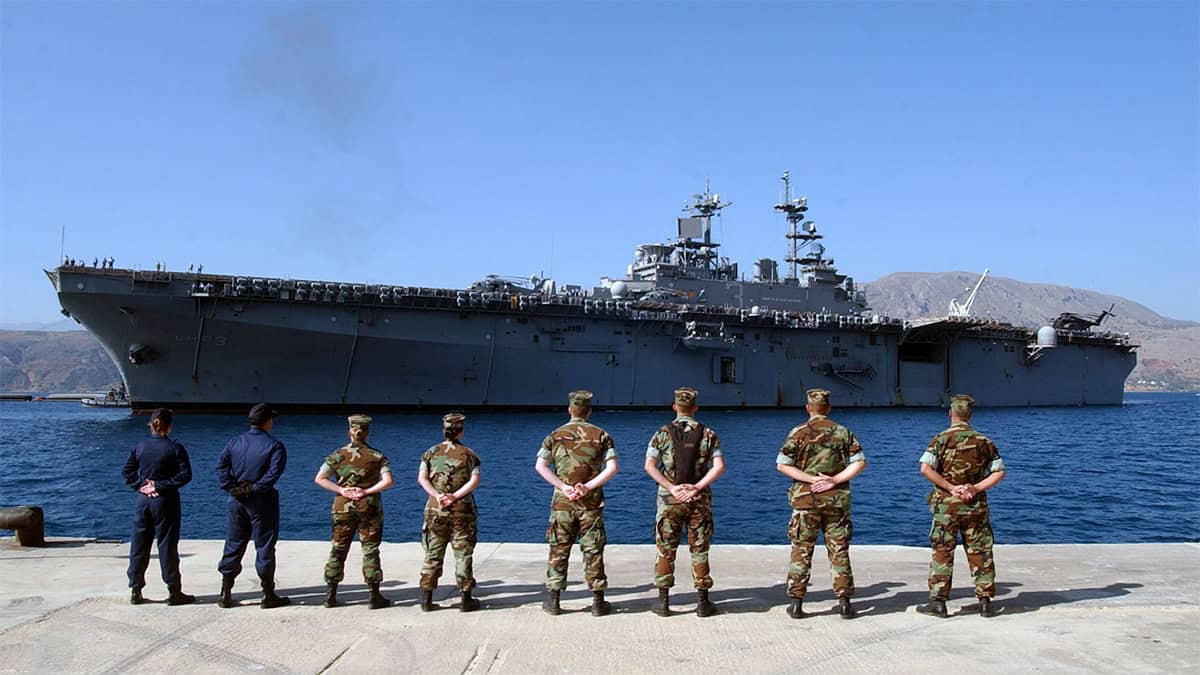
Greece was among the countries that provided logistical support, with Souda Bay serving as a key hub for resupply and operations, reinforcing a long-established role in U.S. military activity in the Eastern Mediterranean.
The relationship is longstanding and clearly defined. What is less clear is how much of this represents something new.
The presence of U.S. forces in Greece, particularly in Crete, did not emerge with this conflict. Souda Bay has been a central point for operations in the region for years, across different administrations and crises. Its role in the region has been consistent over time.
It is also worth remembering that the presence of U.S. bases in Greece has not always been viewed through the same lens. For decades, it was a source of political tension, particularly in the years following the fall of the dictatorship, when opposition to foreign military installations became a defining issue for parts of the political spectrum. In the 1980s, Andreas Papandreou and his PASOK party adopted the slogan “Έξω οι βάσεις του θανάτου” (“Out with the bases of death”), echoing sentiments that were widely present at the time.
Yet once in power, Papandreou moved to renegotiate rather than remove the bases, presenting the agreement that followed as serving Greece’s national interests.
Similar expectations have surfaced before. During the NATO bombing of Yugoslavia in 1999, a widespread belief circulated in Greek business and financial circles, particularly among those active in the stock market during its bubble years, that Greece would emerge as a preferred partner in the reconstruction of Serbia. It was less a policy position than a speculative conviction, absorbed into the optimism of the moment. In practice, the outcome proved more complex, shaped by broader international dynamics rather than the expectations formed at the time.
Framing Greece’s current position as a ‘win’ suggests a shift that has yet to be defined.
Much of the current framing rests on the idea that alignment with Washington will translate into tangible benefits. Reports in U.S. media have suggested that the administration is considering adjustments to its military footprint in Europe, potentially shifting resources toward countries seen as more cooperative. That possibility has been cited as one reason Greece is now being described as a potential beneficiary.
But at this stage, these remain signals, not decisions.
There has been no formal announcement of new agreements specifically tied to this conflict. The expansion of the U.S. presence in Greece is real, including a $75 million construction contract at Souda Bay, a $42 million upgrade to the 115th Air Wing, and ongoing discussions about additional sites. However, it flows from the revised Mutual Defense Cooperation Agreement of 2021, not from the Iran conflict. The trajectory was already set. What the conflict has added, for now, is visibility rather than a change in direction.
Part of that interpretation is also shaped by how Greece’s position is viewed in relation to Turkey. The two countries have long occupied a complex place within U.S. strategic planning in the Eastern Mediterranean, at times overlapping, at times diverging. In recent years, tensions between Washington and Ankara have led to a recalibration of that relationship, shaping how Greece’s position is perceived by comparison.
That contrast reflects perception more than policy.
There is also a broader issue that tends to get lost in this kind of framing.
Conflicts like this rarely produce clear winners for countries operating at the edges of them. They produce exposure.
An economic dimension also complicates any claim of a “win.” Greece, as part of a wider European and global system, is not insulated from the broader effects of instability, even when it is not directly involved. Those pressures move in a different direction from the idea of short-term gains tied to its strategic role.
Greece’s role, while consistent with its existing relationship with the United States, also places it more directly within a volatile regional landscape. Military infrastructure that supports operations can, under different conditions, become part of that landscape in less predictable ways.
That is not a theoretical concern. It is part of the strategic reality that comes with proximity and participation.
At a more everyday level, the idea of a “win” is often understood in practical terms: more personnel, more activity around bases, and the local economic benefits that come with it.
At the same time, the presence of foreign troops has never been universally accepted in Greece. A part of the public remains uncomfortable with it, while another sees it as a source of stability or opportunity. That tension has not been resolved, and it continues to shape how developments like this are interpreted.
It is within that unresolved space that the current narrative of a “win” takes hold.
A more meaningful way to assess Greece’s position would be to look for outcomes that go beyond visibility. A clearer signal would come in the form of formal agreements, expanded and defined U.S. military presence, or a measurable shift in how Greece is positioned within Washington’s regional planning. Economic commitments tied to infrastructure or long-term cooperation would point in the same direction.
Those are the kinds of developments that would indicate a change in status rather than a continuation of an existing role.
The idea of Greece as a “winner” in the ongoing U.S.–Iran conflict is, at this point, a reflection of interpretation rather than measurable change.
Greece is acting within a role it has held for years. It is providing access, support, and continuity within an existing framework. Whether that translates into something more will depend on decisions that have not yet been made.
Until then, the language of victory says more about the narrative than it does about the reality.