
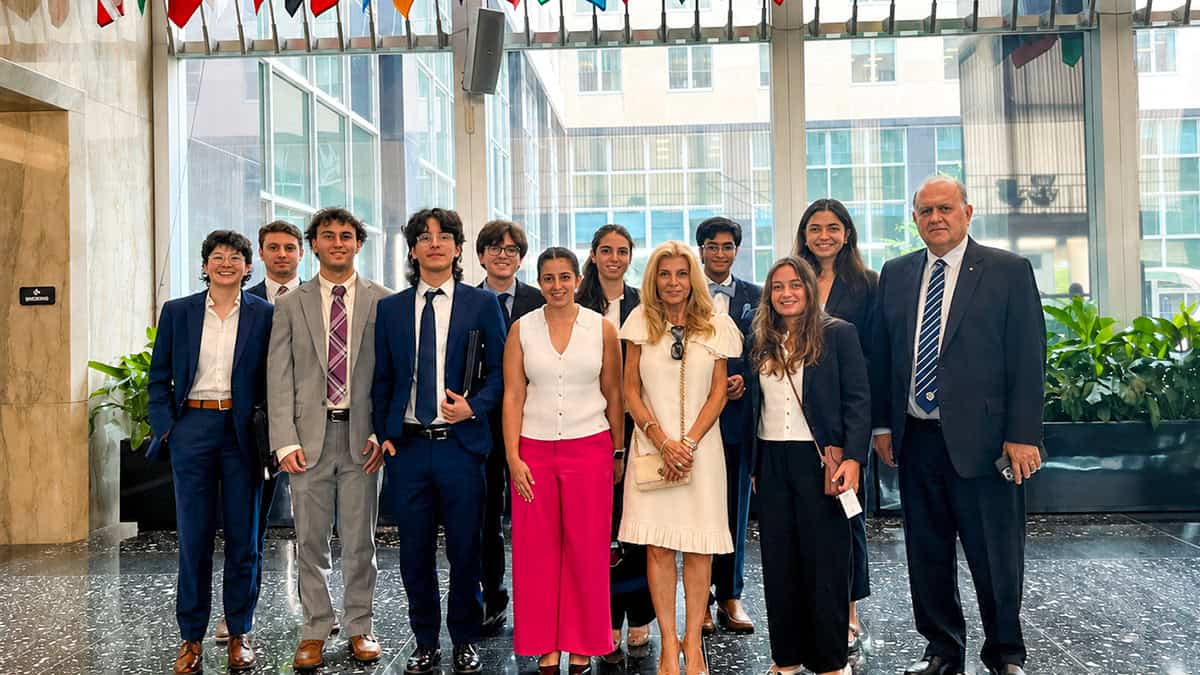
WASHINGTON, D.C. — Nine Greek American and Hellenic students began the 18th year of the American Hellenic Institute Foundation’s College Student Foreign Policy Trip with three days of briefings in Washington, D.C., before continuing to Cyprus and Greece.
The Washington program ran June 22–24 and included meetings at AHI’s Hellenic House, the embassies of Greece and Cyprus, and the U.S. Department of State, according to the American Hellenic Institute. The trip is scheduled to conclude July 10 after the students return from Athens.
AHI, a Washington-based Greek American public policy and advocacy organization, has long focused on strengthening U.S. relations with Greece and Cyprus. Its foundation runs the annual student program around diplomacy, regional security, and the Eastern Mediterranean.
“For 18 years, this program has helped students develop a deeper understanding of the foreign policy issues shaping the Eastern Mediterranean and advancing U.S. interests in the region,” AHI President Nick Larigakis said.
Greece and Cyprus remain part of several issues moving through Washington: NATO cooperation, maritime security, energy routes, Turkey, the Cyprus issue, and the security of the Eastern Mediterranean. On June 17, the Senate Foreign Relations Committee advanced the bipartisan Eastern Mediterranean Gateway Act, a bill introduced by U.S. Senators Cory Booker of New Jersey and Dave McCormick of Pennsylvania to strengthen U.S. engagement with the region as a link between the United States, India, the Middle East, and Europe.
The Washington portion began with briefings by Larigakis and AHI Legislative Assistant Will Martin. Students then met with Greece’s ambassador to the United States, Antonis Alexandridis, and the Republic of Cyprus’ ambassador to the United States, Evangelos Savva, at their respective embassies.
At the State Department, the delegation met with Daniel Lawton, deputy assistant secretary in the Bureau of European and Eurasian Affairs. The students also held discussions with Christine Lawson, director of the Office of Southern European Affairs, and Claire Zimmerman, unit chief for Greece, Cyprus, and Malta.
Other sessions brought in policy analysts, academics, national security specialists, and journalists, including John Sitilides of the Center for the National Interest, Andrew Novo of the National Defense University, Dimitris Tsarouhas of ELIAMEP’s Washington office, Gregory Graves of George Washington University, national security analyst Jack Dulgarian, and Lena Argiri, Washington correspondent for ERT and Kathimerini.
The next part of the trip takes the students to sites tied to U.S.-Greece-Cyprus relations. In Greece, the schedule includes Naval Support Activity Souda Bay in Crete, the NATO Missile Firing Installation, the NATO Maritime Interdiction Operational Training Centre, and Salamis Naval Base. In Cyprus, planned stops include occupied northern Cyprus, the Joint Rescue Coordination Center, and CYCLOPS, the Cyprus Centre for Land, Open Seas and Port Security.
Those visits put the students near several subjects usually discussed from a distance: defense cooperation, maritime security, search and rescue, and the Cyprus issue. Souda Bay remains a key point for U.S. and NATO activity in the Eastern Mediterranean. NMIOTC, located in the Souda Bay area, is NATO’s maritime training facility for interdiction and related operations.
In Cyprus, the students will also encounter the island’s division directly. The U.S. State Department notes that the northern part of Cyprus has been administered by Turkish Cypriots since 1974, that the self-declared “TRNC” is recognized only by Turkey, and that a United Nations buffer zone separates the two sides.
The delegation includes Spyridon Kass, Marilena Kifnidis, Lukas Koutsoukos, Maria Kyriacou, Demetrios Lahiri, George Mantalvanos, Constantina Moustakis, Anna Papakirk, and Iasmi Siopsis. Kifnidis is a rising sophomore at Lehigh University in Bethlehem, Pennsylvania, where she studies International Relations and Economics.
The students come from universities in the United States and abroad, with academic interests that include international relations, economics, law, public policy, journalism, business, diplomacy, mathematics, and public service.
For many of them, the trip offers an early look at the institutions and disputes that shape relations among Washington, Athens, and Nicosia. It begins with briefings in the capital and continues in places where geography, security, and diplomacy meet.