
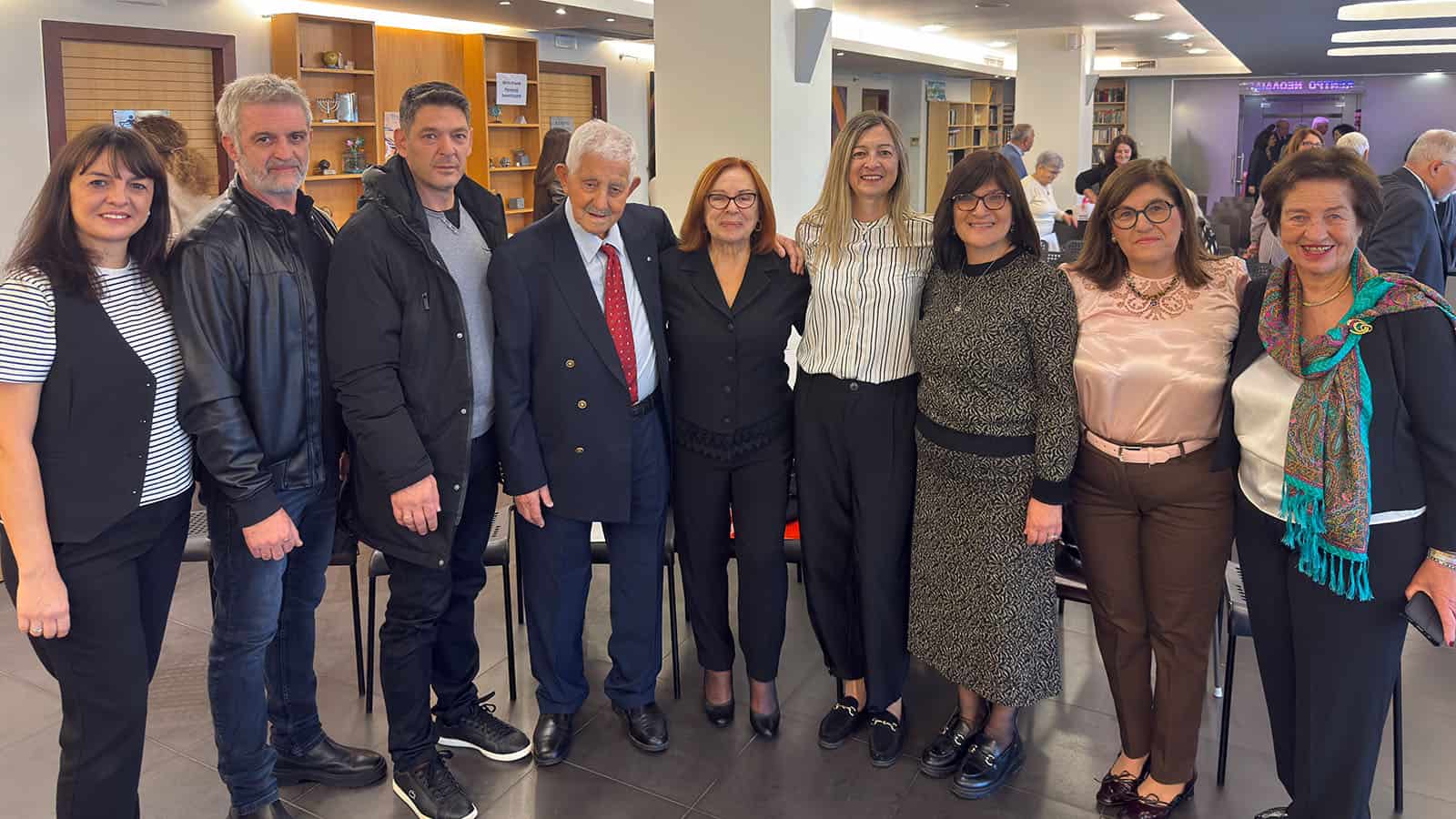
A Greek couple who sheltered a Jewish family during the Nazi occupation of Greece were posthumously honored as Righteous Among the Nations at a ceremony in Thessaloniki on November 1, 2026. Among those attending was Holocaust survivor Victor Venouziou, whose family the couple had protected more than eight decades earlier.
Ilias and Maria Machaira received the recognition from Yad Vashem, Israel’s Holocaust remembrance center, which honors non-Jews who risked their lives to save Jews during the Holocaust. Their daughter, Ifigenia Machaira, accepted the medal and diploma from Israel’s ambassador to Greece, Pninat Yanay, at the Jewish Community Center of Thessaloniki.
“Be proud of your parents and honor their memory,” Venouziou told Ifigenia, according to ERT’s coverage of the ceremony. He thanked her parents and said attending the ceremony to express his gratitude had been a lifelong goal.
Shelter in a Thessalian mountain village
Solomon and Esther Venouziou and their three children fled their home in Karditsa during the German occupation. After seeking refuge in other villages, they reached Mastrogianni, now known as Amarantos, a mountain village approximately 27 kilometers south of Karditsa.
From April until October 1944, the five family members stayed in the home of Ilias and Maria Machaira, a recently married couple who lived with Ilias’s parents, Leonidas and Agapoula.
The village, then under the control of Greek resistance fighters, had become a refuge for Jews fleeing persecution. Residents sheltered 82 Jews from Karditsa and other parts of Greece. Although villagers traveled regularly to the market in Karditsa, none revealed the presence of the refugees to German authorities.
In a 2022 oral-history interview preserved by the Istorima Archive, Venouziou recalled arriving in Mastrogianni and being welcomed into a home where the family was offered food. Someone suggested preparing a pie for the newcomers. While his parents settled in, he went outside to play.
He also remembered how the family managed its daily needs. His job was to gather firewood so his mother could cook. Esther, a seamstress, repaired villagers’ clothing in exchange for food, sometimes receiving a chicken, cheese, or milk. Solomon continued trading goods between nearby villages, occasionally assisted by Ilias Machaira, who helped obtain merchandise from Karditsa.
Venouziou recalled that the villagers had limited resources themselves but shared what they could. The refugees also benefited from the protection of resistance fighters operating in the area.
When German forces withdrew in October 1944, the Venouziou family returned to Karditsa. They found that neighbors had preserved possessions and merchandise entrusted to them during their absence.
The friendship between the Venouziou and Machaira families continued for many years after the war.
Remembering those who helped
Venouziou later became active in Jewish communal life in Greece, serving in leadership positions and working to preserve the history of Jewish communities and Holocaust victims.
His connection to Amarantos remained important. In 2017, he funded a memorial honoring the villagers who sheltered 82 Jews during the occupation. Unveiled on June 18, the monument was attended by surviving refugees, their descendants, and local residents.
At the Thessaloniki ceremony, Ifigenia Machaira described her parents as people who helped others without expecting anything in return. She also remembered her sister, who had passed away a few months earlier after learning that their parents would receive the honor.
Other members of the Venouziou family attended, including Victor’s sister, Lucy, and his niece Claire Venouziou, daughter of his late brother Markos.
Claire spoke of the family’s gratitude toward the people of Amarantos, particularly the Machairas. Their willingness to shelter five people in 1944, she said, had allowed her father and his siblings to survive, raise families of their own, and see their children and grandchildren.
Source: ERT/ANA-MPA.