
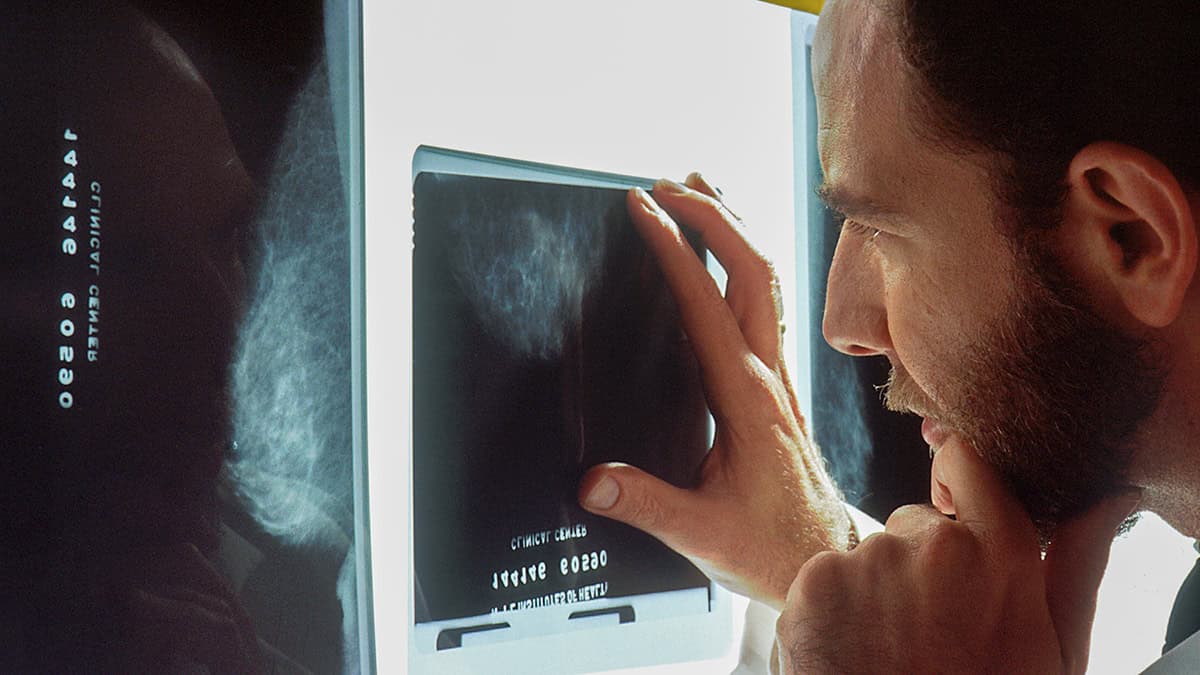
Two Greek researchers co-authored a Swedish study that found commercial artificial intelligence systems assigned elevated scores to some mammograms years before breast cancer was diagnosed, suggesting the technology could eventually help identify women who may benefit from supplemental screening.
Published June 9 in Radiology, the retrospective study analyzed 88,963 screening mammograms from 31,394 women across four regions of Sweden. Researchers applied three commercially available AI systems to examinations performed between January 2008 and April 2019 and tracked how their scores changed in the years before a recorded cancer diagnosis.
At a threshold corresponding to 90% specificity, the three systems potentially flagged between 19% and 19.7% of cancers six years before diagnosis. Four years beforehand, the range was 23.3% to 25.2%. At two years, it rose from 35.4% to 39.3%.
Elevated scores appeared in a smaller share of cases even farther back. Ten years before diagnosis, the systems potentially flagged between 12.7% and 17% of cancers.
The finding does not mean AI had diagnosed those cancers years before physicians did. Because the analysis was retrospective, researchers examined earlier mammograms after the women’s subsequent outcomes were known. Nor did an elevated score establish that a lesion could have been localized, confirmed, or treated at that earlier examination.
The authors instead describe the potential use as an “early alert” that could prompt supplemental imaging or closer surveillance. That approach would require further clinical testing before becoming part of routine breast screening.
Sarah Hickman was the paper’s first author, while Karolinska Institutet radiologist Fredrik Strand served as senior co-author. Pantelis Gialias and Apostolia Tsirikoglou were among the nine researchers credited on the paper.
In RSNA’s account of the research, Strand said changes in AI scores across successive mammograms could eventually help identify women who warrant closer surveillance or additional imaging.
The paper drew renewed attention in Greek media in late August, more than two months after its publication, with attention focusing in part on the participation of Gialias and Tsirikoglou.
In comments reported by Greek media, Gialias said AI may be responding to changes too subtle for a radiologist to confidently classify as suspicious. He cited small disturbances in breast architecture and gradual changes in breast density as examples.
That would not necessarily mean a recognizable tumor was present and overlooked on an earlier mammogram. The systems may instead be assigning weight to subtle patterns that become more pronounced as diagnosis approaches.
Across the dataset, AI scores tended to rise as diagnosis approached among women who later developed breast cancer. Scores among women who remained cancer-free were comparatively stable. Researchers are examining whether changes across repeated screenings could provide information that is difficult to draw from a single mammogram.
Gialias completed his specialist training in radiology in Greece before moving to Sweden in 2012. He later served as chief and medical director of breast imaging at Linköping University Hospital. He is now a consultant radiologist at Mediterranean Hospital of Cyprus in Limassol, specializing in breast imaging.
Tsirikoglou is a Research Specialist in the Department of Oncology-Pathology at Karolinska Institutet and works with Strand’s Computational Breast Imaging group.
She earned an engineering degree in electrical and computer engineering from Aristotle University of Thessaloniki before continuing her studies at Linköping University, where she completed graduate work in media technology and a doctorate focused on synthetic data for visual machine learning.
The study does not show whether acting on elevated scores years earlier would improve survival, reduce the incidence of advanced cancers, or justify changing screening schedules. It also used an enriched retrospective dataset and did not establish that earlier elevated scores corresponded to the same location where cancer was later diagnosed.
Prospective studies would have to determine whether those signals can identify women who genuinely benefit from earlier follow-up. If they can, tracking AI scores across successive mammograms could give radiologists another factor to consider when deciding whether supplemental imaging is warranted.