
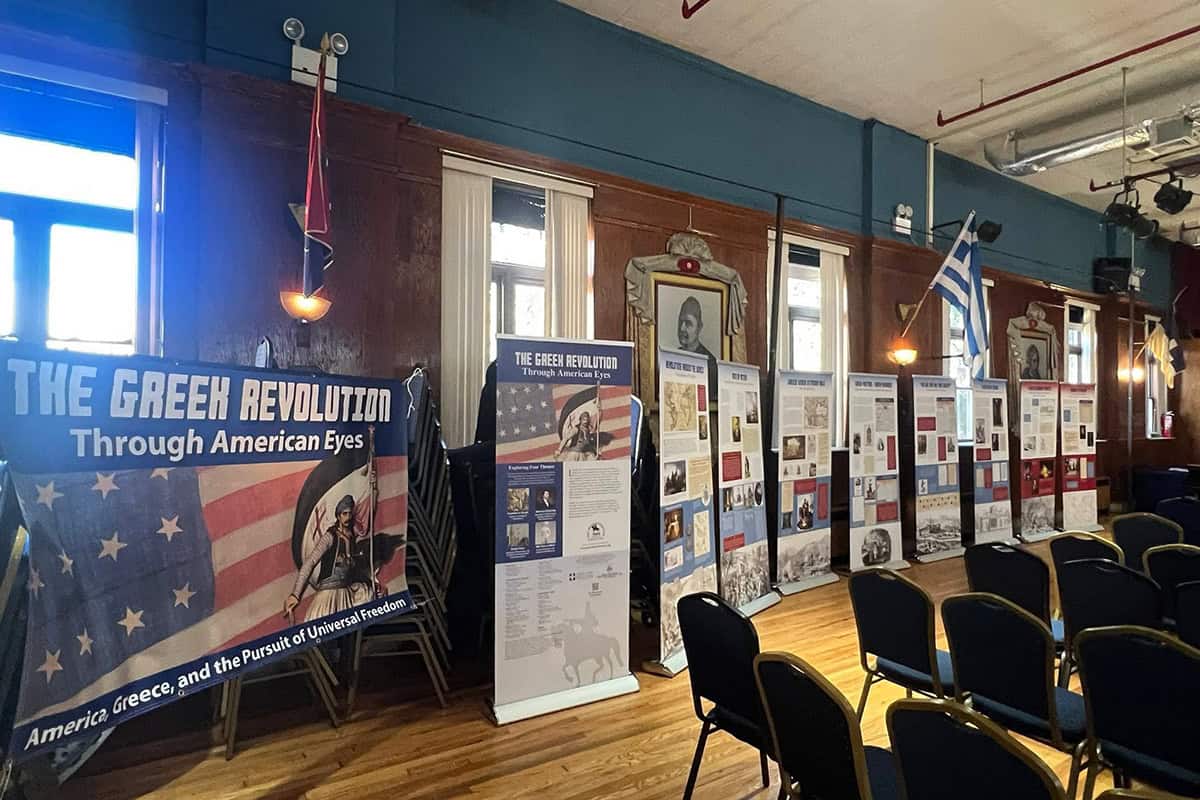
At a cultural center in Astoria, a new exhibition is revisiting the Greek Revolution from an unexpected angle: how Americans saw it as it was unfolding.
“The Greek Revolution (1821–1829) Through American Eyes,” now on view at the Stathakion Cultural Center, brings that perspective into physical form for the first time. The exhibition traces how Americans understood, supported, and sometimes reinterpreted Greece’s struggle for independence. It is not just a retelling of 1821, but a look at how that story traveled.
At the center of the exhibition is what historians have called “Greek Fever,” a wave of sympathy and engagement that moved through the United States in the 1820s. For many Americans, the Greek fight against Ottoman rule felt familiar. The language of liberty, self-determination, and national identity echoed their own revolution just decades earlier, turning distant events into something more immediate.
That connection did not remain abstract. The exhibition highlights figures such as President James Monroe, who expressed support for the Greek cause, and Samuel Gridley Howe, the American physician who traveled to Greece and became directly involved in relief efforts. It also touches on how support for the Greek cause intersected with early abolitionist thinking in the United States, where questions of freedom abroad sharpened debates about freedom at home.
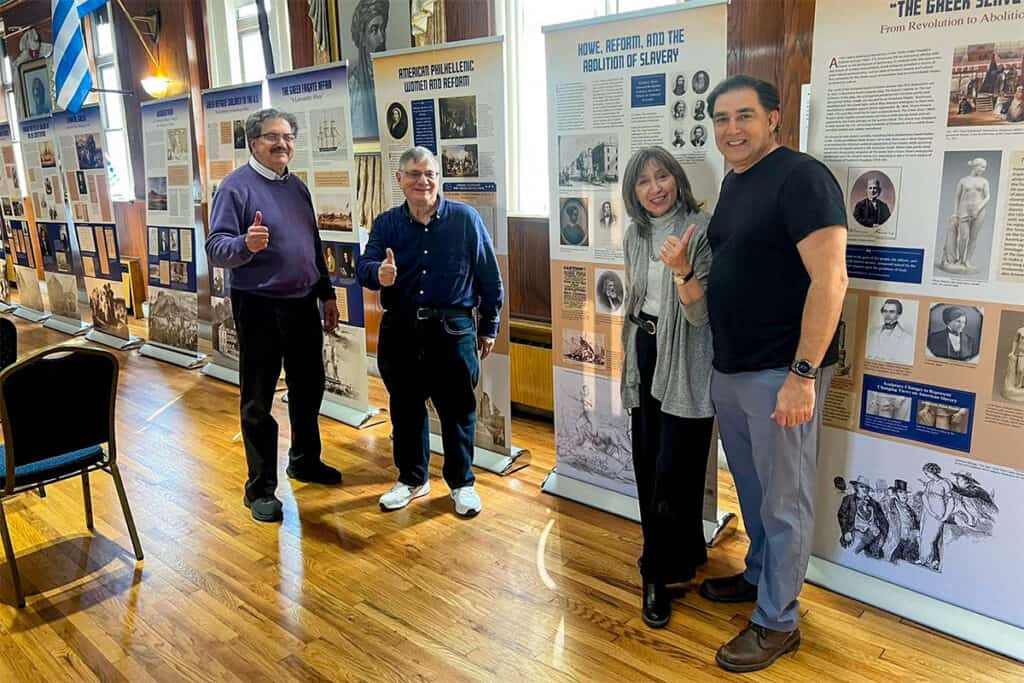
Inside the exhibition, the story unfolds through a sequence of texts and images that move between political response and personal engagement. Visitors follow how ideas circulated across the Atlantic, how sympathy turned into action, and how the Greek struggle was interpreted through an American lens that was still taking shape itself.
The exhibition draws on a wide range of historical material, including essays by scholars from both the United States and Greece. It is co-curated by Dr. Tom Papademetriou and Dr. Nicholas Ganson, and builds on earlier digital work that has now been expanded into a full physical installation.
The exhibition is part of this year’s broader Greek Independence Day programming in New York, marking 205 years since the start of the Greek Revolution, and will remain open through the period following the annual parade on Fifth Avenue on April 26.
What it offers goes beyond commemoration. It suggests that the story of 1821 was never confined to Greece alone. From the beginning, it was observed, debated, and supported abroad, becoming part of a wider conversation about freedom.
At the Stathakion, that conversation is brought back into view.