
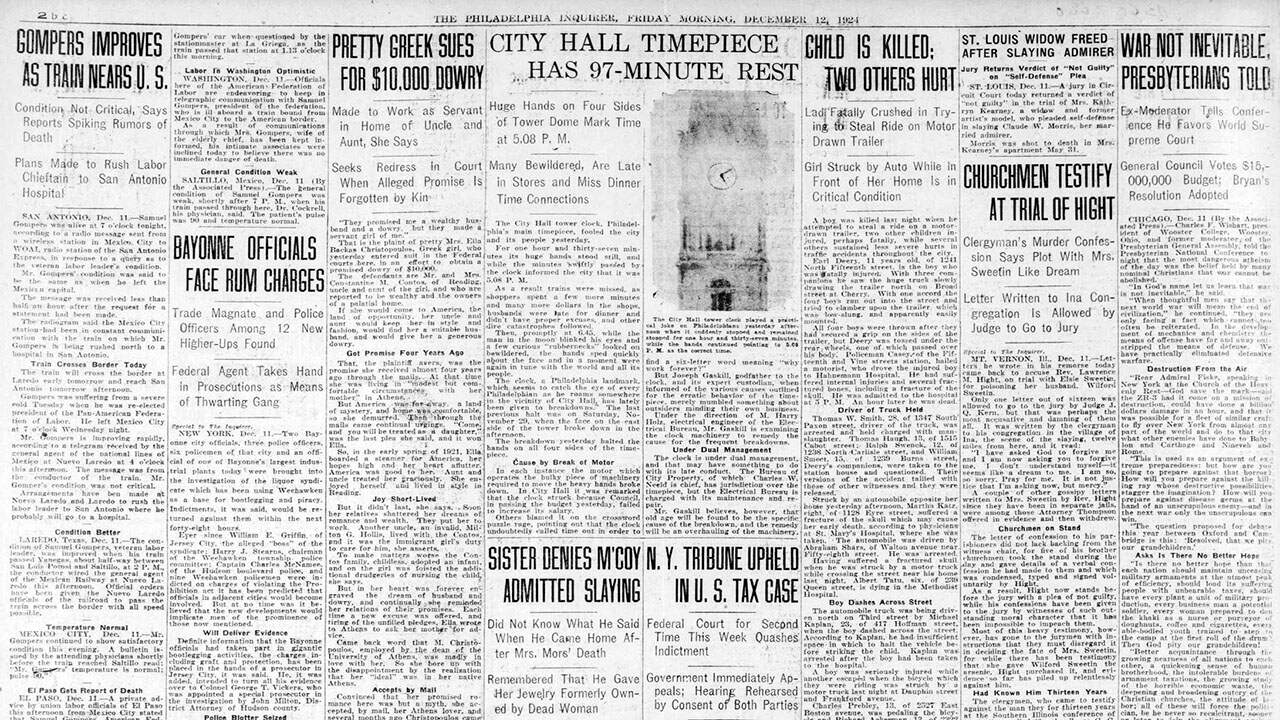
In December 1924, Ella Backas Christopoulos sued her aunt and uncle in Pennsylvania for $10,000, claiming they had broken the promise that persuaded her to leave Greece in 1921. They had offered to treat her as a daughter, find her a suitable husband, and provide a dowry. Instead, she said she had spent nearly three years working in their Reading home as a domestic servant and nurse.
The Philadelphia Inquirer reported the lawsuit on December 12 under the headline “Pretty Greek Sues for $10,000 Dowry.”
“They promised me a wealthy husband and a dowry, but they made a servant girl of me,” the newspaper quoted Ella as saying.
Three months later, a federal judge ruled against her.
A Promise from America
Ella was living with her parents in Athens when three relatives in Reading, Pennsylvania, invited her to join their household.
Her aunt, Despina Hollis Contos, lived with her husband, Constantine Contos, and another of Ella’s uncles, Milton G. Hollis. They agreed that if Ella came to America, they would treat her as a daughter until they found her a suitable husband. They also promised a dowry appropriate to their family’s financial standing.
Under the Greek marriage custom at issue in the case, a dowry consisted of money or property provided in connection with a woman’s marriage.
Ella arrived in Reading in May 1921.

At first, she told the Inquirer, her relatives welcomed her warmly. She enjoyed the comforts of their home and was treated as a daughter.
According to her complaint, Ella was assigned to care for Milton Hollis, who was an invalid. Other household duties followed, and she found herself working as both a nurse and a domestic servant. When the Contos couple adopted a child, she was also expected to help care for the infant.
Her relatives had yet to arrange the marriage they had promised.
Ella eventually wrote to her mother in Athens, asking for help finding a husband. Her mother arranged a match with a young Greek lawyer, identified in the newspaper as M. Christopoulos.
Both Ella and her relatives in Pennsylvania accepted the match.
The Dowry Dispute
With a marriage arranged, Ella sought the dowry her aunt and uncle had promised.
Her complaint stated that the couple responded with excuses that amounted to a refusal. She also alleged that she was required to leave their home.
The court opinion records that other relatives then provided a dowry and that Ella married Christopoulos. The contemporary newspaper placed her request for the promised dowry after the wedding, reporting that Christopoulos had traveled from Greece to America and that the couple married in 1924.
Ella valued the unfulfilled promise at $10,000, which she considered appropriate for a daughter of a family in her relatives’ financial position.
If the court would not enforce the dowry promise, she sought $3,000 for the nursing and domestic work she said she had performed during her years in the household.
Milton Hollis, the third relative involved in the original arrangement, had died by the time the court issued its ruling. Despina and Constantine Contos were the defendants.
What the Court Decided
On March 12, 1925, U.S. District Judge J. Whitaker Thompson ruled against Ella in Christopoulos v. Contos, heard in the Eastern District of Pennsylvania.
The defendants had challenged whether her complaint established a valid legal claim. At this stage, the judge considered her allegations without deciding whether the events had occurred as she described them. The question was whether those allegations gave her a legal right to compensation.
On the dowry claim, Thompson reasoned that the money or property would traditionally have gone to Ella’s husband rather than directly to her.
He acknowledged that she would have benefited indirectly from such a payment. But because other relatives had already provided a dowry, and Ella had not claimed that it was inadequate, the judge concluded that she had not established a recoverable loss.
Her claim for unpaid work also failed. Although Ella described nearly three years of nursing and domestic duties, she had entered the household under an agreement to be treated as a daughter.
There was no allegation that her relatives had expressly agreed to pay her wages. Given the family relationship described in her complaint, Thompson found no basis for treating her work as services performed under an implied employment contract.
The published opinion spells Ella’s first name as “Elle” and describes her as a citizen and resident of Athens, Greece, when she brought the lawsuit. Neither the newspaper report nor the court record establishes where she and her husband later settled or whether events unfolded exactly as she alleged.
Ella had come to America on the promise that she would be treated as a daughter. When she later asked to be paid for the work she said she performed in her relatives’ home, that same family relationship became a reason for the court to deny her claim.