

If you walk into the Greek Orthodox Church of St. Frumentios in Addis Ababa on a quiet Sunday morning, you will still hear a handful of voices singing the hymns we all grew up with. There are not many Greeks left in Ethiopia anymore, maybe around five hundred in a country of more than one hundred million people. Most are older. Many belong to families that span both Greek and Ethiopian heritage. Yet the community still gathers. The flag still flies outside the gate. What remains is small, but it is still alive.
In 2017, Ethiopia and Greece marked one hundred years of diplomatic relations. During those celebrations, the Greek ambassador in Addis Ababa reminded everyone that the ties between the two peoples run deeper than politics or trade. “We are beloved brothers,” he said. The phrase stayed with many who heard it. For older Greek families, it summarized a lifetime of relationships, memories, and moments shared across continents.
Years ago, we met a Greek businessman who had lived in Ethiopia during its more vibrant years. He told us the country felt like a blessed land. He meant it spiritually, but also in the simple way the soil, the mountains, and the people seemed to give more than they took. It was something he never forgot. And for anyone who has listened to the stories of the Greek families who built their lives there, it is easy to understand why.
For the people who stayed, memory is a kind of homeland. They talk about the days when the Greek Community School was full of students and when Greek merchants ran shops in Dire Dawa and Addis Ababa. They talk about weddings, festivals, local businesses, and friendships that reached across cultures. And they talk about the Emperor, because for many older Greeks, he was not a distant figure. He was someone who looked after them.
To understand the Greeks of Ethiopia today, you almost have to walk backwards through time.
A Royal Friend
During the long reign of Emperor Haile Selassie, the Greek community lived through its strongest years. The Emperor considered Greeks part of Ethiopia’s Christian family and saw them as valuable partners in his effort to modernize the nation. His personal physician and closest advisor was a Greek, Dr. Jacob Zervos, who served him from the early 1930s onward. Selassie valued him so deeply that he honored him with the title Bitwoded and later named him Honorary Consul of Greece. Older Greeks still say that no one in the palace had the Emperor’s ear the way Zervos did.
Haile Selassie also defended the Ecumenical Patriarchate during difficult periods, raising concerns directly with Turkish authorities. It was a small detail in his broader diplomacy, but to Greeks in Ethiopia and abroad, it meant a great deal. The Emperor was a devout Orthodox Christian who believed in the unity of the ancient churches.
During his regency as Ras Tafari, he visited Greece in 1924 as part of his European tour. Three decades later, in 1954, he returned on an official state visit and was welcomed with full honors by King Paul and Queen Frederica. A liturgy in Aramaic was celebrated at the Metropolitan Cathedral of Athens, the liturgical language of Ethiopian Christianity. The moment revealed how deeply rooted the spiritual connection between the two nations was.
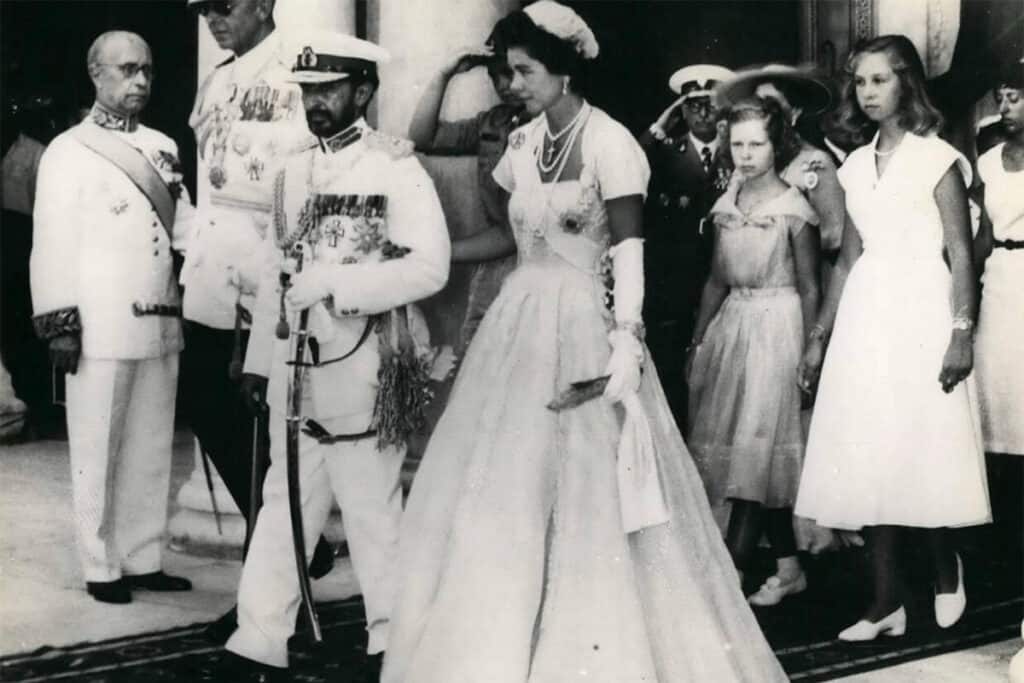
At its height in the 1950s and 1960s, estimates placed the Greek population of Ethiopia between three and six thousand people, making it one of the largest and most established Greek communities in Africa.
Merchants, Coffee Traders, and Railway Pioneers
Before the Emperor’s time, Greeks were already part of Ethiopia’s modern transformation. When the Addis Ababa-Djibouti railway reached Dire Dawa in 1902, Greek workers and merchants were among the first Europeans to settle there. They opened hotels, cafés, small restaurants, and one of the city’s early cinemas. Their businesses lined the main commercial streets. Some became major coffee exporters, while others ran machine shops or imported tools and goods from Europe.
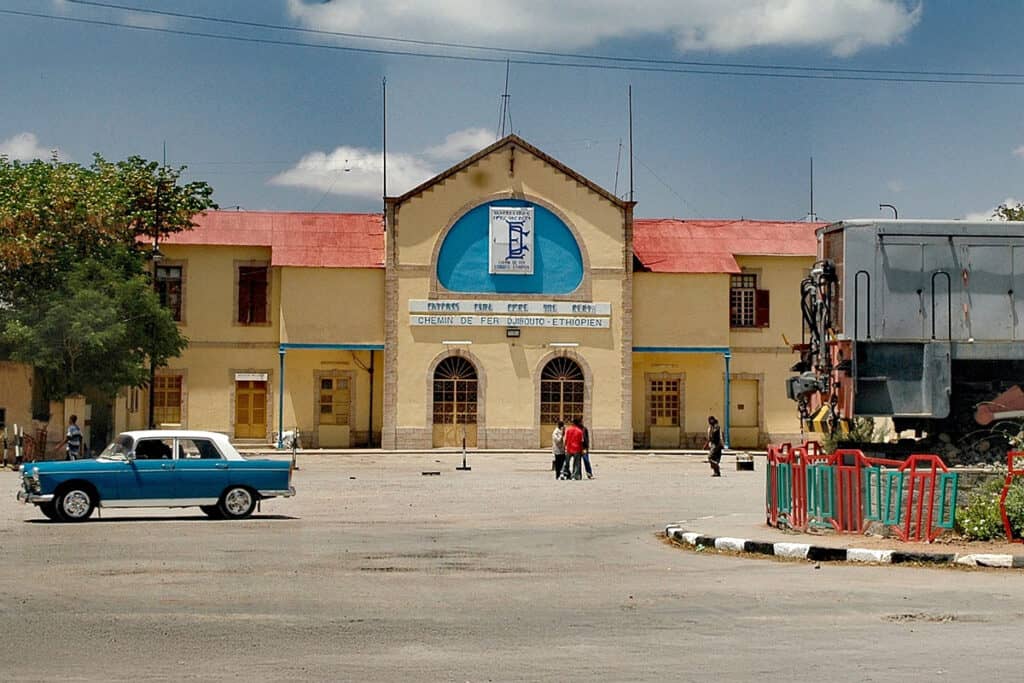
By 1918, the Greeks in Addis Ababa had an organized community, and Dire Dawa followed in 1921. A Greek school first opened in 1915. It survived the Italian occupation of 1936 to 1940, reopened in 1941, and expanded again in 1944. In 1950, it moved to a permanent campus in Piazza.
A few years later, the Hellenic Greek Community secured a thirty-thousand-square-meter property in the Olympia area, where they built the new Greek Community School and the Greek Club. A boarding house went up in 1960, the MOSVOLD Building followed in 1963, and another school building in 1997. The school took a significant step in 1985 by establishing an English Section and, in 2000, adopting the Cambridge International Curriculum. For decades, it was the community’s strongest institution and a place where Greek and Ethiopian families learned and grew together.
For years, Greek was simply part of the soundscape of Addis Ababa and Dire Dawa, a sign of how deeply rooted the community once was.
A Step Further Back: Gondar’s Greek Craftsmen
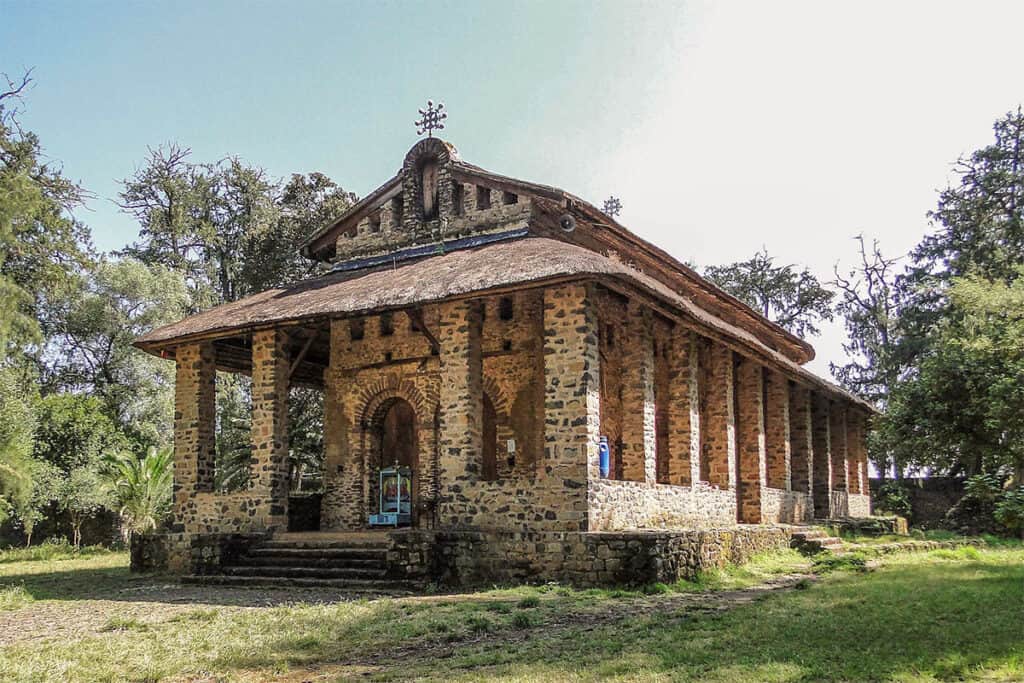
Centuries earlier, another chapter unfolded in the northern highlands. In the eighteenth century, Greek craftsmen and refugees from Smyrna arrived in Gondar, then the capital of the Abyssinian Empire. They worked as silversmiths and metalworkers, commissioned by emperors and church leaders. Their filigree work, liturgical objects, and metal panels remain part of Gondar’s architectural heritage today.
Some of their surviving pieces are preserved in local churches, including those linked to the Palace of Iyasu II. The blend of Mediterranean technique and Ethiopian artistic tradition is still visible. For a brief moment, Greek craftsmanship became part of Ethiopia’s visual language, a chapter that has survived wars, fires, and centuries of change.
A Bond Written in Stone
Long before modern Ethiopia appeared on any map, Axum was already speaking the language of the Mediterranean world. The kingdom carved its presence into stone stelae that still rise above the northern landscape. Several monuments carry Greek inscriptions recording victories, dedications, and trade routes. They remind us that Axum was once a major power communicating with its neighbors in a language the wider world understood.
Greek appeared not only on monuments but also on Axumite coins. Kings minted gold, silver, and bronze currency with Greek lettering, signaling legitimacy to partners across the Mediterranean. Roman merchants recognized these coins and traded with confidence. For Axum, Greek was not foreign. It was a bridge and a tool for reaching the world beyond Africa.

Saint Frumentios and the Christian Connection
The Christian bond between Greece and Ethiopia begins with a story that feels almost legendary. Frumentios was a young Syrian Greek who never planned to shape Ethiopian history. After being shipwrecked on the Red Sea coast, he and his brother were taken to the royal court in Axum. They earned the trust of the kings, educated royal children, and carried the Christian faith of the Mediterranean with them.
Years later, Frumentios traveled to Alexandria for guidance. When he met St. Athanasius, he explained that Ethiopia needed a leader who could guide its emerging Christian community. Athanasius ordained him around 347, a decision that would shape the region’s future.
Back in Axum, Frumentios baptized King Ezana, who then declared Christianity the kingdom’s official religion. Churches were built, liturgy took root, and Ethiopian Christianity developed its own distinct identity while remembering its Alexandrian and Greek beginnings. Ethiopians called Frumentios Abuna, meaning Our Father. His monastery at Dabba Selama and the Church of St. Mary of Zion became central pillars of Ethiopia’s spiritual world.
In the Orthodox tradition, there is also a reverence for the saints who were overlooked in their own time, people whose faith endured quietly. In a way, the Greeks of Ethiopia mirror that story. A once large community that endured war, revolution, and exile now lives its faith with a quiet resilience that has lasted for generations.
The Church in Piassa
The Greek Orthodox Church of St. Frumentios in Piassa has its own chapter in this long story. Built with support from nearly every Greek family in the city and designed by Greek architect Balanos, it rose during a period when the community was strong and confident. Dr. Jacob Zervos helped secure the land from the royal family, decades after the first Greek bishop arrived in Ethiopia.
The neighborhood around it still carries faint echoes of that world. Long after families scattered, stores like Bambis and Sarris kept their Greek names, reminders of the days when Greek entrepreneurs shaped the city’s commercial life.
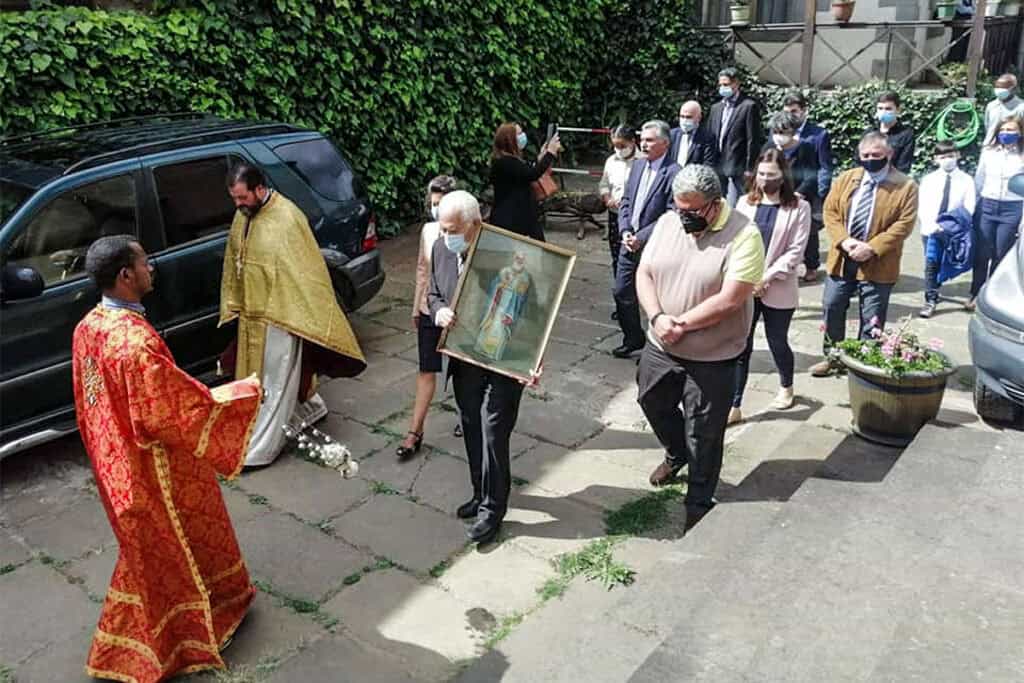
Piassa was once the heart of a lively Greek world. Families ran everything from workshops to cafés and trading houses, and the church courtyard was where they gathered for baptisms, weddings, and feast days. Much of that world began to fade after the failed 1960 coup and disappeared with the rise of the Derg, but the church remains. It still opens every Sunday for the last families of the community.
Return to the Present
Everything changed after the 1974 revolution and the fall of Haile Selassie. The new regime nationalized property and made life difficult for foreign communities. Many Greeks left. Schools, houses, and businesses were lost. What had once been a thriving diaspora shrank to only a few hundred people.
Yet a community remains. And it is more alive, diverse, and determined than its numbers suggest.
Today, the Greek school is still open and full of life. In a 2023 interview on EBS TV, the school was described as a model institution known for its academic standards, its Cambridge curriculum, and a student body that includes Ethiopians, Greeks, Armenians, Arabs, and Nigerians. Several alumni spoke of their identity with quiet pride. One young woman said, “I was born here. I am a little Greek.” Another added, “Ethiopia is our country too.” Their voices show how the community’s identity has become something shared and deeply Ethiopian.
Volunteer groups like the Philadelphia Club continue the old tradition of service by raising money and providing food and supplies to children in need. And some figures have become part of the city’s fabric. One local restaurateur, who playfully calls himself George Axum, says he has been serving locals and visitors for more than a decade. His presence is a reminder that the Greek story in Ethiopia still has familiar faces.
Families who have lived here for generations still gather under the dome of St. Frumentios. The school continues to produce graduates who go on to study in Greece on scholarships. And there are still children who speak both languages at home.
During the centennial celebrations, officials invoked an old Greek myth that the first Greek and the first Ethiopian were brothers, both sons of the gods. Maybe it is only a myth, but after everything that has passed between the two peoples, it carries a certain truth.
Today, the Greek community in Ethiopia may be small, but it carries the weight of a long story. A story that stretches from the palaces of Gondar to the markets of Dire Dawa, from the court of King Ezana to the school in Addis Ababa, and from the days of Haile Selassie to the quiet services of the present. It is a reminder that the Greek story has never belonged to one place. It has always been broader, older, and more connected than we imagine.
And in a small corner of East Africa, it is still being lived.