
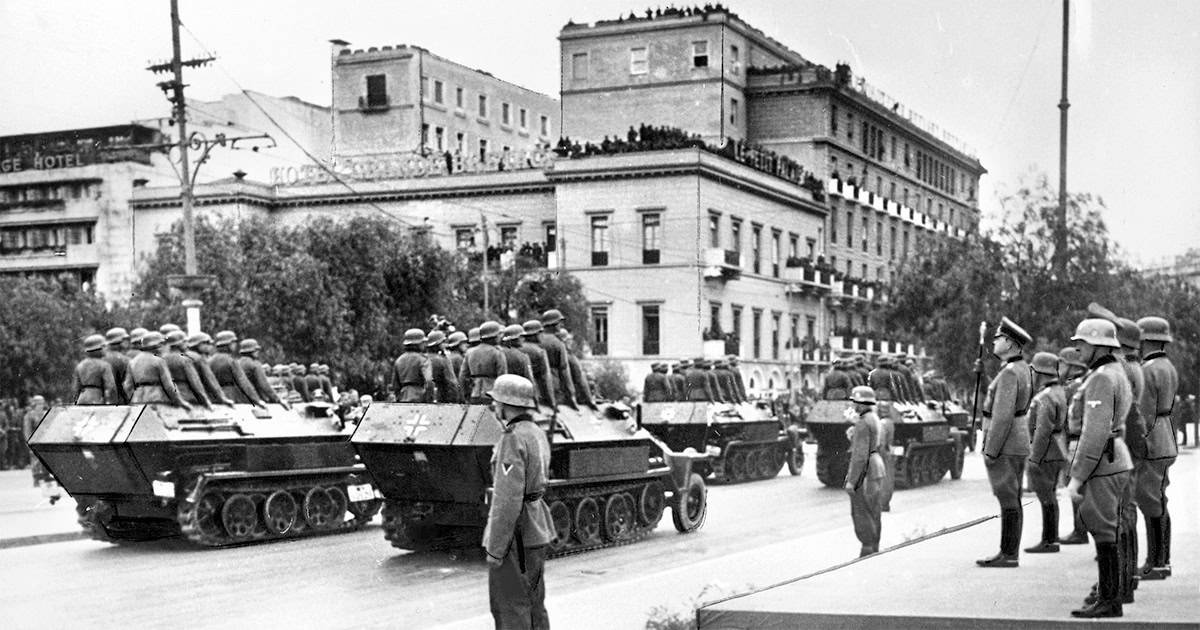
On May 4, 1941, Adolf Hitler addressed the German Reichstag just days after Nazi forces entered Athens. The swastika had been raised over the Acropolis a week earlier. In a long, defiant speech, Hitler stood before parliament to justify the invasion of Yugoslavia and Greece, shifting blame to Britain and offering the world his version of events.
He framed the campaign as reluctant, even regrettable:
“Germany has had no territorial or selfish political interests in the Balkans… I state here expressly that these measures were not directed against Greece.”
According to Hitler, it was British influence that dragged Greece into the war. He accused the Greek government of being manipulated by Churchill and “platonic promises of guarantees,” calling the country a victim of its king and its alliances:
“Greece, who had the least need for such a guarantee, following the British enticement also agreed to link her fate with England.”
He also went out of his way to insist that Germany’s role in the region was purely economic. The Nazi regime, he claimed, sought only peaceful trade partnerships with the Balkan states:
“From the outset, the German Reich has had no territorial or selfish political interests in the Balkans… Germany has always endeavored to open up and consolidate close economic relations with these countries.”
He presented the relationship as mutually beneficial:
“Germany is an industrial State and needs foodstuffs and raw materials. The Balkans produce foodstuffs and have raw materials and require industrial products.”
But these statements stood in sharp contrast to the reality unfolding on the ground. German troops were not building trade partnerships. They were seizing control of cities, railways, and resources. The economy collapsed. Famine spread. Villages were emptied and burned. What Hitler described as “fruitful exchange” quickly became plunder and control.
To further justify the campaign, Hitler invoked the past. He claimed Britain was trying to revive the Salonica Front of World War I, referring to the Allied presence in Thessaloniki that once threatened Germany’s southern flank. British military aid to Greece, he said, was part of a new version of that same strategy:
“England was creating bases for a new Salonika Army… They began building aerodromes… believing that they could occupy the aerodromes very quickly.”
He warned that Germany would not allow a repeat of what he called “the Salonika ideas of the World War.” Preemptive action, he argued, was not aggression but defense. In reality, Greece had become the battleground. And the cost would be high.
Hitler also claimed that his military operation was not an attempt to help Mussolini, whose invasion of Greece in October 1940 had stalled in the mountains. He insisted that Italy never asked for German assistance:
“The Duce himself has never asked me to put at his disposal a single division… The march of the German forces, therefore, represented no assistance to Italy against Greece, but a preventive measure against the British attempt to… set foot on Greek soil.”
This distancing was deliberate. Mussolini’s campaign had become a humiliating failure. Hitler wanted to frame Germany’s intervention as decisive and strategic, not as a rescue mission.
But in reality, Italy’s failure was exactly what opened the door for British troops to enter Greece. That is what prompted Germany’s response.
And yet, even as he justified the invasion, Hitler acknowledged the bravery of the Greek army:
“Historical justice obliges me to state that of the enemies who took up positions against us, the Greek soldier particularly fought with the highest courage. He capitulated only when further resistance had become impossible and useless.”
He also mentioned the fate of Greek prisoners of war, listing 8,000 officers and 210,000 men, and promised their release:
“The Greek prisoners, too, have been or will be immediately released because of their gallant bearing.”
It was a rare moment in the speech where the enemy was not vilified but praised. Hitler wanted to distinguish the Greek army from its government, offering respect to soldiers while blaming political leaders for choosing the wrong side. But for the captured, many of whom were marched, underfed, or briefly detained, the consequences of occupation were already being felt. The promise of early release may have sounded noble in the Reichstag, but for many soldiers, the return home came only after exhaustion, humiliation, or loss.
In Philadelphia and across the Greek diaspora, stories from that time are still passed down. Of soldiers on the Albanian front. Of children starving in the famine of 1941 and 42. Of parents who never returned from the mountains. For many Greek-American families, this was not just history. It was lived.
Today, Hitler’s May 4 speech serves as a reminder of how language can be used to justify invasion. How economic rhetoric can hide military ambition. And how, even in the face of overwhelming force, the Greek people refused to go quietly.
Feature image: As Athenians watch from rooftops, German Field Marshal Wilhelm List (right) reviews troops during a Nazi victory parade in Athens on April 27, 1941. The Greek king and government had already fled to Egypt.