
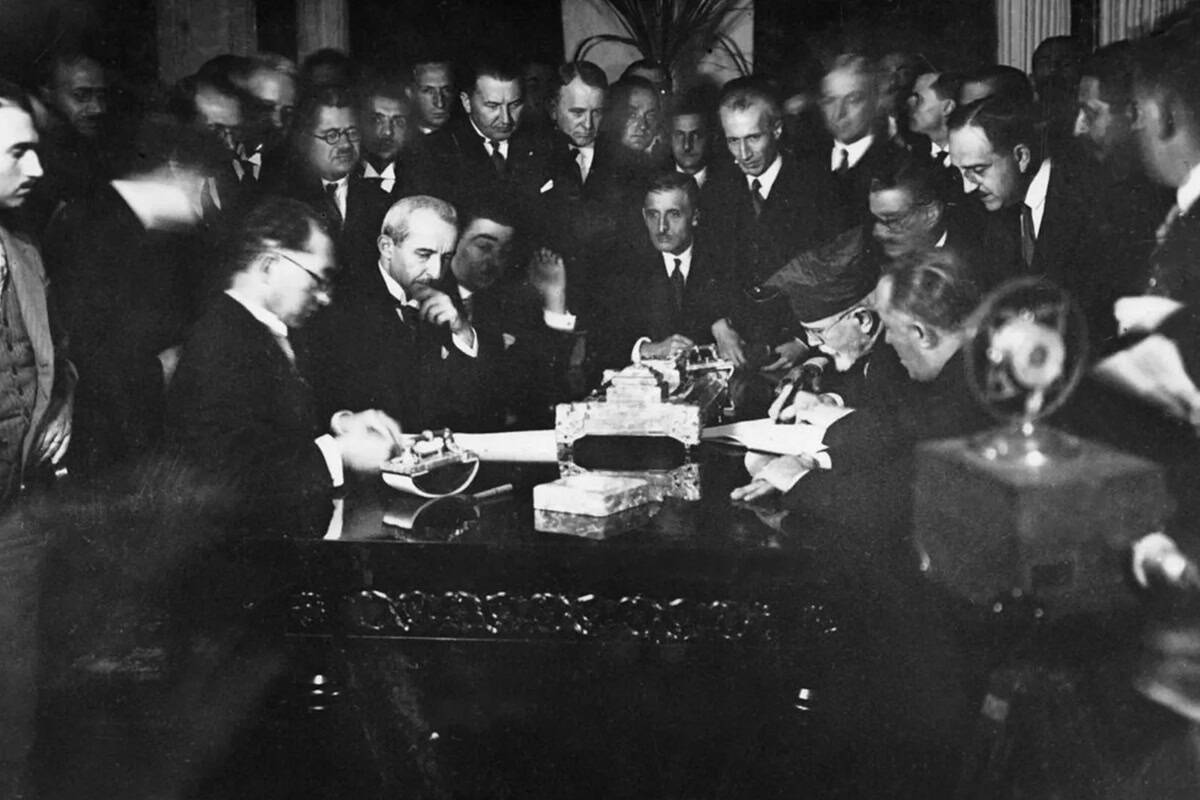
On this day in 1923, an international agreement transformed mass violence and displacement into binding law, permanently reshaping Greece, Turkey, and millions of lives.
On January 30, 1923, Greece and Turkey signed the Convention Concerning the Exchange of Greek and Turkish Populations, a separate but central agreement within the broader Lausanne peace settlement that would be finalized later that year on July 24, 1923, under the Treaty of Lausanne (read the full treaty here). What followed became the first legally enforced, compulsory population exchange in modern international history, uprooting about 1.6 million people based solely on religion.
It was diplomacy written over open wounds.
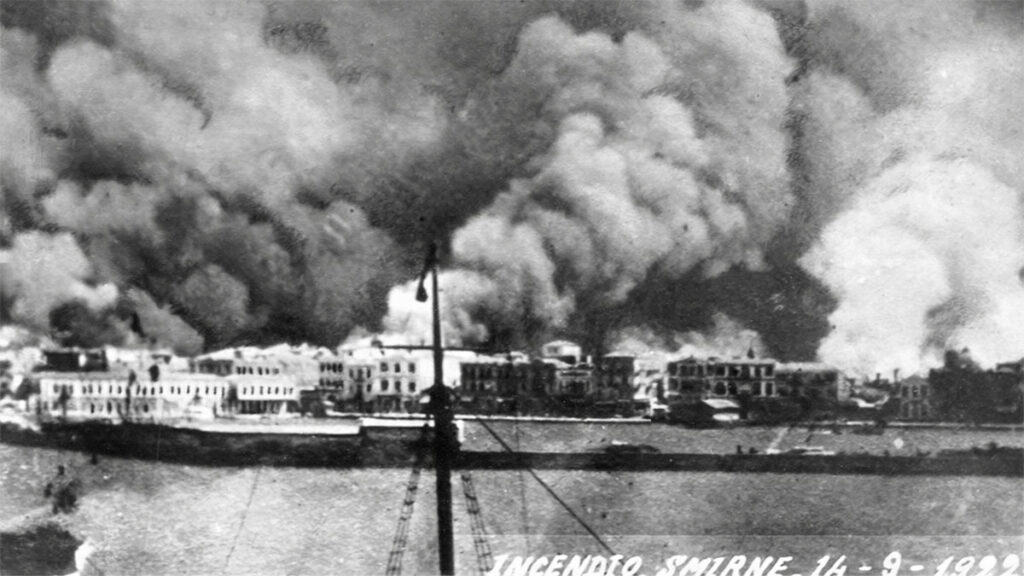
The exchange came after the destruction of Asia Minor Hellenism at the end of the Greco-Turkish War of 1919 to 1922. By the time diplomats gathered in Switzerland, whole cities had already burned, most famously Smyrna in September 1922. By the end of that year, hundreds of thousands of Greeks had been killed, and several hundred thousand more were already displaced or fleeing, pushing the total number of victims and refugees toward one million. Rather than confront responsibility for the violence, the agreement legalized what had already happened on the ground and turned it into policy.
The protocol declared that, starting on May 1, 1923, Greek Orthodox Christians in Turkey would be sent to Greece, and Muslims in Greece would be sent to Turkey, not by choice, but by law. Identity was defined by religion, not language or culture.
For decades, the origins of the exchange’s compulsory nature were framed as something imposed by Ankara and reluctantly accepted by others. New archival research tells a more uncomfortable story. A draft for a compulsory population exchange had already been prepared in October 1922 and approved by the Greek government before the Lausanne Conference began, with humanitarian officials initially involved in its preparation. Only later did senior League of Nations figures attempt to redirect the process toward a voluntary model. In the end, that effort failed, and the final convention restored full compulsion. Responsibility, the record now suggests, was shared rather than imposed from a single side.
The convention also had retroactive force, binding all Greeks and Muslims who had fled as far back as October 18, 1912 to its provisions, more than a decade earlier. This meant that roughly one million Greeks who had already escaped Asia Minor were legally bound by an agreement they had no part in shaping and never consented to.
By the time this official start date arrived, fewer than 190,000 Greeks remained in Turkey for transfer out of a total affected population of more than 1.2 million. In other words, nearly 85 percent had already fled or been violently expelled during the previous decade of war and persecution. The convention did not begin the catastrophe. It sealed it.
A family that had lived for centuries in Cappadocia or Thrace could be forced to leave overnight simply because of how they worshipped.
Key Dates at a Glance
- September 13–22, 1922 — The Burning of Smyrna (Καταστροφή της Σμύρνης) marks the violent collapse of Greek presence in Asia Minor and triggers mass flight.
- October 11, 1922 — The Armistice of Mudanya (Ανακωχή των Μουδανιών) ends active fighting and opens the road to peace negotiations.
- January 30, 1923 — Greece and Turkey sign the Convention Concerning the Exchange of Greek and Turkish Populations, mandating a compulsory exchange based on religion.
- May 1, 1923 — The population exchange becomes legally enforceable. Most displaced Greeks have already fled by this point.
- July 24, 1923 — The Treaty of Lausanne is signed, formally ending the war and embedding the exchange into international law.
- 1923–1924 — Around 1.6 million people are forcibly relocated between Greece and Turkey.
When Displacement Became a Nation’s Reality
By the end of the exchange, about 1.5 million Greek Orthodox refugees were sent to Greece and roughly 400,000 Muslims were transferred to Turkey. For Greece, a country of barely five million people at the time, this meant that one in every five residents was suddenly a refugee.
Several important exceptions were written into the agreement. Greeks of Constantinople were exempt, in part because the Ecumenical Patriarchate remained there and the city carried enormous religious and symbolic weight. Muslims of Western Thrace were also exempt and recognized as a protected minority under international law. Additionally, Greeks on the Aegean islands of Imbros and Tenedos were exempted from the exchange, a protection tied to the islands’ strategic status and long-established Greek populations.
The minority status, education, religious life, and legal protections of these exempt communities remain formally tied to the Lausanne framework and continue to carry political sensitivity today. Even so, many who were technically protected later faced pressure, discrimination, or quiet, unofficial forms of forced migration.
Homes, Land, and the Cost of Abandonment
The agreement also tried to answer the question every refugee carried with them. What about the house, the vineyard, the shop, the olive trees, the chest with dowry clothes left behind.
On paper, it promised valuation, compensation, and a Mixed Commission made up of Greek, Turkish, and League of Nations representatives to oversee claims. In practice, most refugees were never fully compensated. The Greek state was bankrupt, property values were disputed, and bureaucratic procedures dragged on for years.
Many families arrived with nothing but the clothes they were wearing and a few icons or documents tucked into bags. Others kept official papers for decades that never translated into meaningful restitution.
How Refugees Remade Greece
To prevent total collapse, the League of Nations Refugee Settlement Commission oversaw one of the largest resettlement projects in interwar Europe. Marshlands in Northern Greece were drained. Land was redistributed. Entire villages were built from scratch.
New neighborhoods rose around Athens and Thessaloniki. Schools, clinics, and roads followed. Despite poverty, disease, and trauma, refugees reshaped Greece. Tobacco cultivation, urban labor, trade networks, silk production, and carpet weaving were all transformed by Asia Minor Greeks and other uprooted communities.
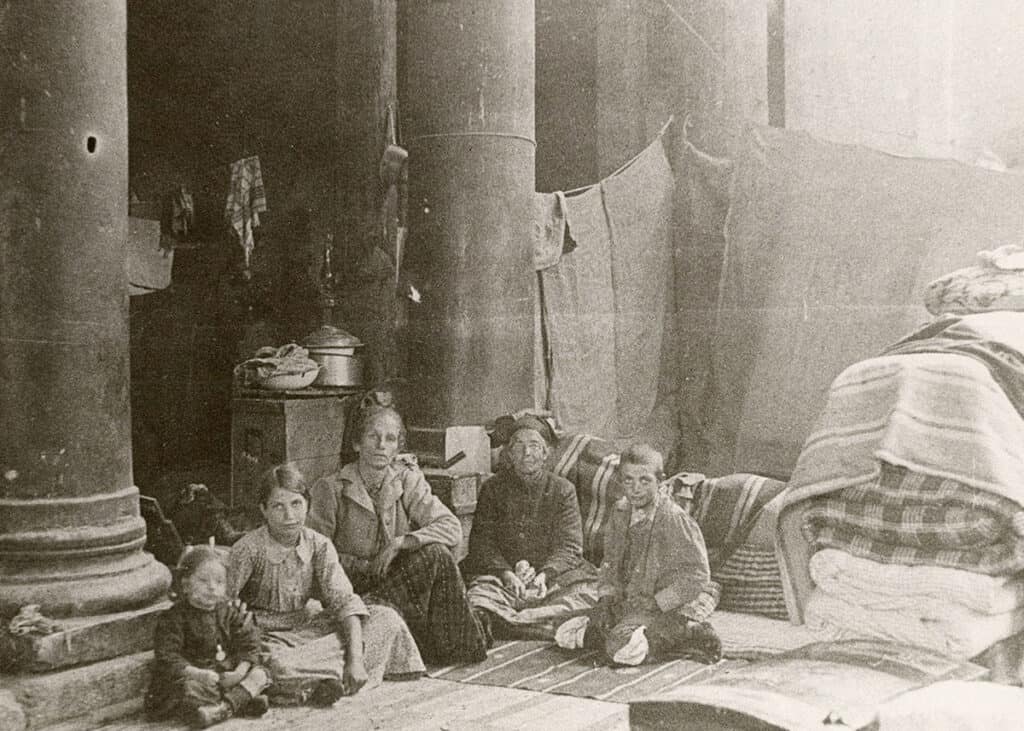
At the same time, the early years were brutal. In the first one to two years after arrival, especially in 1923 and 1924, some settlements recorded death rates higher than birth rates. Disease, malnutrition, overcrowding, and psychological shock took a heavy toll. Refugees often faced suspicion and resentment from locals who saw them as competition for land and work.
The Memory of Asia Minor
For Greeks, the exchange and the wider campaign of expulsions became known as the Asia Minor Catastrophe. It was not only a political rupture. It marked the end of a 3,000-year-old Greek presence in Anatolia.
In Smyrna, families waited for days near the water, sleeping in the open, holding small children above the crowd so they would not be crushed as ships pulled in and out under fire.
In those desperate days, an American YMCA worker named Asa Kent Jennings helped make large-scale rescue possible, leveraging hard-won cooperation from Allied naval commanders to allow the evacuation of Greek civilians and organizing what would become one of the largest civilian sea rescues in history.
Beginning in late September 1922, just days after the fire consumed Smyrna, ships began carrying refugees across the Aegean. In the first phase alone, roughly a quarter of a million people were pulled from the waterfront in just over a week.
The wider evacuation effort continued through 1923, ultimately carrying hundreds of thousands to safety. By the time the operation ended, the Ecumenical Patriarchate of Constantinople credited Jennings with saving as many as a million lives, a reflection of the scale later attributed to his role.
Survivor testimonies speak of families torn apart at the docks, bribes demanded for exit papers, churches and neighborhoods burned, women and children attacked, and children lost in the crowds and never found again. For many families, these stories were passed quietly at kitchen tables, often in dialect and often through tears. Grief became part of family identity, inherited alongside last names, recipes, and icons.
A Peace Signed Without Accountability
One of the darkest features of the Lausanne settlement was its amnesty clause. Crimes committed between 1914 and 1922 were formally forgiven under international law. There would be no lasting international trials for the massacres of Armenians, no accountability for the deportations and killings of Greeks, and no legal reckoning for the destruction of entire communities.
The dangers of such silence were later powerfully captured in the 1971 genocide warning by Marjorie Housepian Dobkin, who cautioned that denying past crimes only prepares the ground for future ones (read the full article here).
As historian Hans-Lukas Kieser later described it in Middle East Peace without Democracy: The Treaty of Lausanne and the Birth of Turkey 1923 (read here), Lausanne became a form of “peace without democracy,” stabilizing borders while abandoning justice.
The meaning was unmistakable. Borders would be redrawn and debts recalculated, but the dead would receive no justice. The survivors would carry memory without legal recognition. Some historians have argued that Lausanne quietly legitimized mass ethnic cleansing as acceptable state policy. If displacement and extermination could be sealed with signatures and stamped into international law, they could be treated as lawful tools of state-building.
When Forced Migration Became Policy
Lausanne introduced into international practice the idea that minority problems could be solved by moving people like cargo. Later in the century, during the Partition of India in 1947, leaders who supported complete religious separation pointed to the Greek-Turkish exchange as proof that compulsory transfer could work. After the Second World War, mass expulsions in Eastern Europe followed a similar logic.
At the same time, on the other side of the Aegean, Muslim families arriving in Anatolia also faced disease, poverty, and dislocation, uprooted and resettled under chaotic conditions. What was once presented as a path to stability is now widely rejected as a violation of basic human rights.
Why Lausanne Still Shapes the Present
Beyond population movements, the Treaty of Lausanne still defines much of the political map of the Eastern Mediterranean. It set borders between Greece, Turkey, and Bulgaria. It recognized Greek sovereignty over many Aegean islands. It framed minority protections, especially for Muslims in Western Thrace and the remaining Greeks in Istanbul.
It also shaped the legal regime of the Straits, later revised by the Montreux Convention. Disputes over how to interpret Lausanne continue to influence Greek-Turkish relations today, from airspace and militarization in the Aegean to minority rights and the status of the Ecumenical Patriarchate.
What This Day Still Carries
January 30, 1923, was not just a diplomatic signing. It was the moment the international community accepted, in legal form, that entire populations could be erased from their ancestral homelands through signatures, seals, and official language.
For Greek families across America, including here in Philadelphia, this day lives quietly inside surnames, recipes, accents, songs, and memories that came on refugee boats. It helps explain why so many Greek Americans trace their roots not to today’s national borders, but to Smyrna, Pontus, Cappadocia, Constantinople, Imbros, Tenedos, and dozens of towns now called by different names in a different language.
It is a reminder that behind every legal agreement are lives that never returned home. Borders can be redrawn in ink. The wounds they mark do not disappear so easily.