
The first time I set foot in Greece, I was in my thirties. My parents had left Katerini in the 1960s and built a life in Philadelphia, like so many from our region. Growing up, Greece was mostly a place of stories and black-and-white photographs. Sometimes, but rarely, there were the voices of relatives carried over long-distance calls. I did not visit as a child or even as a young man. By the time I finally made it, I was already carrying a camera everywhere I went, trying to learn the world through a lens and to understand my Greek heritage with my own eyes.
Those early trips felt like trying to piece together a home I had never lived in. Katerini was where my family came from, but the friendships I made pulled me farther north and west, into Kozani and Ptolemaida. Many first-generation Greek-Americans I knew in Philadelphia had families in Kozani, and when I visited Greece, their cousins and uncles welcomed me as if I were their own. That is how I found myself standing in front of an old roadside pareklisi, a small chapel built for prayer and remembrance, with the smokestacks of the Ptolemaida power plant rising in the background.
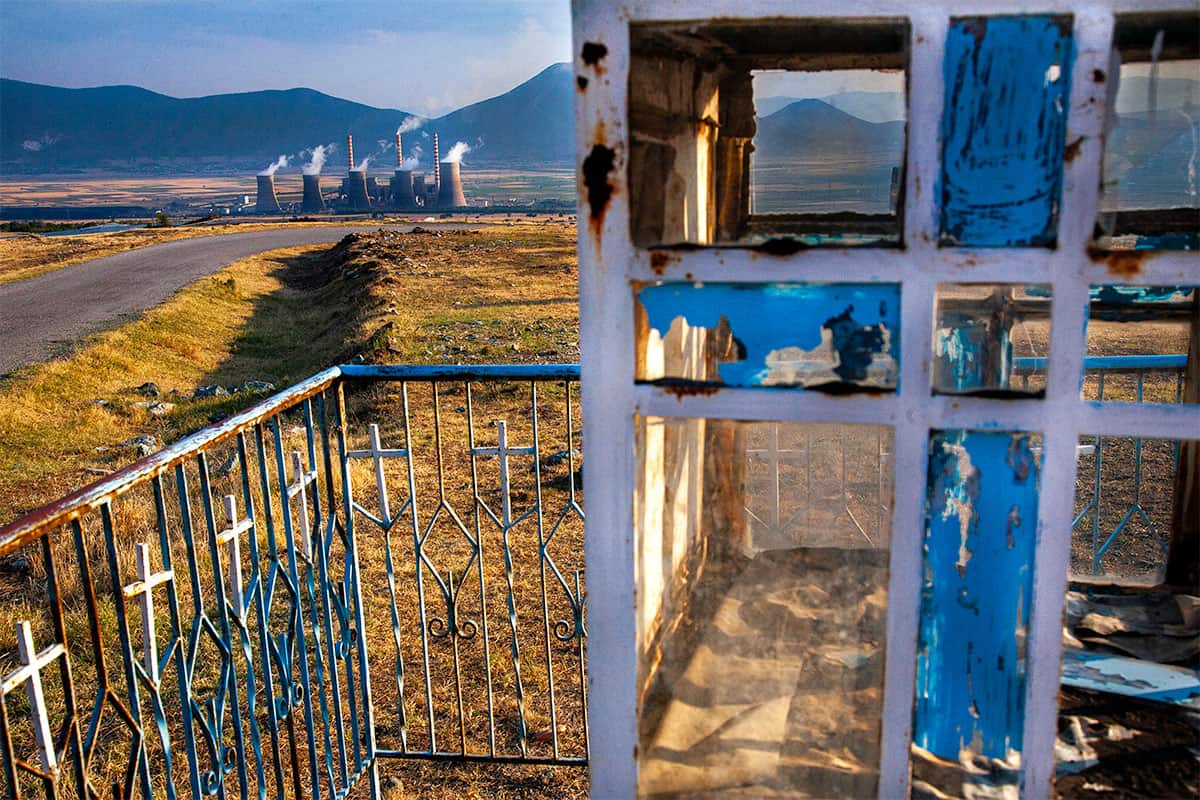
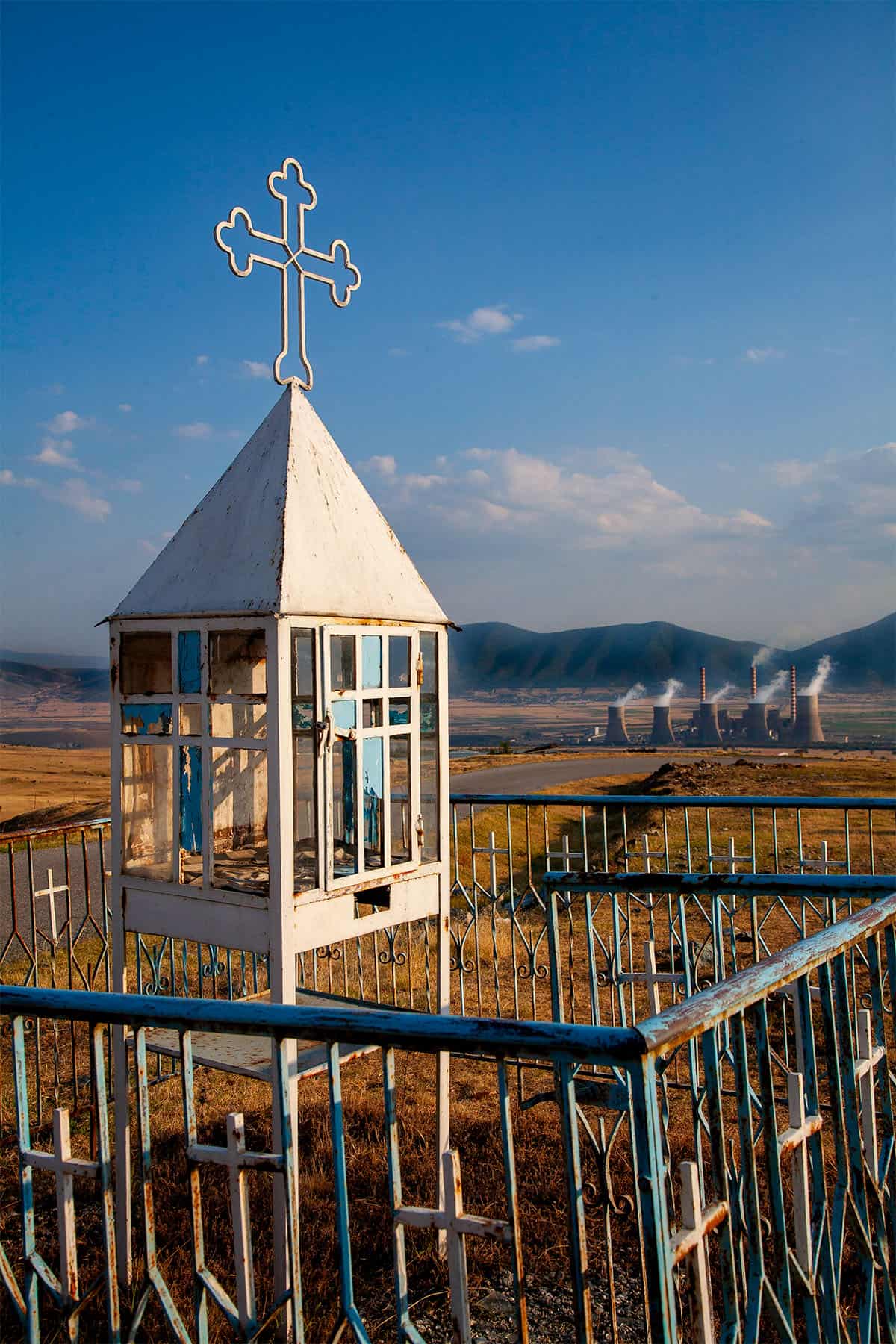
I remember raising my camera and pausing. The pareklisi was rusted, its windows cracked, the white paint peeling in the sun. Behind it, the cooling towers poured smoke into a perfect blue sky. I pressed the shutter, but what I really captured was a contradiction: faith and memory in the foreground, industry and extraction on the horizon.
The inside of the pareklisi was empty, just scraps of blue paint flaking away. Through it I could see the power plant, not just in the distance but framed, contained, as if the past was forcing me to look at the present.
At the time I did not know the full history. I knew coal had powered Greece for decades, that entire villages had been moved to make room for mines, and that the air in Kozani was never truly clean. But it was my friends’ families who gave me the details. Their uncles had worked twelve-hour shifts in the pits, their cousins spoke of houses lost and fields turned to ash. For them, coal was both survival and sacrifice.
I took those photographs back with me to America. Over the years they gathered new meaning. News trickled in about villages like Mavropigi and Anargyri being emptied, landslides swallowing homes, and health studies linking coal to cancers and heart disease. Unemployment in Kozani climbed higher than anywhere else in Greece. Friends who once thought they would return stayed put in New Jersey, Ohio, or Toronto. Those who remained in Greece talked about the same crossroads: the end of coal and the uncertain promise of a green future.
It has been more than fifteen years since I last went back. Life took over with work, family, and the distance that grows when you live between two worlds. But I still follow the news from Kozani and Ptolemaida, through the press and through messages from friends here and abroad. I read about the last plant, Ptolemaida V, which opened only recently and is already scheduled to close by 2026. I see headlines about solar parks rising on abandoned pits, about billions pledged to turn the land into something new.
When I look again at those two photographs, they feel like windows into that whole story. The pareklisi with its cross stands for the families, the memory, the stubbornness of faith. The broken glass, looking out toward smokestacks, stands for what was sacrificed to keep the lights on. And now, with coal almost gone, they remind me of something else: how even when a window breaks, the view through it can still be clear.
I do not know if I will ever go back to Kozani, or whether the pareklisi I photographed is still there.
But I carry these images with me, reminders of what it meant to see Greece not as a child of immigrants but as a grown man searching for connection. Through them, I have learned that photographs can hold not just memory but entire histories of land, of people, and of choices that shape generations.
The view through the broken window is not only about what Greece lost to coal. It is also about what might still be rebuilt.
About the Author
Eleftherios Kostans is a writer, photographer, and filmmaker with Cosmos Philly, who has covered stories about the Greek-American community throughout the Delaware Valley.