
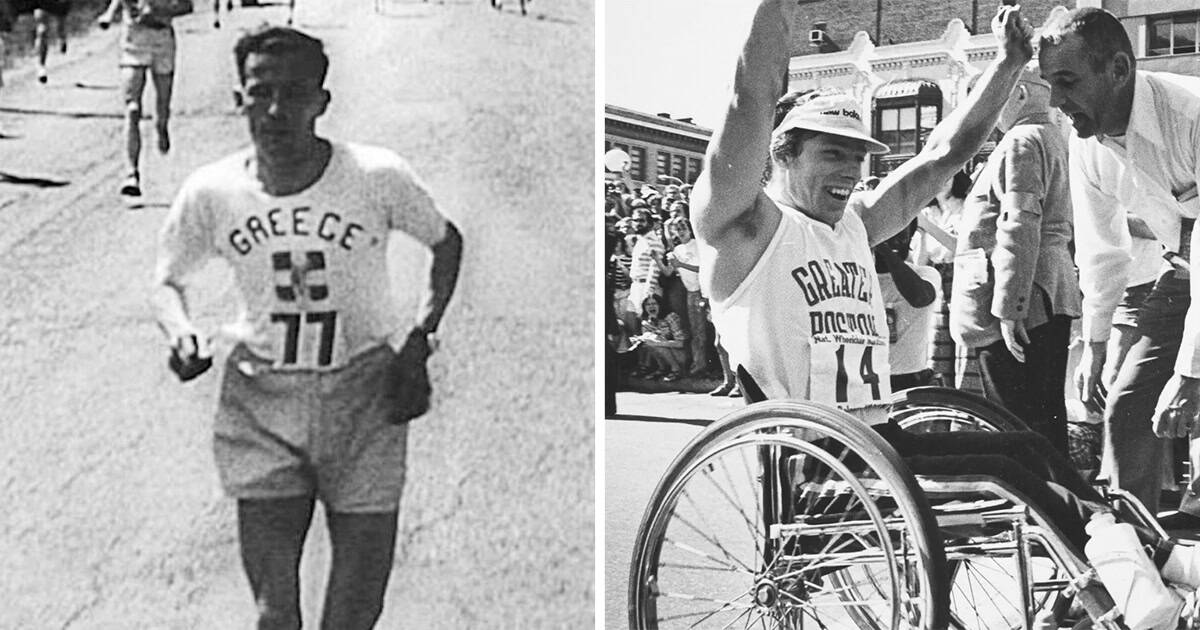
On April 20, 1946, at the 50th running of the Boston Marathon, a 36-year-old runner from a village near Paphos crossed the finish line first. His name was Stylianos Kyriakides.
As he broke the tape, he is said to have shouted, “For Greece.”
He had come to Boston once before, in 1938, and left without finishing. Blisters forced him off the course. In the days after, he told Boston Globe sportswriter Jerry Nason that he would return and win.
What followed belonged to a different kind of endurance.
During the German occupation, Kyriakides lived through famine and collapse in Greece. Like many others, he sold what he could to keep his family alive. Running disappeared from his life. What remained was the idea that if he ever returned, it would not be for himself.
When he came back to Boston in 1946, he was not widely known to American audiences. He arrived from a country still struggling to recover, older than most of the field, and with little expectation around him.
He stayed with the leaders. Mile after mile, he held his position. By the closing stretch, he moved ahead. He finished in 2:29:27, one of the fastest marathon times recorded anywhere that year.
Then he began to speak.
When he was asked what he wanted in return, he answered simply: nothing for himself, only help for Greece.
Kyriakides remained in the United States after the race and described what Greece was facing. Hunger. Shortages. A country that had survived the war but had not yet recovered from it. Greek-American communities responded quickly. Donations were collected. Supplies were organized. Ships were sent.
Within weeks, he had helped raise roughly $250,000 through private fundraising and mobilize shipments of food, clothing, and medical supplies bound for Greece, a response that quickly spread through Greek-American communities across the country. When he returned to Athens later that year, he arrived with aid already in motion, supplies, money, and attention, to a country that received him as more than a champion.
Almost thirty years later, the Boston Marathon became something else again.
In 1975, Bob Hall asked race organizers if he could compete in a wheelchair. At the time, there was no category for him, no rules, no precedent.
He was allowed to start on one condition: he would only receive an official finish if he completed the course in under three hours.
The question was not just whether he could do it. It was whether he belonged in the race at all.
He started anyway.
He finished in 2:58.
That result did more than meet a requirement. It removed it. The following year, the Boston Marathon formally recognized wheelchair competitors. Over time, that single entry became a division, and that division became part of the identity of the race.
Hall went on to win the wheelchair division twice and helped develop the racing chairs that shaped the sport in its early years. What did not exist in Boston in 1975 became, within a generation, part of marathons everywhere.
The Bob Hall Legacy Fund, established through REquipment, carries that legacy beyond the race course by supporting mobility and independence for people with disabilities through refurbished wheelchairs and other assistive equipment. Bob Hall died on April 12, 2026.
In 2006, a bronze statue known as the “Spirit of the Marathon” was placed near the starting point in Hopkinton. It shows Spyridon Louis and Kyriakides running side by side.
It stands at the beginning of the course.
Kyriakides ran so people would see.
Hall ran so others could race.