
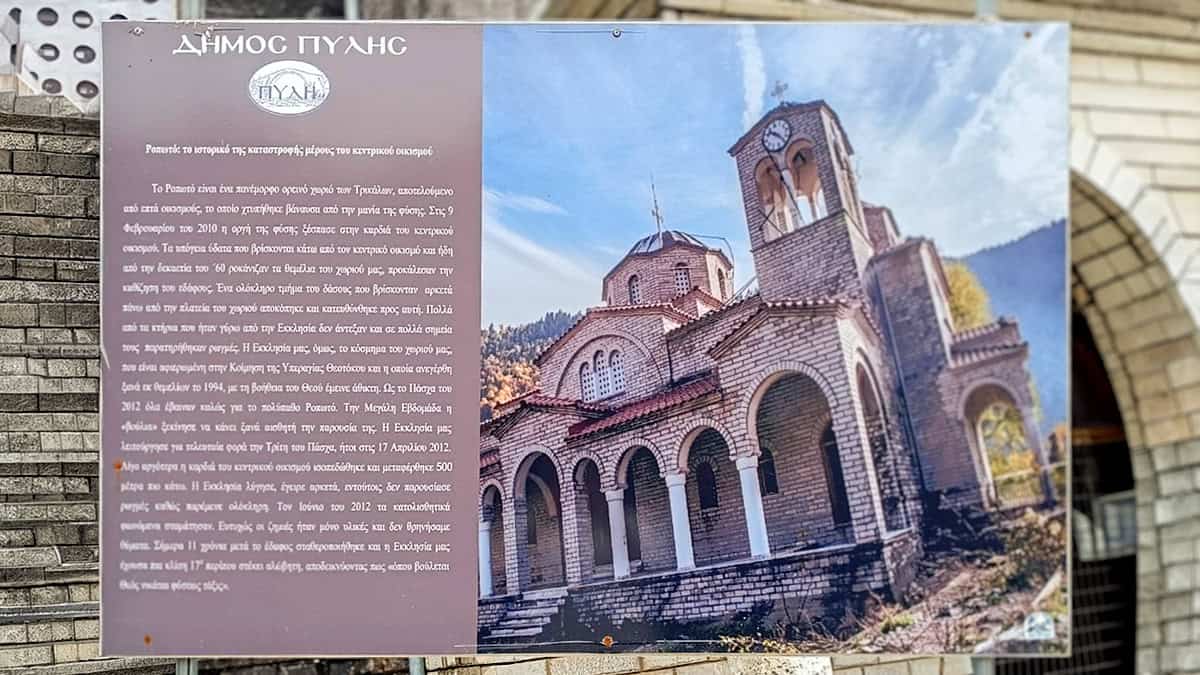
In the mountains of Thessaly, above the plain of Trikala, there is a church that seems to defy the body’s sense of balance.
The floor pulls one way. The walls tell the eye another story. Visitors who step inside often reach instinctively for something solid, not because the building is moving in that moment, but because everything about it feels wrong.
The Church of the Dormition of the Theotokos in Ropoto, dedicated to the Panagia, leans at an angle often reported as roughly 17 degrees, far more dramatic than the famous Leaning Tower of Pisa.
But Ropoto is not a novelty. It is not a theme-park illusion or an architectural trick. It is the visible remnant of a village that lost its ground.
Once a mountain community in the Trikala region of Thessaly, Ropoto lies about 11 kilometers south of Pyli and 31 kilometers from Trikala, at roughly 750 meters above sea level. The wider community includes several settlements, among them the central village, Tsekoura, Panagia, Polythea, Agios Ioannis, Agios Dimitrios, and Loggies.
That setting matters because Ropoto was not only unstable ground. Municipal descriptions present it as a landscape of chestnut woods, fir forest, springs, streams, watermills, feast days, and mountain work. It was not an archaeological ruin or a seasonal curiosity, but a lived-in mountain community tied to land, family, church, and the ordinary routines that make a place feel permanent until the land itself proves otherwise.
Then the mountain began to move.
The instability was not entirely new. According to the Municipality of Pyli’s account of Ropoto’s landslide history, major ground movement struck the area in 1963, causing extensive damage to homes, roads, and cultivated land in the central settlement. Landslides returned in the 1970s and again in 1979. By the 1980s and early 1990s, local authorities were already looking at technical works, geotechnical research, boreholes, trenches, and monitoring instruments to understand whether the settlement could remain safely in place.
The ground was known to be vulnerable. Rainwater gathered in the slope. Underground flows weakened the soil. The mountain held together until, little by little, it did not.
Yet life continued, as it often does in places where danger is familiar but not yet final. Homes were built, roads were used, and families stayed.
By 2012, the slow danger had become a catastrophe. After periods of heavy rainfall, large sections of the village began sliding downhill. In April 2012, the movement became dramatic enough to tear houses apart, break roads, shift buildings, and force residents to leave. Whole parts of the village were rendered uninhabitable. Ropoto became one of Greece’s most striking examples of a settlement overtaken by landslide and subsidence.
The church remained standing, but not where it had once stood in the mind of the village.
As the ground moved, the Church of the Dormition was carried with it. Reports vary on how far the church shifted, with some describing movement of dozens of meters and others placing it much farther down the slope. What is clear is that the building was displaced, tilted, and left in a position that turned it into the most recognizable image of the disaster.
Its survival is part of what makes the scene so unsettling. The church did not collapse into rubble. It endured at an impossible angle, its form still recognizable, its cross still upright, its structure now turned into a physical record of the mountain’s force.
For visitors, the experience inside is almost physical before it is emotional. The body expects churches to offer stillness. In Ropoto, the sacred space bends perception. People describe dizziness, disorientation, and the strange difficulty of walking across a floor that no longer agrees with the eye.
That is why the church has become a viral curiosity. International reports, travel sites, video creators, and urban explorers have presented it as “more crooked than Pisa,” a Greek oddity hidden in the mountains. Videos show people trying to keep their balance inside the tilted nave. The image is irresistible.
But the danger of that framing is that it can make Ropoto seem like a spectacle before it is understood as a loss.
Families were displaced. Homes were damaged beyond repair. A living community was broken by ground failure. The “ghost village” label may be visually accurate, but it can flatten the human story behind it. For former residents, the leaning church is not only a strange landmark. It is part of a village they once knew through feast days, funerals, weddings, Sunday liturgy, and the ordinary movement of life around a parish.
For Greece, where villages often cling to hillsides, ravines, and mountain roads, Ropoto raises questions that reach beyond one community in Thessaly. How are mountain settlements planned? How is water managed? How seriously are early signs of land movement treated before a slow danger becomes irreversible?
These questions matter because Ropoto is still visited. People come to see the leaning church, the cracked roads, the broken homes, and the strange geometry of a village that appears to be sinking. The interest is understandable. Places like this make invisible forces visible. They turn geology into something a person can feel underfoot.
But they also require respect. The area remains unstable. Buildings may be unsafe. The village is not a stage set. It is a damaged community landscape.
The leaning church is powerful because it holds both things at once: the pull of a surreal image and the weight of what happened there.
It can be read as endurance, warning, or simply as the strange dignity of a place that has not fully disappeared.
Ropoto’s leaning church is something more fragile and more serious than a strange Greek landmark. It is a church still standing after the land beneath it failed. It is a village story written into a slope. And it is a reminder that in Greece, even the most dramatic landscapes are not only beautiful.
Sometimes, they move.