
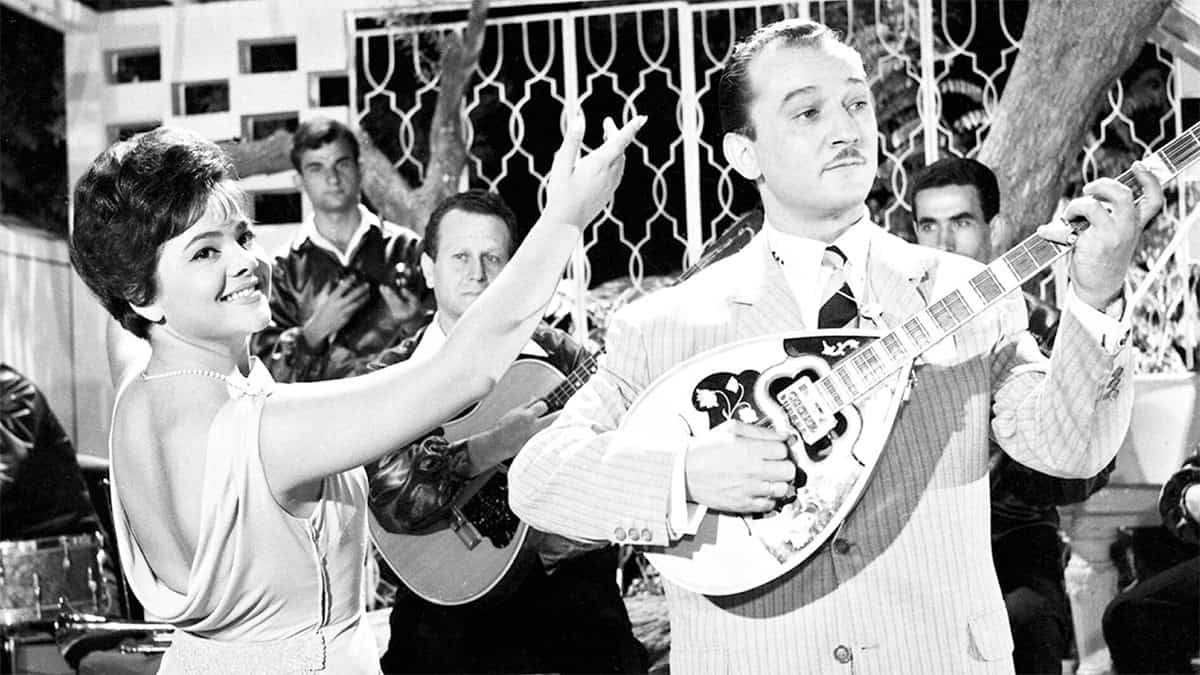
Mary Linda, the singer whose recordings and stage partnership with Manolis Chiotis helped shape postwar Greek popular music, died Wednesday, July 22, at the Athens Nursing Home, where she had lived since 2018.
She died peacefully at 5 a.m. with her daughter, Evangelia, beside her, according to the institution’s announcement. She was 90.
Her funeral will be held Friday, July 24, at the Church of Saint Andrew on the nursing home grounds, a location she had requested. Burial will follow at the First Cemetery of Athens.
Linda’s career lasted roughly seven decades, encompassing laiko, Greek cinema and songs by leading composers associated with entechno music. The ERT archive credits her with more than 1,200 recordings and collaborations with Vassilis Tsitsanis, Giannis Papaioannou, Giorgos Mitsakis, Mikis Theodorakis and Manos Hadjidakis.
From Pyrgos to the Athens stage
Linda was born in Pyrgos, in the western Peloponnese, and grew up in the working-class Athens neighborhood of Kolonos after her family moved to the capital.
She began performing as a child through talent programs organized by filmmaker and lyricist Orestis Laskos, who gave her the stage name Mary Linda. While still young, she found work in variety shows, cabarets and entertainment venues. She entered the recording studio in 1953, singing compositions by Kostas Kaplanis.
The work helped support her large family and placed her inside a rapidly changing entertainment industry. Records, radio, cinema, and Athens nightclubs were introducing performers to audiences far beyond the rooms where they first appeared.
Mary Linda and Manolis Chiotis
Linda met Chiotis early in her career. They married in the late 1950s and became one of the most recognizable musical partnerships in Greece.
Chiotis paired the four-string bouzouki with arrangements influenced by jazz and Latin music. Linda brought a clear, energetic vocal style and a commanding stage presence to their nightclub and recording work.
Their recordings included “Perasmenes Mou Agapes,” “Iliovasilemata,” “Esy Eisai i Aitia pou Ypofero” and “To Teleftaio Potiraki.”
Linda continued to speak about Chiotis with affection decades after their partnership ended. In a 2022 television interview from the Athens Nursing Home, she called him “my other half.”
They also reached a wide audience through Greek cinema, performing in films including O Atsidas, O Filos Mou o Lefterakis, and I Villa ton Orgion.
In 1961, Linda won first prize at the third EIR Light Song Festival in Athens with “Apagogi,” composed by Mikis Theodorakis. She later recorded Theodorakis songs including “Myrtia,” “Rodostamo,” “Mera Magiou” and “An Thymitheis to Oneiro Mou.”
Years in the United States
Linda and Chiotis spent an extended period in the United States during the 1960s, performing for Greek-American audiences in nightclubs, community halls and other venues.
“We became infatuated with the United States,” Linda said in an earlier interview with Ta Nea. “That is why we went even though we were at the height of our success in Greece. Everyone wanted to live the American dream.”
Linda said they initially settled in New Jersey before touring the United States and Canada. Finos Film records appearances in New York and Chicago between 1964 and 1967, years when their recordings and live performances reached Greek communities well beyond Greece.
Linda also recalled that she and Chiotis were invited to perform for President Lyndon B. Johnson during a 1964 visit to the White House. In her account, guests rose to dance the syrtaki during their performance.
A career beyond the celebrated partnership
Linda and Chiotis separated in the late 1960s. Her career continued independently through recordings, concerts and collaborations with younger performers.
She later appeared with Haris Alexiou, Glykeria and Anna Vissi. Her final major nightclub engagement came during the 2011–2012 season, when she performed with Vissi at the Rex in Athens.
Culture Minister Lina Mendoni said Linda’s career showed that popular reach and musical quality were not incompatible, noting how easily she moved across divisions within Greek song. The Ministry of Culture described her as one of the most expressive voices in the country’s popular music.
Linda also said in a 2012 interview that she had endured physical abuse during her second marriage and decided to leave while raising her daughter.
“I could no longer bear the terrible treatment and the beatings. I left,” she said. “I had the strength because I had a golden bracelet on my wrist—my voice.”
She said her career gave her the financial independence to leave and support Evangelia.
Archival tributes and a final interview
ERT marked Linda’s death by making archival television and radio programs available, including a 1985 appearance on Kallitechniko Kafeneio. During the program, she discussed her early work with Chiotis and performed “Perasmenes Mou Agapes,” “Rodostamo” and “Iliovasilemata.”
Voice of Greece also aired archival tributes for listeners in Greece and abroad.
In a 2022 televised interview from the Athens Nursing Home, Linda said she was pleased that she could still sing and dance.
“I miss the applause,” she added. “I want it all—the love, everything.”
Many listeners first knew her as the woman singing beside Chiotis. The voice, however, was entirely her own.