
When most of us first saw the Mask of Agamemnon, it was probably in a school book. The bright gold and the familiar outline of the beard became part of how many Greek Americans first pictured ancient Greece. It is an image that stays with you long after you close the book.
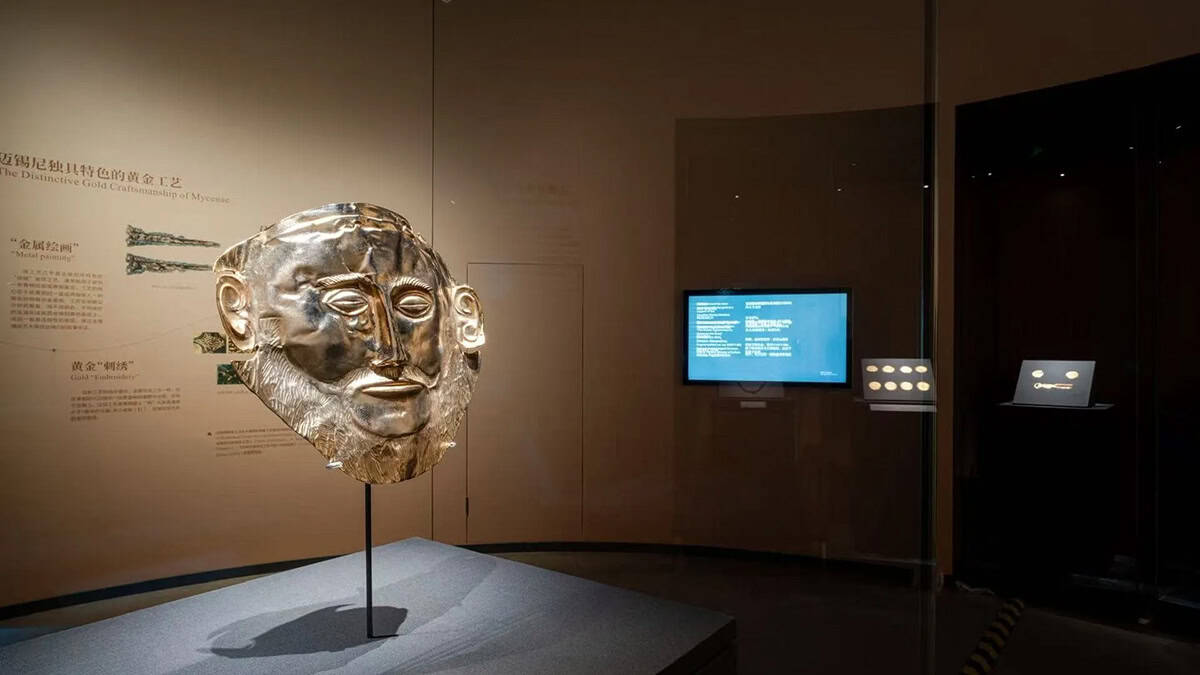
This year, the mask found a new audience on the other side of the world. A faithful replica of the famous Mycenaean funerary mask traveled from Athens to the Sanxingdui Museum in Guanghan, China, where thousands of visitors are lining up to take photos behind it. They position themselves so that their own faces appear to be wearing the mask, and they wait patiently because for many, this is their first real encounter with Greece.
The Sanxingdui Museum is one of China’s most visited archaeological museums, so the replica is reaching an audience that may never have seen Greek history up close.
According to reporting by Kathimerini, the replica was created through a detailed digital process at the National Archaeological Museum in Athens. Conservator Maria Kontaki led the work, building a high-resolution 3D model from more than 600 photographs. Gold is beautiful but unpredictable, and its shine created bright reflections that the software could not read.
The team spent days adjusting the lighting until the surface could be captured without distortion and every movement of the ancient craftsman’s tool marks could be recorded. Much of this process took place on days when the museum was closed so the mask never had to leave its gallery for long.
Once the digital model was complete, the Hellenic Organization for the Management and Development of Cultural Resources used it to produce a physical object. A resin print became the base for a mold, molten brass was poured, and the surface was treated to resemble gold. It is the first time the National Archaeological Museum has created a full replica from a digital model specifically for an exhibition abroad. The result is a precise, noninvasive copy that allows the original artifact to remain safely in Athens.
The replica has been on display in China since July as part of the exhibition A Journey to Ancient Greece. When Heinrich Schliemann uncovered the original in 1876 in the Mycenaean Grave Circle A, he linked it to the Homeric king who led the Greeks to Troy. Modern archaeology places the burial centuries earlier, but the name stayed, and the mask became one of the most recognizable symbols of Greek prehistory.
Other replicas have appeared over the years, including one made by Schliemann’s collaborator, the artist Emile Gilliéron. That early copy now belongs to the Metropolitan Museum of Art in New York, where many Greek Americans have seen it up close.
China’s warm response to the new replica is another sign that Greek history continues to travel. Technology now makes it possible to protect fragile originals while sharing their form and meaning with the world.
The exhibition closes on December 21, and by then, countless visitors will have taken their photograph with the mask. For them, it will be a moment of discovery. For us, it is a reminder that Greek culture keeps finding new paths far beyond Greece itself.