

In Greece, religion and travel have always shared the same path. From the marble temples of antiquity to the mountaintop monasteries of Orthodoxy, the country’s sacred landscapes continue to inspire journeys of both faith and culture. A recent study by Professor Serafeim Polyzos, Emeritus at the University of Thessaly, explores how religious tourism supports regional development, with Meteora at its center.
“Religious tourism represents one of the most influential forms of alternative tourism,” notes Polyzos. “For Greece, the abundance of cultural and religious monuments across its regions creates ideal conditions for further growth.”
His research shows that visiting monasteries, churches, and other sacred sites remains a vital part of Greece’s tourism movement. These places blend art, faith, and history, serving as living witnesses of the country’s Christian heritage.
Among the regions Polyzos examined, Thessaly stands out. Here, the Meteora monasteries, a UNESCO World Heritage Site, rise from the plain like pillars of stone and spirit. The study identifies several destinations across the region, including Kalambaka–Meteora, Pelion, Skopelos, and Mount Olympus, but Meteora remains the strongest draw, both spiritually and visually.
Of the original 24 monasteries built on the rock formations, only six remain active today. Nearby landmarks include the Church of the Dormition of the Virgin in Kalambaka, dating to the 10th or 11th century, and the Monastery of the Assumption of the Virgin Mary in Vytouma, one of the oldest in the region, though its current structure dates to the 17th century. Beyond Trikala, the prefectures of Karditsa, Magnesia, and Larissa preserve equally rich traditions, from the Koronas and Pelekitis monasteries to the mountain chapels of Elassona and Olympus.
Polyzos emphasizes that religious tourism is not only a matter of faith but also a driver of local life. In regions like Thessaly, where development can be uneven, monasteries and pilgrimage routes sustain small businesses, guesthouses, and artisans who depend on the steady rhythm of visitors throughout the year.
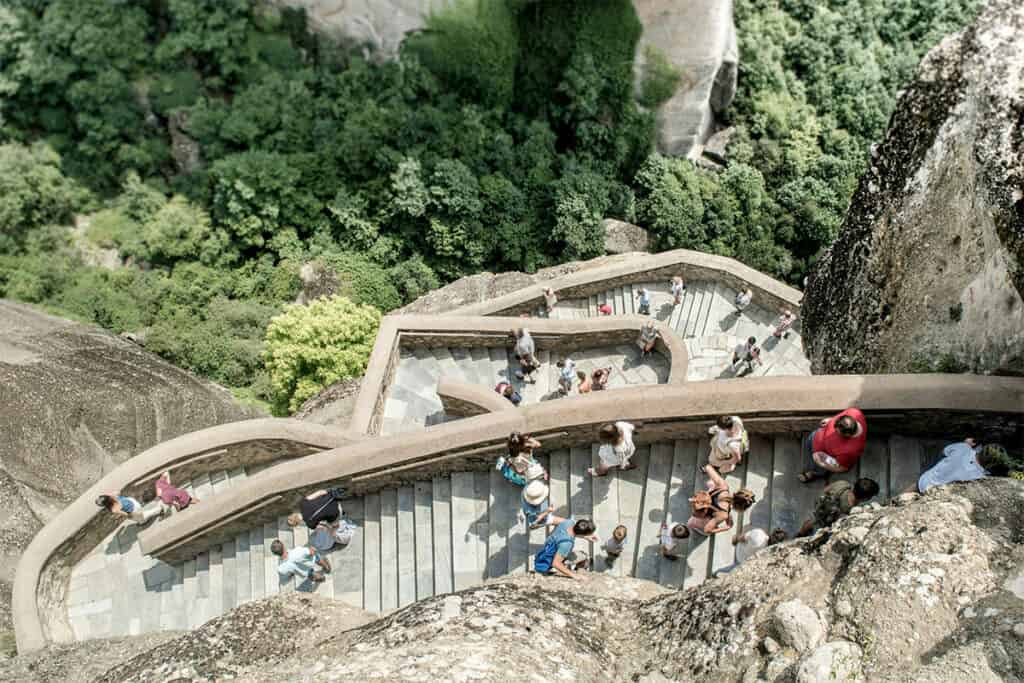
A University of Thessaly field study among 128 visitors found that 72 percent were foreign and 28 percent Greek. Travelers came not only from across Europe but also from the United States, Australia, India, Japan, and China, showing how Meteora’s spiritual and visual power extends across continents.
Most visitors were highly educated, graduates of universities and technical institutes, suggesting that the appeal of Meteora goes beyond pilgrimage or prayer. Many are drawn by a broader curiosity, a wish to experience the intersection of culture, nature, and the sacred. As Polyzos noted in his remarks to the Athens–Macedonian News Agency, visitors approach Meteora much as they do places like Mont Saint-Michel or the Vatican, combining reverence with cultural exploration.
For people of all backgrounds, a visit to Meteora is more than a stop on a travel map. It becomes a pilgrimage of reflection and wonder, where faith meets landscape and time itself feels suspended. Standing beneath those stone towers crowned with monasteries, one senses what countless pilgrims have felt before: that in Greece, faith, beauty, and heritage are inseparable.