
“Nothing is stronger than the Church.”
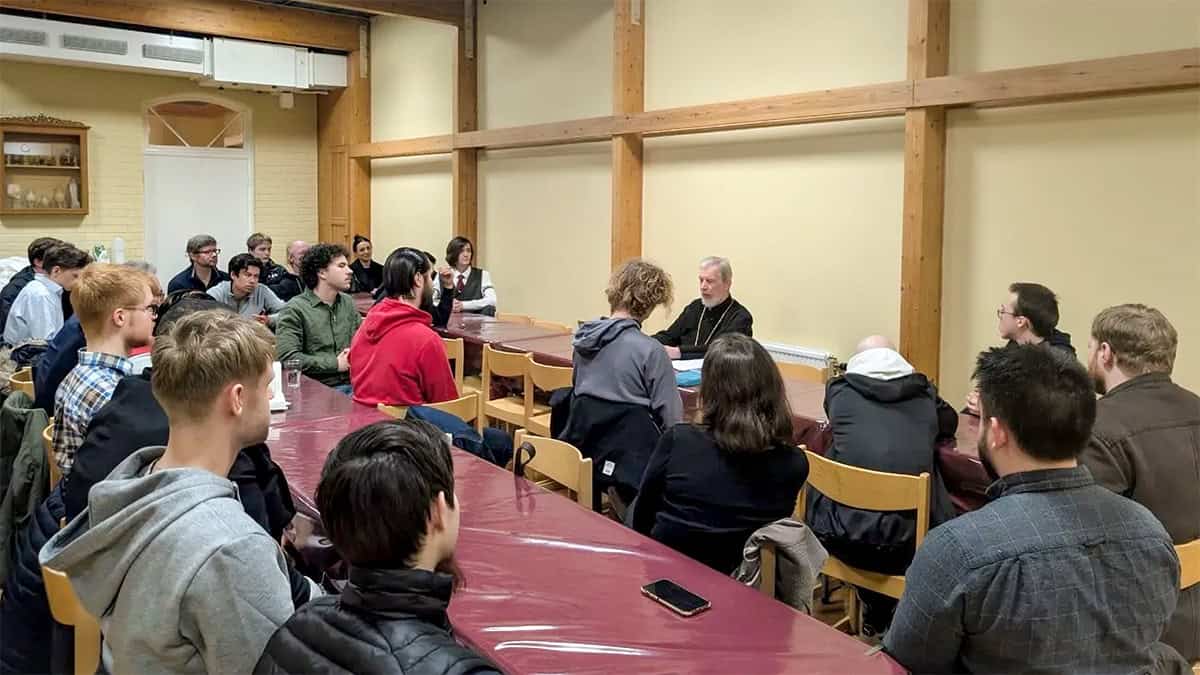
With that line from Saint John Chrysostom, His Eminence Metropolitan Cleopas of Sweden framed a homily at St. George Cathedral in Stockholm on March 26, tracing how the Orthodox Church has understood persecution from its earliest centuries to the present day.
The address was delivered as part of a catechumens’ seminar, a setting intended for those preparing to enter the Church. Catechumens’ seminars are typically structured as a series of talks introducing core elements of Orthodox belief and practice. The full text of the homily has been published on the parish’s website.
At its center was a familiar theme in Orthodox theology: that suffering is part of the life of the Church, not something separate from it.
The Metropolitan moved across two thousand years of Christian experience, beginning with the early centuries under Roman rule and continuing through later periods of political and religious upheaval. The emphasis never shifted, presenting persecution as a recurring condition in which faith is lived and expressed.
The approach reflects a theological reading of history, where events are understood primarily through their spiritual meaning.
Within that framework, endurance is understood as a form of witness, or martyria, a word that also gives rise to the term “martyr.” The Metropolitan drew on the writings of Church Fathers, including Saint Basil the Great and Gregory Palamas, who described suffering as something that can shape and refine spiritual life. In this tradition, persecution is not treated as an interruption of faith, but as one of its defining conditions.
In its later sections, the homily turned toward the present. He noted that in some parts of the world Christians continue to face violence and displacement, while in others the pressures are less visible, taking the form of social marginalization or a weakening of religious expression in public life.
The message remained grounded in its immediate audience. For those preparing to enter the Church, it was framed less as a warning than as an orientation. To follow Christ, the Metropolitan suggested, is to accept that faith may involve difficulty, and that this experience has long been part of the Church’s history.
The homily closed by returning to its central claim: that the continuity of the Church is not the result of political protection or institutional strength, but of endurance sustained through faith.